
A top Federal Reserve official cautioned Friday that the central bank might need to consider tougher monetary policies if inflation fails to decline toward the end of 2024, even as economic uncertainty grows due to volatile oil markets.
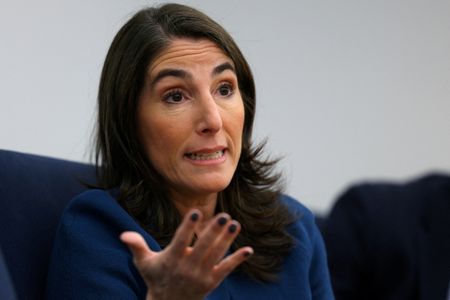
Cleveland Fed President Beth Hammack told Reuters she anticipates inflation will begin moving toward the Fed’s 2% goal, though she doesn’t expect to reach that target by year’s end.
“My expectation has been that inflation would start making progress towards our 2% target. I don’t think we’ll get there by the end of this year by any stretch, but I think we’ll make some decent progress,” Hammack stated during the interview.
Under current economic conditions, “rates should be on hold for …quite some time,” she explained. However, Hammack warned that persistent price pressures could force the Fed to act more aggressively.
“If inflation is not making progress towards our goal in the latter half of this year, as I expect that it should, that might be a reason why we might need to be more restrictive from policy perspective,” she said.
The Fed official acknowledged that while reaching the 2% inflation target by 2027 is possible, it’s not guaranteed. She noted the central bank could still reduce rates if there’s strong evidence inflation is heading in the right direction, even without hitting the exact target.
Hammack expressed uncertainty about how climbing oil prices related to President Donald Trump’s conflict with Iran might affect future inflation trends.
She said it’s “too early to know” the full impact, explaining her approach to analyzing oil market disruptions: “I try to look at what’s the magnitude and what’s the persistence? So, is this something that lasts for a week? Does it last for two months? Depending on what you know, what that time frame is, (that) will determine some more of the underlying economic impact.”
The official suggested that prolonged oil price shocks could simultaneously fuel inflation while hurting economic growth and employment, requiring careful Fed evaluation before making policy changes.
Hammack’s remarks came on the same day government data revealed the U.S. economy shed 92,000 jobs in February, with unemployment climbing slightly to 4.4%. The disappointing employment figures heightened concerns about labor market weakness while Trump’s military actions have sent energy costs soaring due to global supply disruptions.
These competing forces create a challenging situation for Fed policymakers. Rising gasoline prices threaten to worsen already elevated inflation levels, which have been further complicated by Trump’s extensive import tax policies. Such increases could also destabilize public expectations about future inflation, potentially requiring the Fed to maintain current interest rates longer or even consider increases.
Conversely, a weakening job market could justify rate reductions. The Fed cut its benchmark rate by three-quarters of a percentage point last year to a range of 3.5% to 3.75% to support employment, despite inflation remaining above the 2% target.
Markets widely expect the Fed to keep rates unchanged when it meets March 17-18. Hammack serves as a voting member of the Federal Open Market Committee, which sets interest rate policy.
Regarding the employment data, Hammack said the numbers suggest stabilization and that she’s focusing primarily on unemployment rates given current uncertainties affecting payroll calculations.
The Fed official reported no major systemic problems in financial markets but noted she’s monitoring private credit issues that could potentially harm investors.
Hammack also supported the current banking regulatory framework as the Fed considers modifications that might reduce financial system oversight.
“I believe that the system has been made safer by a number of the regulations that were put in place” following the 2008 financial crisis, she said. These rules helped banks successfully weather the COVID-19 pandemic, when they “able to be a source of strength and a source of lending into the real economy” during the crisis.
“I think it’s important that we maintain that level of support,” Hammack concluded, while acknowledging some regulatory areas might need adjustments.