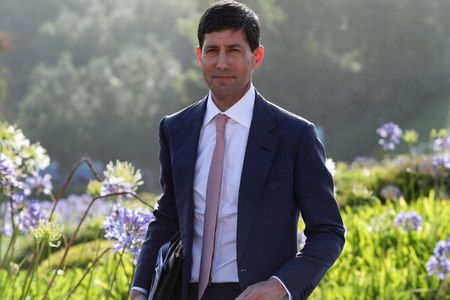

Federal Reserve Chairman Kevin Warsh revealed Wednesday that the names of outside experts appointed to a group of newly formed “task forces” reviewing central bank operations would be disclosed as soon as next week — and that some of those experts will come from outside the United States.
Speaking at a European Central Bank gathering of central bank leaders in Sintra, Portugal, Warsh told attendees, “I can tell you likely next week who will be the outside experts” serving on these panels. He added that the group would draw from a broad pool of talent: “Some of them would have been folks in seats like this in prior years, some would have been academics in the audience, but we really tried to find the best minds” in the economics community, “including people from countries outside the U.S.”
Warsh declined to name any specific individuals, but Bloomberg reported Wednesday that former Bank of England leader Mervyn King, who departed that institution in 2013, is expected to head one of the panels.
To explain why he is looking beyond American borders for expertise, Warsh invoked the 19th-century French political thinker Alexis de Tocqueville, who famously traveled to America in the 1830s to study its society and democracy. “We’re not asking for de Tocqueville to come to America, but sometimes we need a foreigner to sort of see things clearly, and the idea of these is not to prejudge the outcomes,” Warsh said.
He also suggested the work of these task forces could carry lessons beyond just the Fed itself. “I think some of the lessons learned might not just be for the American central banker who’s new to this crew, but my colleagues on the stage,” Warsh said, referring to the leaders of the European Central Bank, the Bank of England, and the Bank of Canada who were seated alongside him.
Warsh first announced the creation of five task forces following the June 16-17 Federal Open Market Committee meeting. Those panels are tasked with examining Fed communications, the central bank’s balance sheet, its use of economic data, productivity and employment, and the Fed’s framework for managing inflation.
Warsh was confirmed to lead the Federal Reserve in May, having campaigned for the position by sharply criticizing how the Fed has been run in recent years. He called for major reform — including what he described as “breaking some heads” — and has consistently criticized the central bank’s communications, its balance sheet management, and its approach to monetary policy. Since taking office, he has made a point of not offering guidance on the future direction of monetary policy.
The task forces are structured as advisory bodies, meaning Warsh would need buy-in from the broader Fed leadership to turn any recommendations into actual policy changes.
The inclusion of international advisers mirrors a role Warsh himself has played in the past, having previously advised the Bank of England on monetary policy matters.