
VANCOUVER — With World Cup excitement drawing fans to Vancouver’s BC Place stadium, a small supporter-owned club from nearby Richmond is a living example of how Canada’s soccer rise has been built on more than just big-money investment — it’s also been powered by community dreams.
TSS Rovers, a semi-professional club competing in the British Columbia Premier League — the third tier of Canadian soccer — grew out of the TSS Academy, which was established in 1997. The club itself launched in 2017 with a clear mission: create a development pathway for Canadian players to reach the professional level and, eventually, the national team.
That goal has already delivered remarkable results. Men’s national team defender Joel Waterman was part of the Rovers’ very first squad and has since been selected for Canada at both the 2022 and 2026 World Cups, though he has yet to see game action in the tournament. Former Rover Julia Grosso made an even bigger mark, scoring the decisive penalty kick that earned Canada its Olympic gold medal in Tokyo.
Chris Corrigan, one of the club’s three majority shareholders, reflected on just how far the club has come since its early days.
“If you had told us in 2017 that within five years we would have a player that played for us, that went on, developed himself in the other levels of the Canadian game and then showed up on the national team, we would have told you you were being optimistic,” Corrigan said. “But we’re a band of optimists, so we kind of began with that in mind. To see it happen feels like a dream come true.”
The club has also been a trailblazer off the field. In 2021, TSS Rovers became the first soccer club in Canada to transition to supporter ownership — a move Corrigan said was designed to ensure the club’s long-term future. Since making that change, more than 450 community members have become shareholders in the organization.
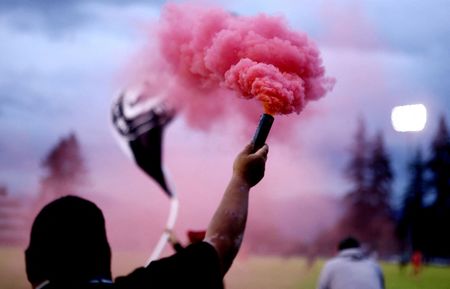
The club’s devoted fanbase, who call themselves the “Swanguardians,” follow both the men’s and women’s teams to matches home and away, generating an energy that is unusual at the semi-professional level of the game.
Corrigan said the World Cup has sparked a level of interest in soccer across Canada that he has never witnessed before, particularly notable in a country where ice hockey has historically dominated the sports conversation.
“I’ve been a football fan for a decade and a half. This team, this moment, I’ve never seen so many people interested in the game,” he said. “They’re jumping on the bandwagon. And it’s not just Canada they’re watching — they’re watching all the games in the tournament… They’re starting to understand what football means to the rest of the world.”
The Rovers play their home matches at Swangard Stadium in Burnaby, where tall trees and mountain scenery provide a striking backdrop to a club built on optimism and neighborhood pride.
For goalkeeper Callum Weir, who grew up in Haines Junction in Canada’s Yukon territory, the club opened doors that simply didn’t exist before for players from areas where soccer has not traditionally been a priority.
“From last year, I was lucky enough to make my professional debut with Valour in the Canadian Premier League… Development has been amazing and the club as a whole has been incredible,” Weir said.
Supporter and shareholder Paul Sabourin-Herzog said watching Waterman’s journey from the Rovers to the World Cup stage brought a flood of emotions.
“I was at BC Place when Canada played Qatar at the World Cup, and the first thing I did was take a picture of Joel Waterman warming up. Because it kind of tied a lot of things together over the however many years we’ve been here,” Sabourin-Herzog said.