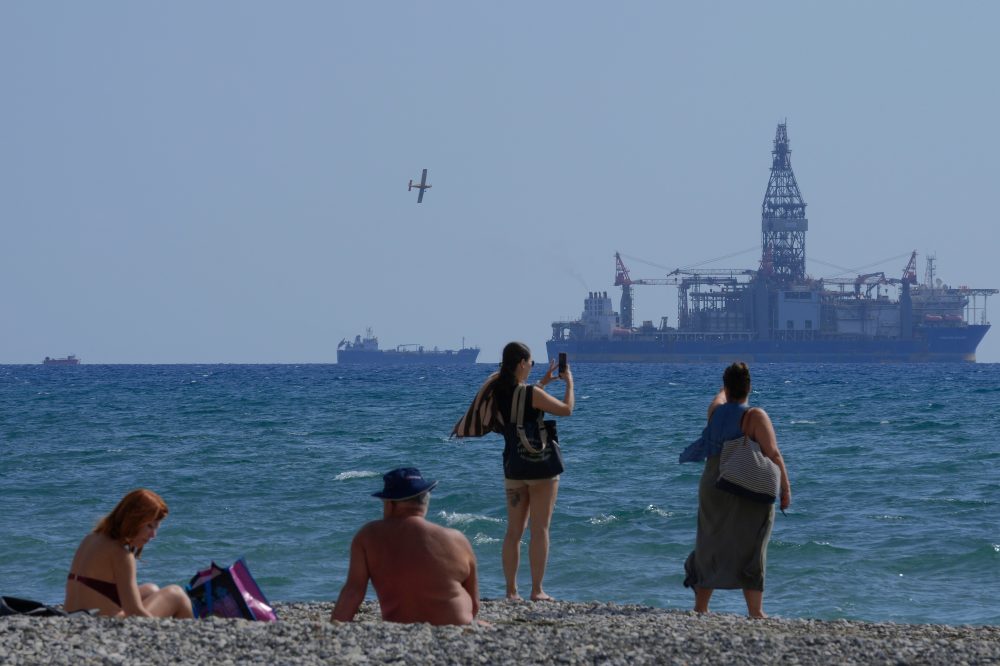

NICOSIA, Cyprus — Natural gas from two underwater deposits found by ExxonMobil in waters off Cyprus could be flowing to market as early as 2033, a top company official announced Tuesday. The development could help transform the eastern Mediterranean island into a key energy supplier for Europe.
ExxonMobil’s Vice President of Global Exploration John Ardill said the company and its consortium partner, QatarEnergy, believe the most practical route to market would be sending the gas through a pipeline to existing processing facilities in Egypt, where it could be liquefied and then exported. Other possibilities — such as building onshore infrastructure in Cyprus or a floating facility above the deposits — have been ruled out for now due to high costs.
“Everything you’ve seen between the government of Cyprus and the government of Egypt gives us a lot of confidence that there’s good government to government coordination, the agreements in place to leverage that eastern Mediterranean energy hub concept,” Ardill said.
His remarks came after ExxonMobil and QatarEnergy signed an agreement with Cyprus formally declaring the two deposits commercially viable. The fields — named Glaucus and Pegasus — sit within Block 10 of Cyprus’s exclusive economic zone and are estimated to contain a combined 7 trillion cubic feet of natural gas.
Ardill said the consortium is also looking to expand its footprint in the region, expressing interest in exploring a block on the southwestern edge of the exclusive economic zone that sits next to an area where the consortium already holds drilling licenses. He added that additional drilling at the Pegasus deposit is planned for around the end of this year to gather more critical data needed for the field’s development.
“So what we should tell ordinary people is we have been working very diligently together between government and investor to make these discoveries and we’re working very diligently to get the gas flowing for the people of Cyprus,” Ardill said.
Cyprus has been working to establish itself as a new energy source for Europe and beyond since natural gas was first discovered off its southern coast in 2011. Beyond ExxonMobil and QatarEnergy, two other consortiums hold exploration licenses in Cypriot waters.
A group made up of Italy’s Eni and French company TOTAL holds licenses for four blocks, with two deposits there estimated to hold a combined 5.6 trillion cubic feet of gas. Meanwhile, a partnership between Chevron, Dutch Shell, and Israeli NewMed holds a license for one block containing the Aphrodite deposit, the oldest discovery in the area, which also holds approximately 5.6 trillion cubic feet of gas.
Earlier this year, Eni’s Chief Operating Officer Guido Brusco said his company was close to making a final decision on developing the Cronos gas field, which could potentially deliver gas to European markets by late 2027 or early 2028.