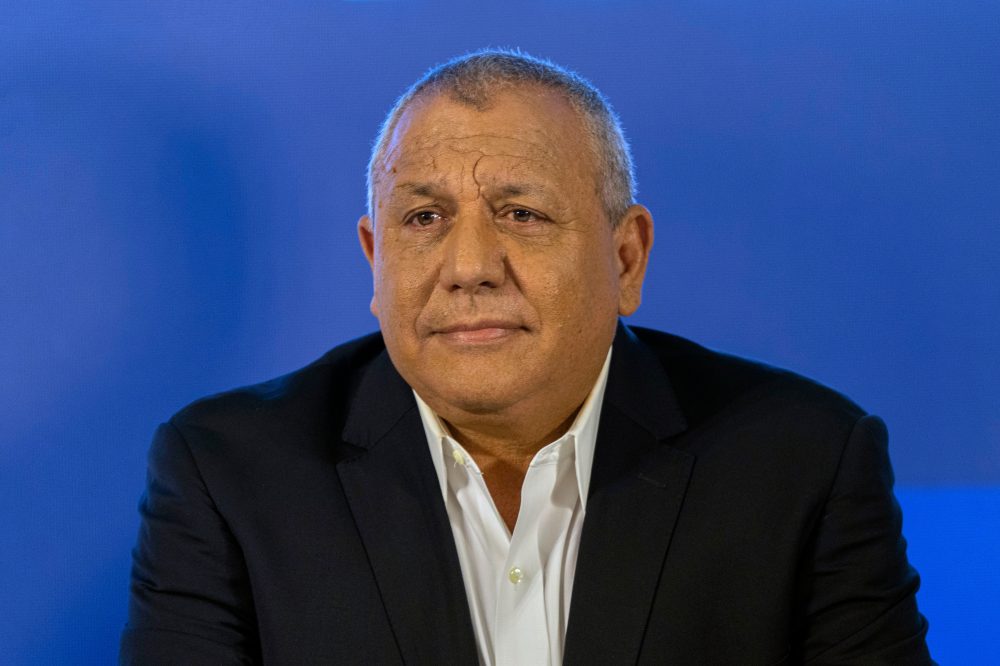

JERUSALEM (AP) — A prominent Israeli military leader who walked away from Prime Minister Benjamin Netanyahu’s war Cabinet — publicly blaming the prime minister for having no clear plan in Gaza — has now positioned himself as one of Netanyahu’s most serious political threats heading into elections scheduled for this fall.
The challenger’s name is Gadi Eisenkot. His centrist political party, called “Yashar!” — which translates to “Straight!” — formally kicked off its election campaign on Tuesday in Israel.
Eisenkot’s background as one of Israel’s most decorated military figures could intensify public examination of Netanyahu and how he has led the country through a series of conflicts. Like most of Netanyahu’s political opponents, Eisenkot has broadly backed Israeli military campaigns in Gaza, Lebanon, and against Iran. However, he has also charged Netanyahu with strategic failure in the aftermath of the Hamas-led attacks on October 7, 2023, and warned that Netanyahu’s vision of an increasingly isolated Israel poses a danger to the country’s long-term future.
In recent days, Netanyahu — who leads Israel’s right-wing Likud Party — has pushed back sharply, claiming that had he followed Eisenkot’s advice and held back on certain operations in Gaza, “all of Hamas” would still be in power there.
As someone new to the political arena, Eisenkot “looks like a front-runner because he’s everything Netanyahu is not,” according to Gideon Rahat, a senior fellow at the Israel Democracy Institute think tank in Jerusalem. “He’s not polarizing, he’s not a populist like Netanyahu, and he will try to unify the country,” Rahat added.
At 66, Eisenkot is the son of Jewish Moroccan immigrants and presents a sharp contrast to Netanyahu, a U.S.-educated figure currently facing corruption charges in court. Eisenkot grew up in a working-class household, speaks unpolished English, and devoted four decades of his life to Israel’s military.
He has never built his political identity around connections to U.S. President Donald Trump. And in a deeply personal distinction from Netanyahu, Eisenkot lost his 25-year-old son, Gal Meir Eisenkot, in combat in Gaza. Netanyahu’s son, a podcaster, has lived part-time in Florida. Eisenkot also lost two nephews in the war.
Those losses have elevated Eisenkot’s standing among Israelis and lent him a kind of moral authority — a sense that someone who has paid such a devastating personal price will not send soldiers into harm’s way without good reason.
“People trust him to be a real person and a patriot. They expect him to take care of the country and not himself,” said Rahat, who also serves as a professor at Hebrew University.
Eisenkot’s platform centers on strengthening Israel’s national security, including through regional cooperation. He has said he supports Jewish settlements in the occupied West Bank that are “in line with Israel’s interests.” He has also adopted the campaign slogan “Service for All,” which signals his push to require military service from Israel’s ultra-Orthodox communities — a politically charged issue. For Israelis exhausted by years of conflict and the burden of sending family members to fight, these positions could carry significant appeal.
“He presents as an everyman, a reflection of the ordinary Israeli,” Joshua Leifer, a columnist for Israel’s Haaretz newspaper, wrote, describing Eisenkot as “a kind of antipolitician.”
In 2024, Eisenkot resigned from Netanyahu’s war Cabinet, saying the prime minister lacked any real strategy for the war in Gaza. He sent a pointed letter to fellow Cabinet members warning them that they were confusing small battlefield advances with the kind of decisions that could actually neutralize Hamas and make Israel safer.
His objections, however, were not focused on the scale of destruction in Gaza or the high number of civilian casualties — both of which have drawn widespread international condemnation. And while he has at times pointed to diplomacy as a tool for addressing Israel’s security needs, Eisenkot is also credited with developing Israel’s so-called “Dahiyeh Doctrine,” named for the area in southern Beirut where the Hezbollah militant group maintains a stronghold.
He explained the doctrine in a 2008 interview with the Israeli daily Yedioth Ahronoth, following his role as a senior military official during Israel’s 2006 war with Lebanon. “What happened in the Dahiyeh quarter of Beirut in 2006 will happen in every village from which shots will be fired in the direction of Israel,” he said. “We will wield disproportionate power against every village from which shots are fired on Israel, and cause immense damage and destruction. From our perspective, these are military bases.”
Israel’s fragmented multi-party political system rarely allows prime ministers to complete full four-year terms — coalitions fall apart and new alliances take shape. Because of this, and despite Netanyahu’s unpopularity, it would still be a significant challenge for any rival to assemble a coalition broad enough to remove him from power.
Even if Eisenkot’s party wins more seats than Netanyahu’s Likud, he would still need to build alliances with enough other parties to reach a governing majority. Eisenkot has stated he will not back down on legislation requiring ultra-Orthodox Israelis to serve in the military — a community that also holds considerable political influence. He will also face a decision about whether to bring Arab-led parties into a potential coalition to reach the necessary threshold, a move that Netanyahu and his far-right allies have already begun using as an attack line against him.