
Israel is facing its most difficult diplomatic position with the United States in modern memory, and may be more isolated internationally than it has been in decades — that is the stark assessment of former Israeli Ambassador to the United States Michael Oren.
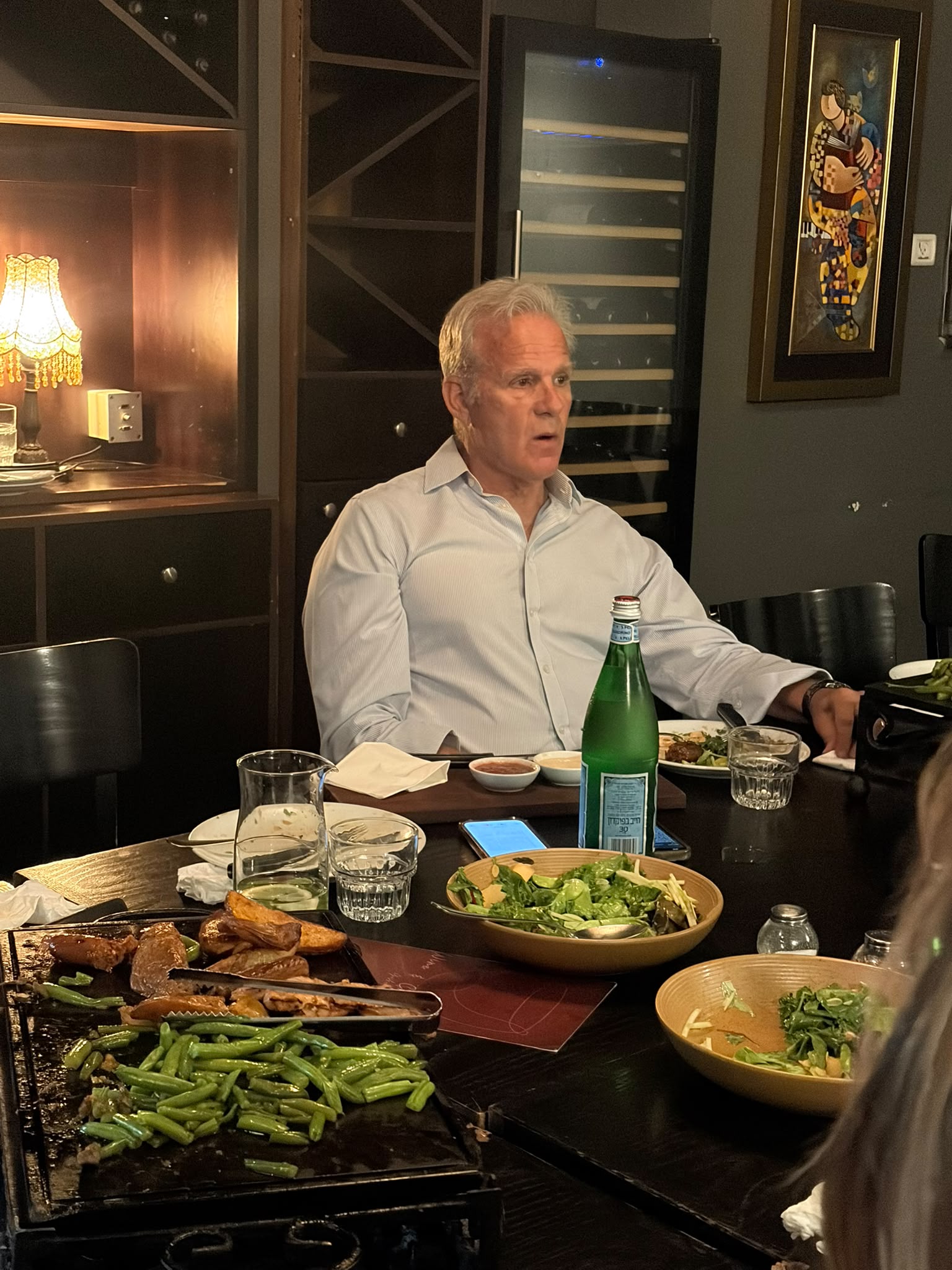
Oren shared his views last week with a small gathering of foreign journalists at an event organized by MediaCentral, speaking openly over a meal at a Tel Aviv restaurant. Born in the United States, Oren immigrated to Israel in 1979 and went on to become one of the country’s most recognized diplomats. He held nothing back when addressing the challenges confronting Prime Minister Benjamin Netanyahu, the possibility that Netanyahu could survive politically, and what the future might look like if the Israel Defense Forces fail to secure the northern front.
“For the first time in history, we have no recourse,” Oren told the group. “Traditionally, if there was a problem with an [American] administration, we went to Congress. If there were problems with Congress, we went to the administration. We can’t do that. There’s nobody we can go to complain to.”
Oren explained that Israel has, in his view, “lost the Democratic Party,” while the Republican Party is split between those who “may not like us very much” and others whose primary loyalty is to President Donald Trump.
“So, who are we left with? Maybe, at times, Lindsey Graham, Ted Cruz. That’s a slim limb to be hanging from,” he said.
Oren noted that several Republicans have told him the upcoming US midterm elections, set for November 3rd, represent an “existential fight for Trump.” He said Trump’s supporters believe that if the president fails to contain the conflict in Lebanon, it will hurt him politically. At the same time, Netanyahu understands that a military defeat in Lebanon could mean “he can find himself being Citizen Netanyahu and not prime minister.”
Despite this, Oren placed some of the blame on Netanyahu himself, saying the prime minister bears responsibility for “alienating the Democrats.”
“I opposed his March 2015 speech to Congress,” Oren said, referring to Netanyahu’s controversial address before a joint session of the Republican-led US Congress — an appearance arranged without the Obama administration’s knowledge. Netanyahu used the occasion to argue against the Joint Comprehensive Plan of Action, the Iran nuclear agreement that President Obama later signed.
“I didn’t think it was going to affect the vote on the nuclear deal at all, and it didn’t; and it would only cost us further support in the Democratic Party,” Oren said. “They still talk about that speech, so I don’t know what we gained.”
Looking ahead, Oren pointed out that many potential Democratic presidential candidates — including several who are Jewish — are “highly critical of Israel.” He expressed support for Netanyahu’s push to negotiate a new framework for defense cooperation and US military assistance, but expressed doubt that Israel has the decade-long window Netanyahu is counting on to put such an arrangement in place.
In January, Netanyahu introduced a plan to gradually phase out US military aid in favor of expanded joint defense programs. Oren warned that if Democrats return to power, “they’re going to cut it [the aid] off immediately. There’s a big difference between morphing into a partnership where we’re equal partners and one where one side is simply cutting off the aid.”
The situation for Jewish communities outside Israel is also deteriorating, Oren said. According to Tel Aviv University’s 2025 Annual Antisemitism Report, 20 Jewish people were killed in antisemitic attacks last year — the highest annual death toll in more than 30 years. The same report found that antisemitic incidents across every Western nation remain far above pre-Gaza war levels.
“I’ve been in Australia, Canada, most recently in Italy and France. In every community I’ve visited, they say there’s no future for that community, which is very disheartening,” Oren told journalists. “It’s like we’re reaching a situation where the Diaspora as we know it is going to constrict very, very fast.”
In the past, Oren said, Jews facing persecution in one country could relocate to another — from France to England, Canada, or New York. Those escape routes, he noted, no longer feel as secure. He described Hamas’s October 7th border attack as having “broke through a dam, which had held back the currents of antisemitism for about 80 years, and what followed was a torrent.”
Oren suggested it may not matter much who leads Israel after its upcoming election — whether that turns out to be Naftali Bennett, Gadi Eisenkot, or Netanyahu himself. He said a new prime minister might earn a brief “grace period” of two or three weeks in terms of international perception, but that a fundamental shift in Israel’s global standing is unlikely. He argued that no incoming government would establish a Palestinian state overnight, and military operations in Gaza and Lebanon would likely become more aggressive, not less.
On the Lebanon front specifically, Oren was unequivocal: “This is not a strategic issue. This is an existential issue … If we lose the North, we lose the country.” He warned that pulling back prematurely would allow Hezbollah to eventually redirect rocket fire from border communities like Metula toward larger cities like Ashkelon.
“For a large segment of the people who now define themselves as anti-Zionist, it’s not what we do anymore; it’s who we are, and that’s not going to change,” Oren stressed.
On the question of responsibility for October 7th, Oren said Netanyahu deserves some of the blame but should not be held solely accountable, even if “the buck ends there.” He revealed that just days before the massacre, the Israeli government had held a meeting in which it decided to send a delegation to Cairo to offer Hamas de facto sovereignty over Gaza and participation in a gas-sharing arrangement. Further details, Oren said, will appear in a new book he plans to publish later this year.
“I was in the government until 2019, and I had a tremendous amount of responsibility for Gaza,” Oren said. “I worked closely with the army, worked closely with the Shabak [Israel Security Agency], worked closely with Mossad. And I will tell you unconditionally, unequivocally, that the ‘concepzia,’ as they call it, was that Hamas was deterred, was that Hamas wanted to devote its time to developing Gaza, was uninterested in the conflict, and that Israel could focus on the serious dangers, which were Hezbollah and Iran.”
Oren said this belief was not unique to Israeli leadership — it was shared by American officials across both the Biden and Trump administrations. He said the only prominent figure who publicly challenged that assumption was Member of Knesset Avigdor Liberman, head of the Yisrael Beitenu party and a former defense minister.
Despite nearly three years of war and mounting political pressure, Oren cautioned against writing Netanyahu off. “It’s always premature to eulogize” him politically, he said. Israel remains sharply divided: in Oren’s largely Mizrahi neighborhood in southern Israel, criticism of Netanyahu is virtually nonexistent, while among the more Ashkenazi, center-left community where he rows on the Yarkon River, people are eager to see the prime minister removed from office.
“The problem with Bibi … he’s a very, very difficult act to follow,” Oren said. “He is physically robust. He spent a lot of time in ridiculously overrated schools, and he’s probably the smartest guy I’ve ever encountered. He is a brilliant politician, whatever you want to say. He’s a survivor.”
A recent N12 poll showed Netanyahu’s Likud party still leading with 24 seats, with former IDF chief Gadi Eisenkot’s centrist Yashar party close behind at 22 seats.
Oren also defended Netanyahu against some critics, arguing that many decisions attributed to him personally would likely have been made by any Israeli prime minister. On the US-Iran agreement, Oren said the greatest damage is not to Israel but to America’s standing globally.
“It is an incalculable blow to America’s prestige and deterrence power,” Oren said. “The Chinese are going to take notice, and the Russians are going to take notice. I can’t imagine any country will join the Abraham Accords right now. If anything, they’ll be seeking rapprochement with Tehran very quickly. I think they’re already doing it.”
Oren said Israel should use the coming years to broaden its foreign policy reach, building stronger ties with India, South America, and Africa. As for why Netanyahu should be the one to lead those efforts, Oren suggested the prime minister simply may not be willing to step aside — describing him as someone who sees himself as “transformative, if not messianic,” driven by a belief that he was born to fulfill a mission.
“Here’s a man who’s got a pacemaker, who’s now recovered from cancer, has been through I don’t know what. He doesn’t stop, and you have to ask yourself, what’s driving this human being? What animates him?” Oren said. “What animates him is a sense of mission: the mission to save Israel and the Jewish people.”
Whatever one makes of Oren’s analysis, his overall message was unmistakable: Israel is confronting serious headwinds on the world stage, including a deeply uncertain relationship with its most important ally. In that environment, he suggested, the identity of whoever holds the prime minister’s office may matter far less than whether Israel — and the broader Jewish world — can find its footing in the turbulent years ahead.