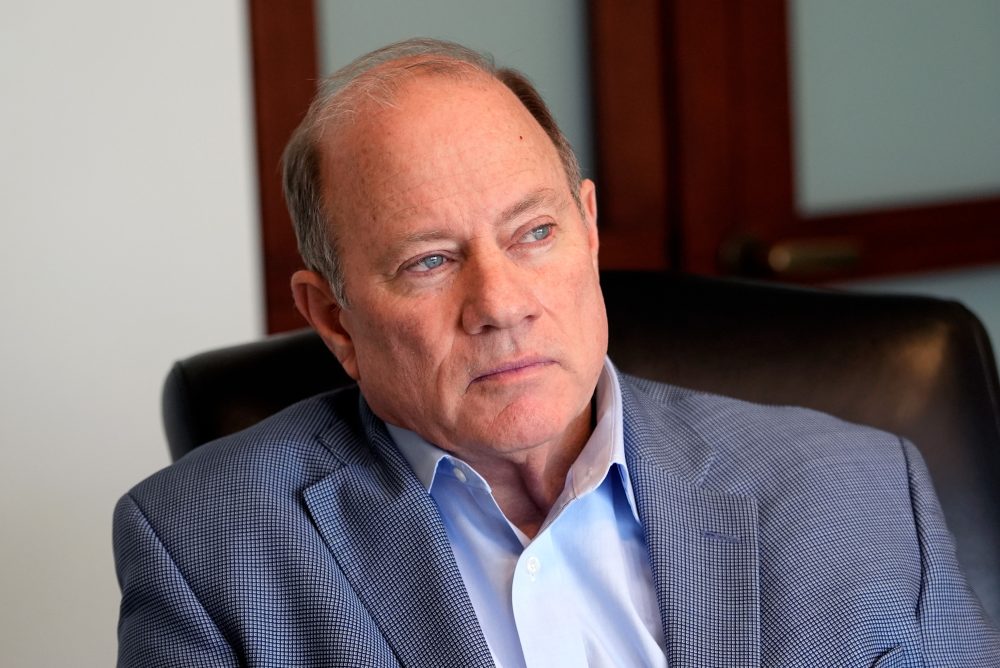

DETROIT (AP) — Mike Duggan, who previously served as Detroit’s mayor, announced Thursday he is halting his bid for Michigan governor, pointing to an increasingly hostile political environment driven by President Donald Trump’s conflict with Iran and rising fuel costs.
The veteran Democrat was seeking the governor’s mansion as an independent candidate to succeed Democratic Gov. Gretchen Whitmer, who cannot seek reelection due to term restrictions. Speaking with The Associated Press, he explained that victory would be extremely difficult as Democrats who might have backed him are now rallying against developments in Washington.
“Democrat anger against Trump and Republicans is extremely high,” Duggan said. “In 60 days there’s been a huge change in the attitudes of this country. People are feeling the pain at the pump and are angry about it.”
No independent candidate has ever held Michigan’s governorship, and third-party contenders historically struggle in races for the state’s highest office. For Duggan, who avoided partisan battles by choosing an independent path, the challenges were becoming insurmountable.
“As long as I knew there was a path for victory, I was going to fight,” he said. “I don’t see a likely path to win.”
Following the Iran conflict’s start in late February, petroleum costs have surged over 50%. Thursday’s data from AAA Michigan showed regular gasoline averaging $4.74 per gallon statewide, exceeding the $4.56 national figure. Michigan’s average was $3.13 one year prior, while the national average stood at $3.18.
Trump has consistently stated that fuel prices will decrease when the conflict concludes, though he hasn’t specified a timeline.
Across the nation, Trump’s economic approval ratings have declined somewhat since the Iran war commenced, based on AP-NORC survey data. Recent May polling revealed that even Republicans express less satisfaction with Trump’s economic leadership compared to several months ago, despite generally maintaining their support. Roughly 6 in 10 Republicans currently approve of his economic handling, down from approximately 8 in 10 before hostilities began.
Duggan believed his campaign was behind Democratic Secretary of State Jocelyn Benson and Republican U.S. Rep. John James in the gubernatorial contest. Genesee County Sheriff Chris Swanson is also seeking the Democratic nomination, while millionaire businessman Perry Johnson pursues the Republican ticket.
Michigan will conduct its primary voting on Aug. 4, followed by the general election on Nov. 3.
In December 2024, Duggan revealed his gubernatorial ambitions, surprising observers when he simultaneously announced his independent candidacy rather than remaining with the Democratic Party.
During that December AP interview, Duggan said he wanted to provide Michigan voters with additional options.
“It’s clear to me that there are a lot of people in this country who are tired of both parties and tired of the system,” Duggan said then. “You have a (state) legislature that’s almost evenly divided that makes the stakes of each issue become magnified. It has gotten harder and harder to address things as the partisan climate has gotten more toxic.”
His independent decision came as Michigan joined several swing states that supported Trump’s November 2024 return to the White House for a second term.
“I’ve done everything I know how to do for almost a year and a half,” Duggan said Thursday. “You could feel the mood of this state wanting the toxic partisanship to end. They wanted the parties to work together.”
Duggan led Detroit for twelve years as mayor. His initial election came in November 2013 during the city’s difficult and unprecedented bankruptcy while operating under a state-appointed emergency manager. The former county prosecutor and medical center executive became Detroit’s first white mayor since Coleman A. Young won election in the early 1970s as the city’s first Black mayor.
Many credit Duggan with guiding Detroit’s transformation after emerging from bankruptcy in December 2014 into a more prosperous and dynamic city.
Detroit’s population, approximately 80% Black, reelected Duggan on two occasions. He declared in November 2024 that he wouldn’t pursue a fourth mayoral term, departing the office in January.
Throughout the campaign, Duggan faced criticism from his former Democratic allies, who worried his candidacy would siphon votes from the Democratic nominee despite his nearly four decades as a Democrat in a predominantly Democratic city.
“I was running to change politics, not to be a spoiler,” he said Thursday.
After Duggan’s gubernatorial announcement, Republican and former Michigan Lt. Gov. Brian Calley commented on X that Duggan possessed the qualities of a “credible, independent candidate with the ability to raise money.”
“But there are huge advantages of having a political party behind you,” Calley wrote. “And being a target of the left and the right will be intense.”