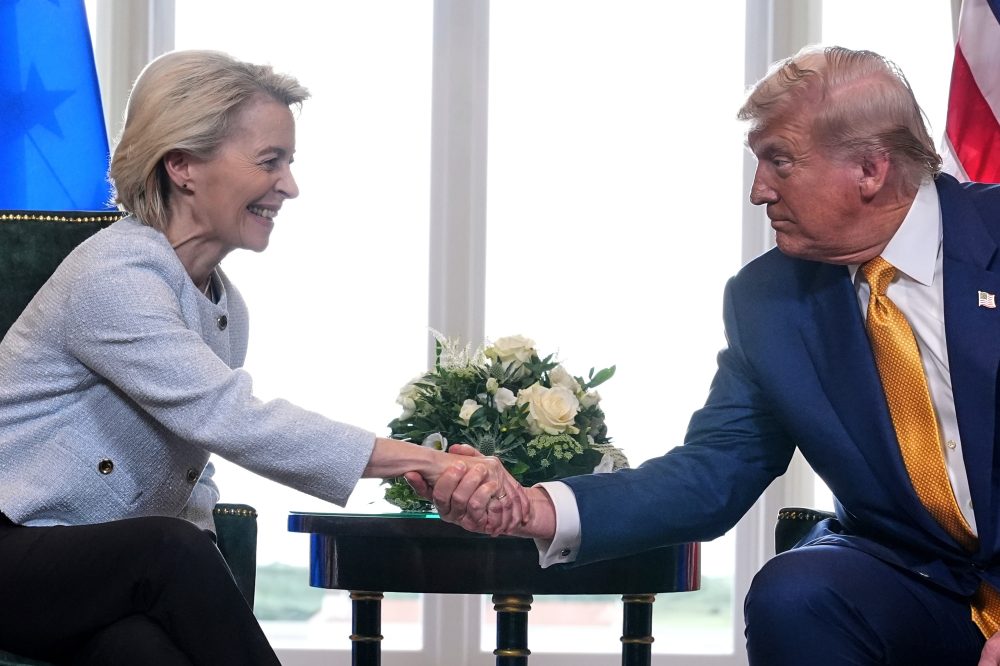

BRUSSELS (AP) — Following intense internal discussions, the European Union gave final approval Wednesday to a trade agreement with the United States that establishes a 15% ceiling on tariffs for most European exports, preventing a potential confrontation with President Donald Trump before his July 4 deadline.
Sharp disagreements erupted within the 27-member union’s legislative body and leadership, threatening the carefully negotiated agreement that governs the enormous flow of commerce between two of the globe’s biggest economic powers, both currently dealing with serious consequences from the conflict in Iran.
Within the European Parliament, members threatened to reject the commercial pact that European Commission President Ursula von der Leyen had negotiated last July with United States President Donald Trump at his Turnberry golf facility in Scotland, after extended discussions following his administration’s worldwide wave of tariff impositions.
The agreement between von der Leyen and Trump launched additional months of detailed negotiations between Washington and Brussels, even as European criticism of the arrangement intensified after Trump made threats regarding Greenland, a semi-independent Danish territory. He has since stepped back from those threats, at least temporarily.
“A deal is a deal, and the EU honours its commitments,” stated the EU executive in a social media message celebrating the accord.
European legislators had successfully demanded the inclusion of safeguards in the agreement should the U.S. retreat or hesitate on specific terms, according to Bernard Lange, who chairs the parliamentary trade committee.
“If there is something going wrong, of course, we are self-confident to act on that,” he stated.
The basic framework of the agreement is straightforward: a 15% tariff ceiling on most European imports, while duties on US industrial products would drop to zero. Although the deal imposed higher costs on consumers and businesses compared to the former average of 4.8%, it also provided commercial certainty for future planning, a benefit credited with helping Europe sidestep recession last year.
Given the ongoing blockade of the Strait of Hormuz that continues pushing up costs as Middle Eastern warfare persists, affecting interest rates and inflation from Latvia to Louisiana, supporters of the EU-U.S. agreement maintain that resolving trade disputes between them is essential during this period of worldwide economic uncertainty.
The American Chamber of Commerce in Brussels released a statement expressing relief at seeing the EU achieve agreement on the deal. “The trilogue agreement is a sign that the EU is honouring its commitments under the deal,” it stated, enabling Washington and Brussels to “move beyond tariffs” and address complex matters like vital supply chains.
The EU’s trade negotiator, Maroš Šefčovič, explained that the final effort to approve the deal occurred after five hours of “an intensive night” of trilogue talks between the European Council, European Parliament and the EU’s executive, the European Commission.
He noted that once the political agreement receives formal adoption by legislators in upcoming weeks, “this outcome will reinforce stability in EU-U.S. trade and open the door even wider to constructive cooperation on many issues of strategic importance.”
However, European concerns remain about whether the White House can deliver on the agreement after the U.S. Supreme Court ruled this year against the legal foundation Trump had relied upon to implement that tax.
This situation left Trump searching for alternative legal justifications, and his administration has implemented a 10% tax while examining trade imbalances and national security concerns, to establish new tariffs compensating for lost revenue. In May, a federal court determined that Trump had exceeded the tariff authority Congress had granted the president under existing law, rendering the new tariffs “invalid” and “unauthorized by law.”
This could potentially encompass tariffs Trump has threatened to impose on EU automobiles and trucks in a social media message where he also criticized the EU regarding the deal for not “as usual” adhering to it, without specifying the sources of disagreement.
Following the EU’s completion of its internal democratic procedures, it now awaits a favorable response from Washington, according to Lange, the EU legislator.
“That’s, of course, a big question mark. I have not my crystal ball here with me,” he stated.