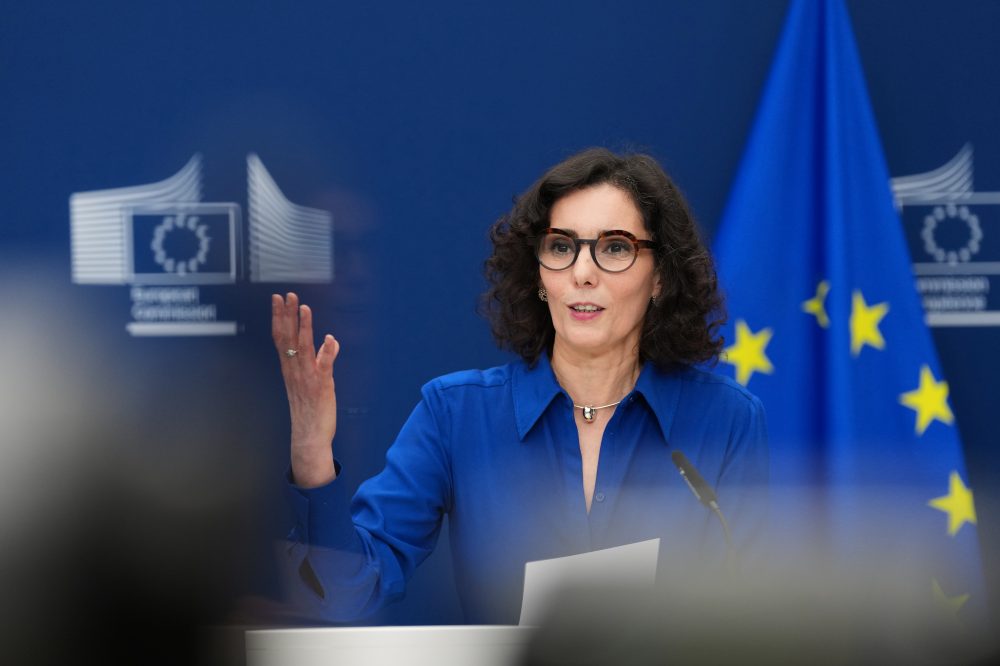

BRUSSELS — European Union officials announced Thursday they will provide financial assistance to women seeking abortion services, following a massive citizen-led advocacy effort that gathered support from over one million people throughout the 27-member alliance.
European Commissioner for Equality Hadja Lahbib revealed that member countries can now utilize the EU’s 147 billion euro European Social Funds Plus program to cover abortion-related medical expenses and costs for women from any nation within the union.
“Nearly half a million unsafe abortions take place in Europe every year,” Lahbib stated. “Safety and freedom must never depend on your postcode or your income.”
Lahbib commended the organizers behind the My Voice, My Choice movement, noting they had delivered numerous boxes containing letters from women throughout the European bloc.
While activists had originally requested the EU establish a dedicated fund to help women travel beyond their home countries for safe abortion procedures, campaign leaders expressed satisfaction that the commission’s approach accomplishes their goals through alternative methods.
“While no new legal instrument is being created, the Commission has formally acknowledged that the core objectives of our initiative can be achieved and outlined a concrete pathway to implement it in practice,” explained Nika Kovač, who coordinated the My Voice, My Choice campaign. “This is not symbolic. It is a political commitment to women’s rights.”
Kovač added, “It establishes beyond doubt that access to safe abortion is a matter of public health and social justice. For the first time, the Commission confirms unequivocally that EU funds can be used to guarantee access to safe abortion care — particularly for women in vulnerable situations, regardless of where they come from in Europe.”
While abortion procedures remain legal throughout most European countries — with France even adding abortion rights to its constitution in 2024 — several nations maintain strict limitations. According to the European Parliamentary Forum on Sexual & Reproductive Rights, Poland, Malta, Liechtenstein, and Monaco impose tight restrictions on abortion access.
The commission’s response resulted from a distinctive EU mechanism known as the European Citizens’ Initiative. Advocacy efforts launched through the official platform must collect more than one million signatures distributed across member nations to trigger formal consideration by EU leadership in Brussels.
Following the campaign’s achievement of surpassing one million signatures beginning in 2024, European Parliament members approved the funding proposal by a vote of 358-202, with 79 abstentions, in December.
Critics of the proposal argued it would impose majority EU viewpoints on countries that have adopted more restrictive policies.
“How can I explain to my people, the Maltese, that what they decided for, we overturn it here?” questioned Maltese representative Peter Agius during December parliamentary discussions about the initiative. Agius belongs to the European People’s Party, the same political group as European Commission President Ursula von der Leyen.
“Today is a good day for women’s rights in Europe,” Kovač declared. “Today we won, today we will celebrate, and tomorrow we will start working more.”