
BRUSSELS — European nations find themselves increasingly entangled in the escalating Middle East conflict between the U.S.-Israel alliance and Iran, scrambling to safeguard military installations and rescue thousands of citizens trapped in the expanding war zone.
The crisis has thrust European countries into emergency mode, despite having no voice in the initial U.S.-Israeli military operations against Tehran. Now they’re grappling with the consequences as Iranian retaliation spreads throughout the region that houses vital European trading partners and strategic commercial pathways.
Thousands of Europeans residing in major Middle Eastern cities like Beirut, Dubai, and Jerusalem now face uncertainty, while extensive immigrant communities from Turkey, Egypt, and Gulf nations living across Europe watch developments with growing concern.
Although European powers have declined direct military participation, Britain, France, and Germany announced their willingness to collaborate with Washington in countering Iranian attacks. The United Kingdom has granted American forces access to British military installations for strikes against Iranian missile facilities.
The conflict’s reach has already touched European soil. Cyprus, currently holding the EU’s rotating leadership, was forced to clarify its non-involvement after an Iranian-designed Shahed drone struck a British air facility on the island’s southern shoreline this past weekend. These same drone models have previously appeared in European skies during Russia’s assault on Ukraine.
Anticipating potential domestic threats, several European governments have enhanced security protocols at transportation hubs including train terminals and airports.
Notably, European leadership has largely avoided condemning the American-Israeli military campaign. Many officials welcome the potential collapse of Iran’s government, which has repeatedly detained European nationals and undermined continental economic interests over recent years.
Spain stands as a notable exception to this consensus. Prime Minister Pedro Sánchez declared Sunday, “One can be against a hateful regime, and at the same time, be against a military intervention that is unjustifiable, dangerous and outside of international law.”
European involvement remains essential given the region’s volatility and the continent’s need for Middle Eastern stability. Concerns about prolonged petroleum price increases and potential unpredictable migration waves ensure continued European engagement.
The immediate European focus centers on protecting thousands of nationals caught in the spreading conflict zone.
EU foreign ministers addressed evacuation concerns during weekend emergency discussions. While no coordinated rescue operation launched, officials acknowledged one might become necessary shortly.
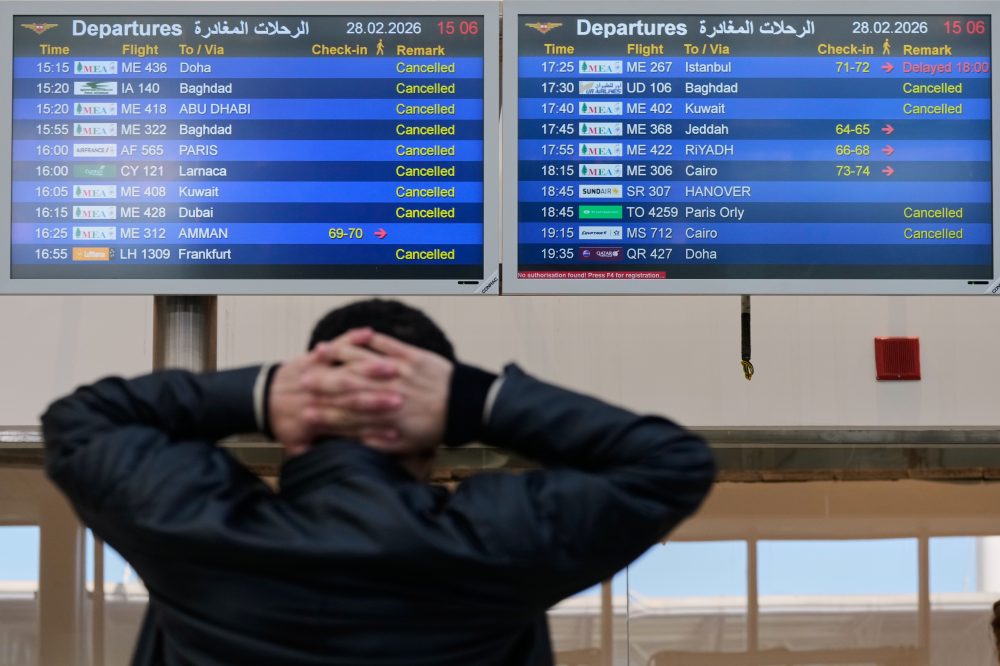
German authorities report approximately 30,000 German travelers stranded aboard cruise vessels, in hotels, or at shuttered airports, unable to return due to the fighting. Most remain in Middle Eastern locations, though some are stuck elsewhere because their connecting flights route through Abu Dhabi, Qatar, or Dubai. Military extraction proved impossible due to closed airspace.
The Czech Republic has dispatched two aircraft to Egypt and Jordan for citizen retrieval, collecting dozens of Czech nationals who traveled overland from Israel. Four additional planes were scheduled for Oman to transport more of the estimated 6,700 Czechs throughout the region.
Iranian threats against vessels in the Strait of Hormuz—the narrow Persian Gulf passage handling one-fifth of global oil commerce—have prompted calls for enhanced EU merchant ship protection following actual attacks in those waters.
France responded by deploying two additional warships to strengthen Operation Aspides, the European naval mission in the area. However, these vessels will only patrol the distant Red Sea and Gulf of Aden—entry points to the Suez Canal connecting the Red Sea and Mediterranean—joining three ships already stationed there.
Operation Aspides launched two years ago to shield maritime commerce from potential Houthi rebel attacks originating in Yemen. While the Houthis have voiced support for Iran, they haven’t immediately declared military action on Tehran’s behalf.
Officials are reviewing the mission’s authorization and considering stricter engagement protocols, though immediate changes appear unlikely.
Preserving broader Middle Eastern stability remains a primary European objective. Iran’s retaliatory actions across multiple countries have drawn widespread condemnation.
EU foreign policy chief Kaja Kallas plans to organize talks with Gulf Cooperation Council nations at the ministerial level this week, as the bloc works to reassure Iran’s neighbors and other regional countries facing potential threats.
“Iran’s attacks of a number of countries in the Middle East are inexcusable. The events must not lead to further escalation that could threaten the region, Europe and beyond, with unpredictable consequences,” Kallas stated following Sunday’s emergency discussions.
The European Union intends to spearhead diplomatic initiatives aimed at reducing regional tensions while maintaining efforts to prevent Iranian nuclear weapons acquisition, despite the collapsed nuclear agreement after the Trump administration’s withdrawal.
EU officials indicate no preferred successor for Tehran’s leadership, noting it’s premature to identify potential candidates for future support. Foreign ministers primarily expressed “solidarity with the Iranian people.”
They pledged assistance for “their fundamental aspirations for a future where their universal human rights and fundamental freedoms are fully respected.”
European leaders maintain that authentic popular opposition to the regime emerged recently but was crushed through unprecedented violence. Thousands died and tens of thousands faced detention.
One certainty remains: the EU will unlikely support any leadership promoted by Iran’s Revolutionary Guard. The IRGC’s addition to the bloc’s terrorism list last month makes European recognition of them as legitimate negotiating partners virtually impossible.