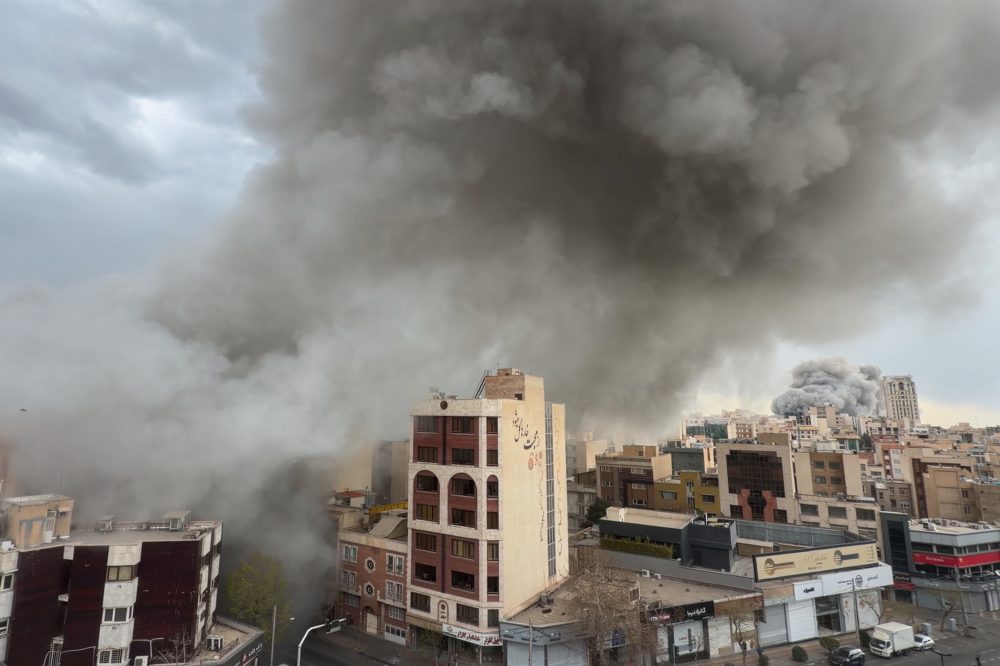

THE HAGUE, Netherlands — Recent military operations involving American and Israeli forces targeting Iran have intensified concerns about violations of international legal standards, as Tehran and allied groups responded with missile strikes throughout the Middle East region on Monday.
From United Nations headquarters in New York, the center of post-World War II international governance, Secretary-General António Guterres addressed the Security Council on Saturday, declaring that American and Israeli military strikes breached international law and UN Charter provisions. Guterres simultaneously criticized Iran’s counter-attacks as violations of Middle Eastern nations’ sovereignty and territorial boundaries.
Trump administration representatives maintain their military operations represent legitimate actions to prevent Tehran from developing nuclear capabilities. “It’s a matter of global security. And to that end, the United States is taking lawful actions,” stated Mike Waltz, Trump’s UN ambassador.
In a Sunday correspondence to the United Nations, Iranian Foreign Minister Abbas Araghchi described the death of Supreme Leader Ayatollah Ali Khamenei as “constitutes a grave and unprecedented breach of the most fundamental norms governing relations among States.”
Defense Secretary Pete Hegseth offered a forceful defense of American military actions on Monday. “No stupid rules of engagement, no nation building quagmire, no democracy building exercise, no politically correct wars. We fight to win and we don’t waste time or lives,” Hegseth declared from Pentagon headquarters.
These Iranian operations follow by fewer than eight weeks the American military operation that resulted in the capture of former Venezuelan President Nicolás Maduro in Caracas, subsequently transporting him to New York for prosecution.
International law expert David Crane, who established and led a United Nations tribunal prosecuting Sierra Leone war crimes, authored an assessment stating that American operations in Iran and Venezuela “highlight a dangerous trend: the normalization of unilateral force as a tool of foreign policy. Even when the outcome is positive, the violation of international law and constitutional limits sets a precedent that threatens global stability and undermines America’s own legal foundations.”
Democratic lawmakers in Washington have characterized the military strikes as unlawful. Their position maintains that constitutional authority for war declarations rests exclusively with Congress. Critics argue the Trump administration has not provided adequate justification or strategic planning for the military operations and their consequences.
Congressional leadership rapidly organized a Monday debate regarding Trump’s constitutional authority for Iranian bombardment under war powers legislation.
The International Criminal Court’s founding treaty amendment defines aggression as “the use of armed force by a State against the sovereignty, territorial integrity or political independence of another State, or in any other manner inconsistent with the Charter of the United Nations.”
The court specifically identifies aggressive acts including: “Bombardment by the armed forces of a State against the territory of another State or the use of any weapons by a State against the territory of another State.”
Since the United States, Israel, and Iran maintain non-membership status with the court, ICC jurisdiction over the current conflict requires Security Council referral to court prosecutors.
UN Charter provisions restrict nations to using force against other countries only with Security Council authorization or for self-defense purposes, explained Marieke de Hoon, who teaches international criminal law at Amsterdam University.
De Hoon characterized the Iranian attacks as aggression crimes.
“It is a violation of the prohibition to use force, the cornerstone of the international legal order, and there is no legal justification for it: it is not a self-defense against an armed attack by Iran or an imminent threat” of attack, “nor is there a UNSC resolution to authorize use of force,” she explained to The Associated Press. “Regime change moreover violates the sovereignty of another state.”
Iranian leadership maintains an established record of violently suppressing opposition movements and supporting extremist activities that have created Middle Eastern instability. Trump administration forces targeted the nation’s nuclear facilities in previous military strikes last year.
However, De Hoon argued these factors cannot justify American and Israeli bombardments.
International law grants Tehran self-defense rights, she noted, while adding that “Iran is not allowed to attack civilian infrastructure in other countries. Its response needs to be proportionate to stop the aggression, without offering itself a legitimation toward, for instance, regime change in the aggressor country.”
Crane acknowledged that removing Maduro and Khamenei from power might enhance regional stability, decrease human suffering, and improve democratic and peaceful prospects, but “international law does not permit states to unilaterally decide which tyrants to remove by force.”
Reading University international law professor Marko Milanovic stated that during peacetime, “it is a clear violation of international law to assassinate the head of state or government of some other state.”
Government leaders “enjoy personal immunities and inviolability, and any attacks against them would also violate the sovereignty of their state,” he explained.
Wartime conditions alter these protections, he noted, explaining that when political leaders serve as armed forces members, “then they are combatants like any other members of the armed forces and are not immune from attack.”