
BERLIN — British Prime Minister Keir Starmer stepped down Monday following a sharp drop in his approval ratings, but leaders across Europe were quick to offer kind words for a leader many had found far more cooperative than those who came before him.
Starmer made history as the first non-Conservative prime minister since Britain’s vote to leave the European Union. While he firmly ruled out any possibility of the UK rejoining the 27-nation bloc, he worked actively to repair the strained relationship that followed the painful Brexit process.
He also kept Britain firmly committed to supporting Ukraine, working alongside fellow “E3” partners French President Emmanuel Macron and German Chancellor Friedrich Merz throughout his tenure.
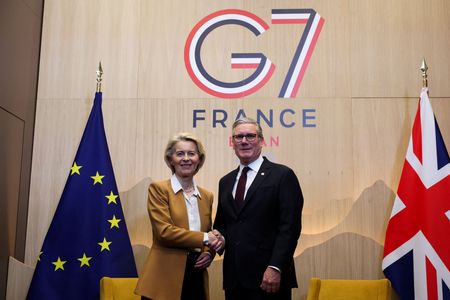
European Commission President Ursula von der Leyen took to the social media platform X to honor his service. “It can take many leaders years to grow into the statesman you became in just two years,” she wrote. “European and Ukrainian security is stronger because of you. Thank you, dear Keir.”
Starmer first took office in 2024, defeating a deeply unpopular government that had overseen a struggling economy and a country still fractured by the divisive Brexit debate. But much like other European leaders of his era, he found himself unable to hold onto voters who had grown frustrated with mainstream political parties and were increasingly turning to anti-establishment movements promising dramatic change.
While critics at home often described him as lacking charisma and conviction, those qualities seemed to weigh less heavily on the international stage, where he was seen as a steady and dependable partner.
Irish Prime Minister Micheál Martin issued a formal statement praising Starmer’s diplomatic efforts. “I want to acknowledge the significant role Keir played in resetting the Irish-British relationship as well as relations between the UK and the European Union during his time as prime minister,” Martin said.
Starmer continued the strong pro-Ukraine stance established by Conservative predecessors, including Boris Johnson, who threw Britain’s support behind Ukrainian President Volodymyr Zelenskiy following Russia’s attack on Kyiv in 2022.
Zelenskiy personally thanked Starmer on X, saying he was grateful “for always being in touch, always engaged, and always striving to do what is needed.” He added that their conversations had always been “filled with real substance” and extended an open invitation: “Keir, you are always a welcome guest in Ukraine.”
A spokesperson for the German government described Starmer as “a reliable and close partner,” though German Chancellor Merz — himself dealing with record-low approval ratings and growing speculation about his political future — did not issue a personal statement.
The reaction from across the Atlantic was far less generous. U.S. President Donald Trump had actually announced Starmer’s departure a day before it was made official, and said the outgoing prime minister had “failed badly” on immigration and energy — two areas where Trump has sharply disagreed with British policy.
Russia, which views Britain as one of its chief adversaries largely due to its backing of Ukraine, went even further. A post on X from Russian President Vladimir Putin’s special envoy Kirill Dmitriev claimed responsibility for Starmer’s exit. “We did this jointly,” the post read, “by exposing Starmer’s warmongering and consistently wrong policies on immigration, crime, energy and economy.”