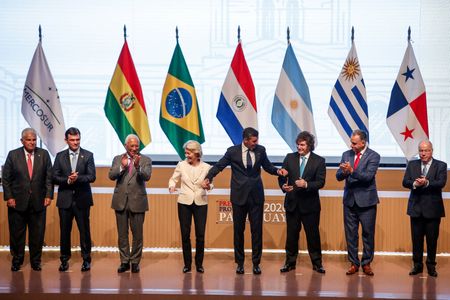

The European Union launched a major trade agreement with South American nations on Friday, moving forward with a disputed deal aimed at helping European businesses weather the impact of American tariffs.
The pact with Mercosur countries represents the EU’s most significant tariff-cutting agreement ever, concluding negotiations that stretched across 25 years. European officials hope the deal will provide relief to exporters struggling under U.S. trade restrictions while reducing dependence on China for essential materials.
Nations like Germany and Spain champion the agreement as necessary protection against President Donald Trump’s tariff policies. However, France leads opposition voices who worry the deal will flood European markets with inexpensive beef and sugar, hurting local agricultural producers. Environmental groups also express concern about increased Amazon rainforest clearing.
The European Parliament challenged the agreement in court earlier this year, with a ruling potentially two years away. Despite this legal challenge, the European Commission chose to begin provisional implementation starting May 1st.
Since Trump’s return to office, European leaders have accelerated efforts to secure trade partnerships with India, Indonesia, Australia and Mexico. These agreements aim to strengthen global free trade principles while Trump’s tariffs and Chinese restrictions on critical materials threaten established international commerce rules.
European officials project their exports to America could drop 15% or more, potentially reducing the region’s economic output by 0.3% this year alone.
Economic experts remain skeptical about these new partnerships fully replacing American trade relationships. Carsten Brzeski from ING Research noted the significant difference in purchasing power.
“Put simply, GDP per capita in the U.S. is by far larger than in these new trading partners,” he said.
The European Commission estimates the Mercosur deal will increase EU economic output by just 0.05% by 2040. Even the India agreement, which officials call the “mother of all deals,” would only add 0.1% to GDP according to the Kiel Institute for the World Economy.
These modest gains won’t materialize for at least a decade when agreements reach full implementation, while Trump’s tariff effects hit immediately.
European companies also face intense competition from Chinese businesses that have spent twenty years building market presence in these regions.
“The elephant in the room is China,” said Lucrezia Reichlin, an economics professor at London Business School.
“And this is not just about tariffs. If you look at what China has done in Asia and in Africa, it has been about investment and the energy transition, too.”
Maximiliano Mendez-Parra from ODI Global explained that circumstances have shifted dramatically since his 2020 research predicted modest EU benefits from the Mercosur agreement. Chinese companies have significantly expanded sales of vehicles and machinery – the same products European businesses want to export.
While reduced tariffs should help European firms compete against typically lower-priced Chinese products, the competitive challenges continue growing.
China has already begun compensating for U.S. tariff impacts, achieving a record trade surplus approaching $1.2 trillion in 2025 through increased exports to non-American markets.
Global Trade Alert research shows U.S. tariffs redirected approximately $150 billion worth of Chinese exports, with Southeast Asian nations absorbing over $70 billion in additional Chinese goods, alongside substantial increases to Latin America, sub-Saharan Africa and Gulf regions.
While these new trade agreements should provide some assistance, European officials recognize that replacing lost American exports requires internal focus as well. Since 60% of EU exports flow between member countries, creating a more efficient and competitive internal market could easily compensate for external losses.