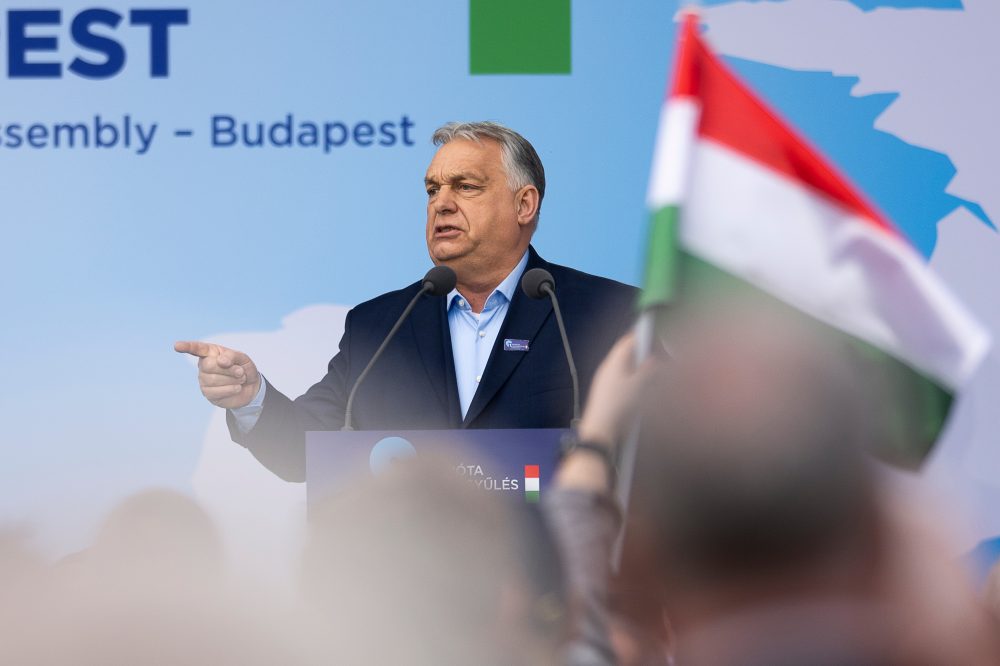

BUDAPEST, Hungary (AP) — The upcoming Hungarian elections scheduled for April 12 could send major ripples throughout the European Union, as numerous officials within the 27-member alliance are hoping to see the end of nationalist Prime Minister Viktor Orbán’s tenure, viewing him as a threat to the bloc’s future stability.
Currently trailing in polling data, Orbán has maintained control for 16 years as the EU’s most tenured leader, challenging the union’s governance framework designed to maintain peace through economic and political cooperation following the devastation of two world wars. His challenger Péter Magyar informed the Associated Press that he would work to restore Hungary’s relationship with the EU should he win the election.
The European Union currently faces massive challenges including the growth of right-wing populist movements, ongoing conflicts in Ukraine and Middle Eastern regions, Russian interference operations, China’s economic expansion, and a White House administration that has disrupted longstanding transatlantic partnerships.
However, Orbán’s blocking tactics have hampered EU responses to these issues. Political experts and lawmakers indicate he has exploited his veto authority and developed an intricate knowledge of how the union distributes member funding to consolidate his authority and wield disproportionate influence by obstructing decision-making processes to secure favorable deals.
“He entered a club, read the rules, figured out how he can rig the rules, and then started to be a free rider and blackmail all of the other club members,” said Dániel Hegedűs, deputy director with the Berlin-based Institute for European Politics. “The question is, how long will the club members tolerate it?”
The relationship wasn’t always contentious. Following the Cold War’s end, Hungary became an EU member alongside nine other nations in 2004 during the bloc’s most significant expansion. There was considerable optimism surrounding Hungary’s membership, according to Jim Townsend, a fellow at the Center for a New American Security.
However, following economic downturns, Orbán gained power by pledging economic prosperity for all social classes, explained Gábor Scheiring, a former Hungarian parliament member currently teaching at Georgetown University in Qatar. He also forged relationships with conservative leaders throughout the union.
Orbán subsequently began attacking the EU, frequently drawing comparisons between Brussels and the Soviet Union, despite receiving substantial EU financial assistance, while resisting demands to halt democratic deterioration.
Between 2014 and 2022, “Hungary was one of the biggest beneficiaries of EU funds,” Scheiring said. “Orbán could navigate the EU system really well: get all the money and get away with his political shenanigans.”
The EU became increasingly frustrated with Orbán’s inability to guarantee judicial independence and press freedom while controlling corruption. The union started withholding billions in funding from Budapest in 2022 due to violations of rule-of-law principles.
Following Russia’s comprehensive invasion of Ukraine in 2022, Orbán repeatedly employed his veto authority to obstruct efforts supporting Kyiv and imposing sanctions on Moscow. His close relationship with Russian President Vladimir Putin drew significant attention.
Last month, when Orbán backed out of a December agreement to provide Ukraine with a 90-billion euro ($104-billion) loan, the typically diplomatic European Council President Antonio Costa displayed visible frustration: “Nobody can blackmail the European Union institutions,” he said.
Many view the EU’s requirement for unanimous agreement on major decisions as a significant weakness. Critics argue this has prevented the bloc from taking stronger positions on other crucial matters like the Gaza conflict.
Internal European Parliament documentation reveals that Orbán has used his veto more frequently than any other leader in EU history, according to German lawmaker Daniel Freund.
“It’s staggering. No one else even comes close,” Freund said. “This is the biggest design flaw in the EU that he has exposed.”
Orbán’s obstructionist tactics have sparked discussions about reforming the union’s founding treaties to protect against future authoritarian leaders — or Orbán himself, should he secure reelection.
Several options exist for addressing this issue, though each comes with constraints.
The EU could decrease the number of matters requiring unanimous approval. This would enable measures to pass with simple majority support from the 27 national leaders representing approximately two-thirds of the bloc’s population.
Hegedűs suggested the European Commission “could play even more hardball” by developing sanctions targeting specific violations of EU regulations.
Some officials have even suggested invoking Article 7 of the EU Treaty, a legal mechanism that could strip Hungary of its voting privileges within the bloc.
Such action would need approval from all other EU leaders, but Slovak Prime Minister Robert Fico has indicated he would block such a proposal.
Additional tools remain available to the EU.
The European Commission has withheld approval for Hungary’s request to access approximately 16 billion euros ($18.4 billion) from an EU program designed to enhance member nations’ defense capabilities. The 18 other countries that submitted funding proposals have received approval.
Should Orbán win reelection, the EU could leverage this funding as negotiating leverage to secure concessions such as removing his veto of the 90 billion euros for Ukraine, Hegedűs suggested. However, there’s no assurance he won’t identify other policies to obstruct once Hungary receives the funds.
“What will the EU offer in two to three or four months when the next strategic decision will come and Orbán will block again?” Hegedűs said.
Orbán’s behavior has triggered a reassessment of how the EU evaluates new member applications and oversees existing members.
Current membership discussions with Moldova, Montenegro and Ukraine are increasingly influenced by the challenging experience with Hungary.
In February, European Commissioner for Enlargement Marta Kos noted that the 12 countries including Hungary that joined the EU from 2004-2007 “led to a new era of stability for our continent and an impressive level of economic convergence.”
Without specifically mentioning Hungary or other nations, Kos stated that a key lesson from 2004 is that “we need to have safeguards that ensure new members stick to the rules.”
“If countries go backwards on our fundamentals, such as democracy and rule of law, the safeguards must bite,” the commissioner said, adding: “No Trojan horses.”