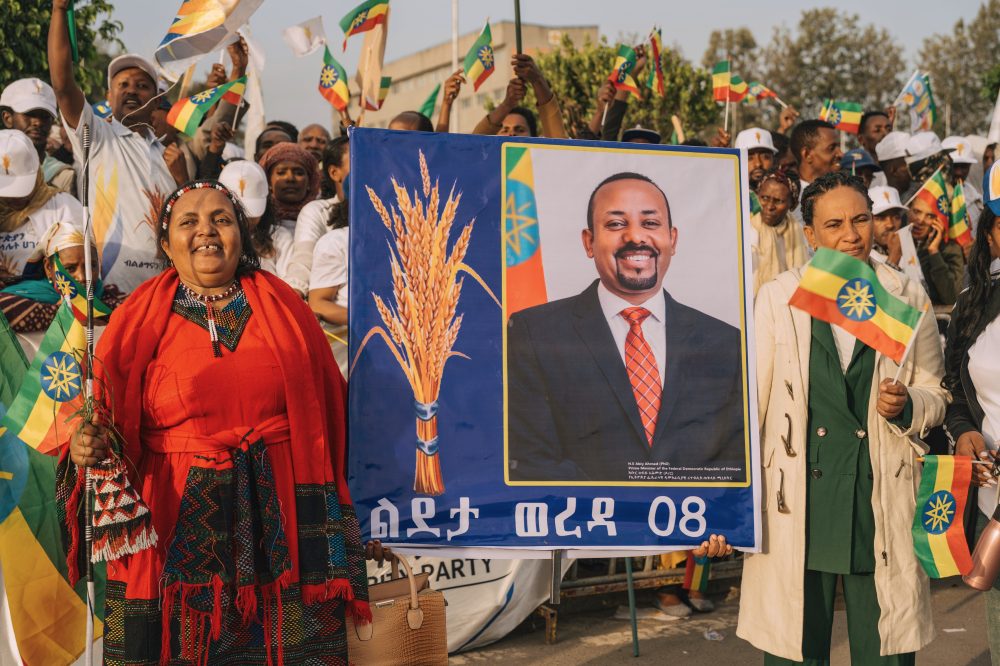

ADDIS ABABA, Ethiopia (AP) — Ethiopian citizens will cast ballots Monday in a national election where the governing party is anticipated to achieve an overwhelming victory amid a divided and weakened opposition landscape.
The Prosperity Party of Prime Minister Abiy Ahmed presently controls over 500 positions in the House of Representatives and is projected to secure a majority in Monday’s voting, guaranteeing him an additional five-year tenure.
Approximately 50 million citizens from Ethiopia’s total population of 130 million are anticipated to participate in selecting House of Representatives members, though safety concerns in heavily populated areas like Amhara and Oromia may impact voter participation.
Under Ethiopia’s electoral framework, citizens choose their representatives, who subsequently select the prime minister. Voters will additionally choose members for their regional government councils.
Key campaign issues this year center on national unity following conflicts in areas including Tigray, Oromia, and Amhara, alongside development promises as officials commit to implementing significant infrastructure initiatives.
Former Kenyan President Uhuru Kenyatta, who previously mediated Tigray peace negotiations, is directing 73 African Union election monitors.
Upon his Saturday arrival in Ethiopia, Kenyatta stressed the continental significance of Ethiopia’s electoral process, given the nation serves as home to African Union headquarters. “Ours is to call for peaceful situation as Ethiopians are known for,” he said.
Critics have charged Abiy’s government with human rights abuses targeting opposition voices and media professionals, contradicting his 2020 commitments to democratic governance and peace.
His leadership period has included the northern Tigray conflict, resulting in hundreds of thousands of deaths when federal military forces battled regional troops. Peace accords were finalized in November 2022.
Abiy received the Nobel Peace Prize in 2019 for resolving Ethiopia’s prolonged dispute with neighboring Eritrea, though relations between the nations have deteriorated, with Addis Ababa claiming Asmara backs insurgent organizations seeking to undermine stability.
Concerns exist that tensions could intensify and pull the unstable Tigray area into a surrogate conflict, while humanitarian organizations highlight critical conditions in the region.
The Tigray People’s Liberation Front — the leading political organization in Ethiopia’s northernmost Tigray territory — has been banned while maintaining regional authority and threatening to abandon the 2022 peace deal, which federal officials view as an effort to restart hostilities.
For a second consecutive election cycle, the territory will remain absent from national voting, eliminating its federal representation in Ethiopia’s 547-member parliament and further marginalizing the region amid worsening hunger and violence, plus alleged resource restrictions by central authorities.
Tigray has lacked federal parliamentary representation for six years running.
Political analyst Bayu Samuel, based in Addis Ababa, believes this election will likely be conducted fairly due to “technological advancements in the electoral process” and heightened public engagement.
Nevertheless, several opposition groups have criticized the governing party’s unfair electoral benefits.
Mistresilasie Tamerat, the youngest candidate and leader of the opposition Ethiopian People’s Revolutionary Party, describes the electoral process as “far from genuine and democratic.”
“The system favors the ruling party, and we can’t even freely operate (or) meet with our constituents,” she said.
Eyoel Solomon, a spokesperson for the main opposition Ezema party, stated his organization aims to eliminate identity-based political divisions.
“We have seen citizens being attacked because of their identity. We have seen them being persecuted simply for living in areas deemed by others not to be ‘theirs’,” he said.
While most campaign activities occurred in Addis Ababa, the capital has experienced significant military deployment in recent days.
Electoral discussions have dominated local discourse throughout the city, despite unusually subdued campaigning featuring fewer public gatherings and minimal community outreach efforts.
Election officials have designated Monday as a national holiday, shutting government facilities to promote voter participation.