
When Moira Cathleen Delaney learned she had an aggressive intestinal cancer, she began planning how she wanted her body handled after death. Her passion for gardening, wildlife, and forests led her to choose natural organic reduction, a process that transforms human remains into soil.
Following her death in October at 57 years old, Delaney’s family scattered portions of her transformed remains beneath her beloved backyard tree and distributed other portions in glass containers to close friends and family members for planting.
“For her, it was a very comforting thought to be able to return to the earth in that kind of way, and to have her final physical act contributing to the life process,” said Marcos Moliné, her son.
Research conducted for the National Funeral Directors Association shows growing interest in environmentally conscious body disposal methods. Experts and researchers note that people are increasingly concerned about how traditional death practices like embalming, fire cremation, and vault burials impact climate, environment, and human health. Many also desire their final resting place to be in natural outdoor settings they treasured.
“How we die does lead to a substantial impact on not only the people around us and our communities, but the earth itself,” said Mark Shelvock, a psychotherapist and lecturer at Western University in Canada, who co-wrote a paper on green death practices.
Available options differ depending on location and local regulations. Traditional practices carry significant environmental costs.
The embalming process uses known cancer-causing chemicals like formaldehyde, which are injected into veins to preserve bodies for viewing. While the Environmental Protection Agency has labeled formaldehyde gas an “unreasonable risk” to public health, studies suggest minimal likelihood of soil and groundwater contamination.
Fire cremation, chosen by nearly two-thirds of respondents in funeral association surveys, typically relies on fossil fuel energy. The Cremation Association of North America calculates that a standard cremation uses energy equivalent to powering a 2,000-square-foot home for one week.
Casket and vault production requires substantial resources, involving wood harvesting, mining, and energy-intensive manufacturing. Concrete production alone accounts for approximately 8% of global carbon dioxide emissions and 2% in the United States.
Traditional cemeteries demand ongoing maintenance including mowing, watering, and fertilizing, requiring continuous energy and resource consumption.
“There’s all of this management that goes into conventional cemeteries that looks very much like a golf course,” said Samuel Perry, a funeral director and president of the Green Burial Council, a global nonprofit that guides green burial standards and certification.
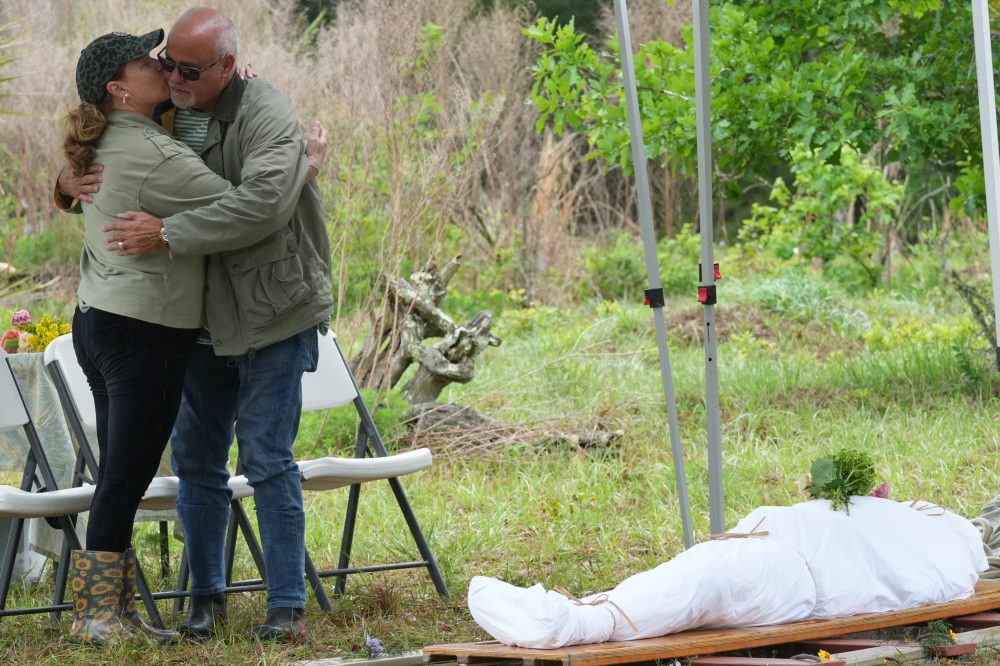
Prairie Creek Conservation Cemetery in Florida combines natural burials with land preservation efforts. Workers dig graves manually, and bodies must be placed in biodegradable caskets or shrouds made from materials like bamboo or cotton. The facility prohibits embalmed bodies and vaults, requiring cremated remains to be stored in chemical-free, biodegradable urns.
The approach emphasizes natural decomposition processes.
Scott King initially doubted his mother Linda’s wish for this burial method, but research convinced him of its elegant simplicity. Linda was interred in a Prairie Creek meadow last October, and recently, King buried his brother Kenneth nearby.
“Through death, life begets life,” said King. “She really liked that idea, too, that she can, in her passing, help give life to something else. That was very important to her. My brother, I think, sort of went along with the ride.”
The cemetery collaborates with a land trust to manage, restore, and protect property from development. Staff remove invasive plant species, introduce native vegetation, and conduct controlled burns.
Executive director Heather Grove explains the benefits extend beyond burial practices. The area now supports increased biodiversity and wildlife populations, and “if you want talk about carbon capturing and all that, conservation is key to sequester,” she said.
Green Burial Council data indicates that eco-friendly burials sequester approximately 25 pounds of carbon.
Elena Slominski, a researcher studying environmentally conscious disposal methods, describes conservation burial as “by far the best thing you can do because it’s actually, technically a carbon sink. It actually restores ecological habitat and protects the land.”
However, this option faces limitations in areas where space is scarce, and critics argue it’s impractical due to land requirements.
Earth Funeral specializes in natural organic reduction, sometimes called terramation or human composting. Bodies remain in sealed containers for 30 to 45 days alongside mulch, wood chips, and flowers. Microorganisms break down remains into soil through natural processes that generate heat reaching 131°F or higher, sufficient to eliminate pathogens.
“What we are fundamentally doing is using science and technology to accelerate a completely natural process” using renewable energy sources, said Tom Harries, the company’s co-founder and CEO. Families receive portions of the resulting soil, while remaining amounts go to conservation or reforestation projects.
Fourteen states currently permit this process, with 15 others considering legislation to legalize it, according to Earth Funeral. Experts recommend this option for urban residents facing limited and expensive burial space.
Alkaline hydrolysis also aims to accelerate natural decomposition. Colorado-based water cremation company Be a Tree places bodies in vessels containing 95% water and 5% potassium hydroxide, then heats the mixture to approximately 200°F for about 18 hours.
Remaining skeletal material is air-dried, processed, and returned to families as powder in urns or formed into stone shapes. Most families use some liquid for houseplants or gardens, while the majority goes to land conservation partners as fertilizer, said founder and CEO Emily Nelson. Other companies discharge remaining liquid with regular wastewater.
This method consumes roughly 90% less energy than fire cremation.
Perry from the Green Burial Council addresses frequent questions about whether post-death disposal choices significantly impact individual environmental footprints.
“The quick and dirty answer is no, I don’t think this one thing is going to change a whole lot. But it’s always about changing industries. And as an industry, if we do better, we are making a bigger impact.”