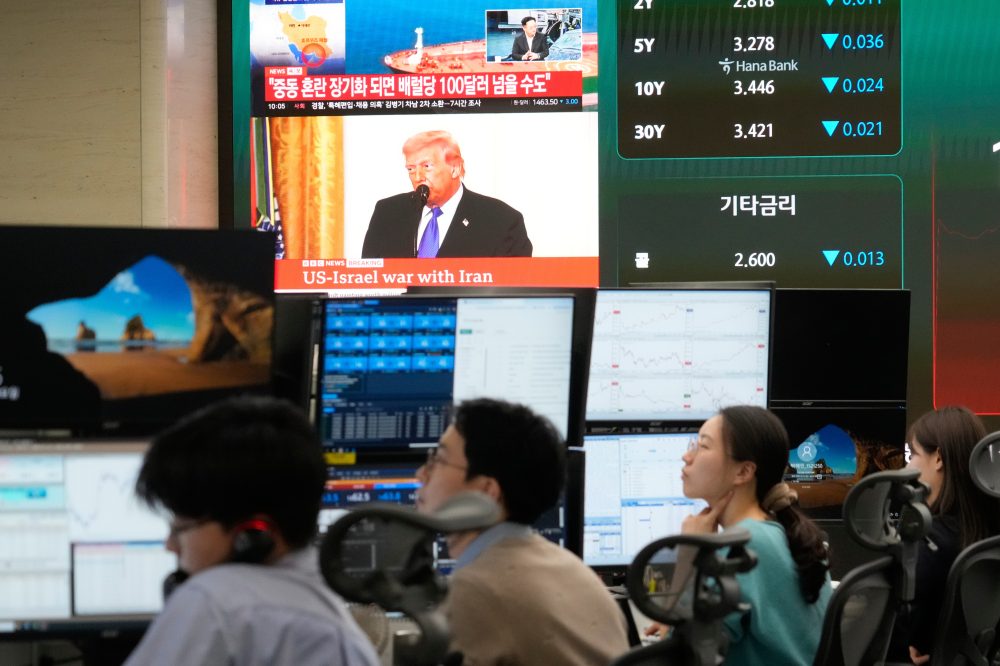

TOKYO — Stock markets throughout Asia experienced significant declines Tuesday while crude oil prices jumped dramatically as financial markets reacted to concerns over potential energy supply disruptions stemming from the conflict involving Iran.
South Korean markets took the biggest hit, plummeting 4.8% to close at 5,946.06 as trading resumed following Monday’s holiday closure.
Energy prices saw substantial increases, with U.S. benchmark crude climbing 77 cents to reach $72.00 per barrel. International Brent crude gained $1.10, settling at $78.84 per barrel. Both oil benchmarks had spiked Monday before retreating, though they remain elevated from pre-conflict levels due to concerns the fighting could disrupt global petroleum distribution networks.
Tokyo’s Nikkei 225 index dropped 2.1% to finish at 56,853.48. Japan faces particular vulnerability to energy supply disruptions since the resource-limited nation relies heavily on oil and natural gas shipments passing through the Strait of Hormuz.
Market analysts note that Japan maintains substantial energy reserves exceeding 200 days of supply, meaning any supply threat wouldn’t create immediate shortages.
Japanese energy companies saw sharp declines, with Eneos Corp. falling nearly 6% and Idemitsu Kosan dropping almost 4%. Defense contractors, which had recently gained on expectations of increased military spending under Prime Minister Sanae Takaichi, retreated as investors took profits from earlier gains. Mitsubishi Heavy dropped 5%, while IHI declined 4%.
Other regional markets also posted losses, with Australia’s S&P/ASX 200 falling 1.2% to 9,089.50. Hong Kong’s Hang Seng index slipped 0.1% to 26,038.29, and Shanghai’s Composite index decreased 0.3% to 4,170.63.
Aviation stocks suffered particularly steep losses following Monday’s airline sector decline on Wall Street. Rising fuel costs threaten carriers already facing substantial operational expenses, while Middle Eastern airport closures have stranded passengers. Japan’s ANA fell 2.4%, Japan Airlines dropped 5.2%, Korean Air declined 8.9%, and Qantas Airways lost 2.9%.
Despite the volatility, market responses to the conflict have remained relatively contained. Historical data shows previous Middle Eastern military actions haven’t triggered prolonged U.S. market declines. Morgan Stanley strategists, led by Michael Wilson, suggest oil would likely need to exceed $100 per barrel to cause significant, sustained damage to American equities.
“Since 2000, there have been 22 one-day oil price spikes of more than 10 percent,” said Stephen Innes, managing partner at SPI Asset Management. “In other words, energy shocks do not automatically derail equities unless they are severe and sustained. The market is well aware of that playbook.”
Monday’s U.S. trading session saw the S&P 500 initially fall 1.2% before recovering to post a minimal gain of less than 0.1%, closing at 6,881.62. The Dow Jones Industrial Average edged down 0.1% to 48,904.78, while the Nasdaq composite advanced 0.4% to 22,748.86. All major indices recovered from steep morning losses.
Gold prices rose 1.2% as investors sought safer assets amid ongoing diplomatic efforts to contain the conflict’s duration and scope.
U.S. energy companies benefited from higher crude prices, with Exxon Mobil gaining 1.1% and Marathon Petroleum surging 5.9%. Defense contractors also posted strong gains, including Northrop Grumman up 5.9%, RTX climbing 4.7%, and Palantir Technologies jumping 5.8%. Major technology stocks contributed to market recovery, with Nvidia rising 2.9% and providing the strongest individual boost to S&P 500 performance.
Bond markets saw the 10-year Treasury yield increase to 4.04% from Friday’s 3.97% close. A manufacturing growth report exceeding economist expectations also supported higher yields.
Currency markets showed the dollar weakening to 157.32 Japanese yen from 157.47 yen, while the euro gained slightly to $1.1693 from $1.1690.