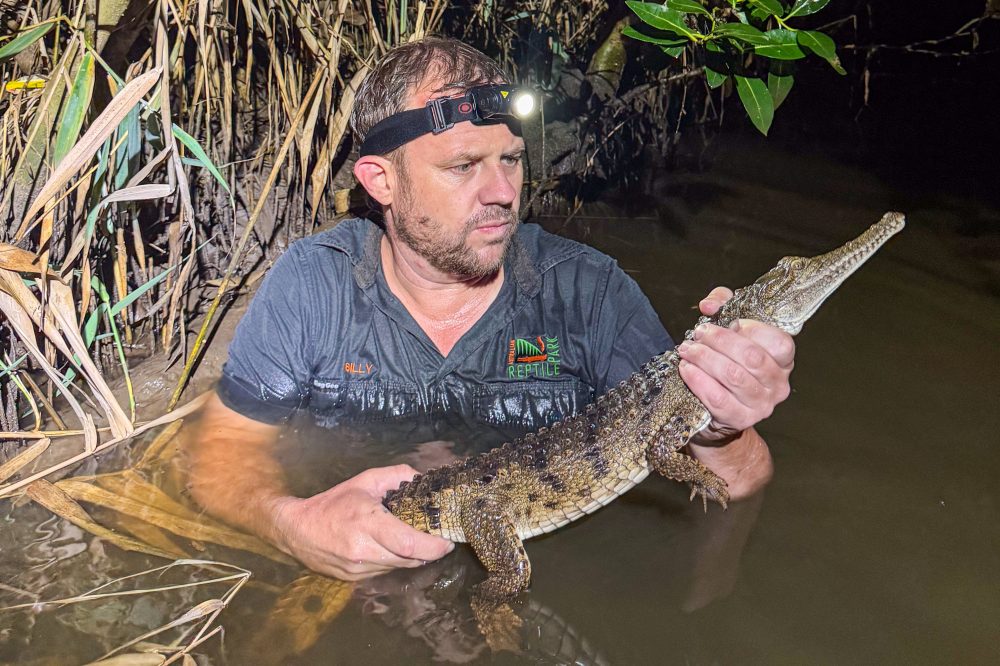

MELBOURNE, Australia (AP) — When 12-year-old Lionel Saunders called his mother to report seeing a crocodile in their neighborhood creek, Stephanie Kirsop thought he was pulling her leg.
The Newcastle family lives in a temperate coastal region located 2,000 kilometers (1,200 miles) away from where crocodiles naturally inhabit Australia’s tropical northern areas.
Young Lionel and his companions discovered the 39-inch juvenile reptile on Saturday afternoon in the local waterway. While officials were initially doubtful about the sighting, they managed to capture the wandering crocodile by Sunday evening.
“My son took videos because he was trying to convince me it was real and I didn’t believe him. It did look like a crocodile but I was like, no it’s a log,” Kirsop explained on Tuesday.
“He rang me back a little bit later and he’s like: ‘I’m so serious mom. You have to come down here and have a look,’” she recalled. “The whole drive down there I’m thinking this is going to be a trick. They’re going to laugh at me.”
When Kirsop arrived at the scene, there was no mistaking what she saw.
“There is a little crocodile just swimming around in the creek where local kids go to fish and sometimes kids swim in there. Wow,” she said.
After contacting a wildlife rescue organization, Kirsop was told crocodiles weren’t found in their region. She provided photographic and video evidence to prove otherwise.
The case was then forwarded to the Australian Reptile Park, a facility that houses crocodiles in climate-controlled conditions.
Billy Collett, the park’s manager, initially wondered if the images might be digitally created fakes. However, police verification confirmed a genuine crocodile was indeed present in Ironbark Creek.
“I was a bit suspicious because we get a lot of phone calls. These days with AI, it’s just so crazy,” Collett explained.
Upon examination, Collett identified the animal as an Australian freshwater crocodile, scientifically known as crocodylus johnstoni. This species is smaller and poses less threat than saltwater crocodiles.
“They’re capable of inflicting a serious injury,” Collett noted regarding the smaller variety.
Collett’s rescue team successfully captured the reptile on Sunday evening, approximately 3 kilometers (2 miles) from its original location.
“I just wanted to get him out of there because he would’ve perished in winter,” Collett stated. The Southern Hemisphere is currently experiencing autumn weather.
The healthy crocodile will remain at the reptile park while officials determine its permanent placement, as crocodiles receive protection under Australian wildlife laws.
Collett believes the animal was likely an escaped or abandoned pet that had outgrown its aquarium home or become too hazardous for private ownership.