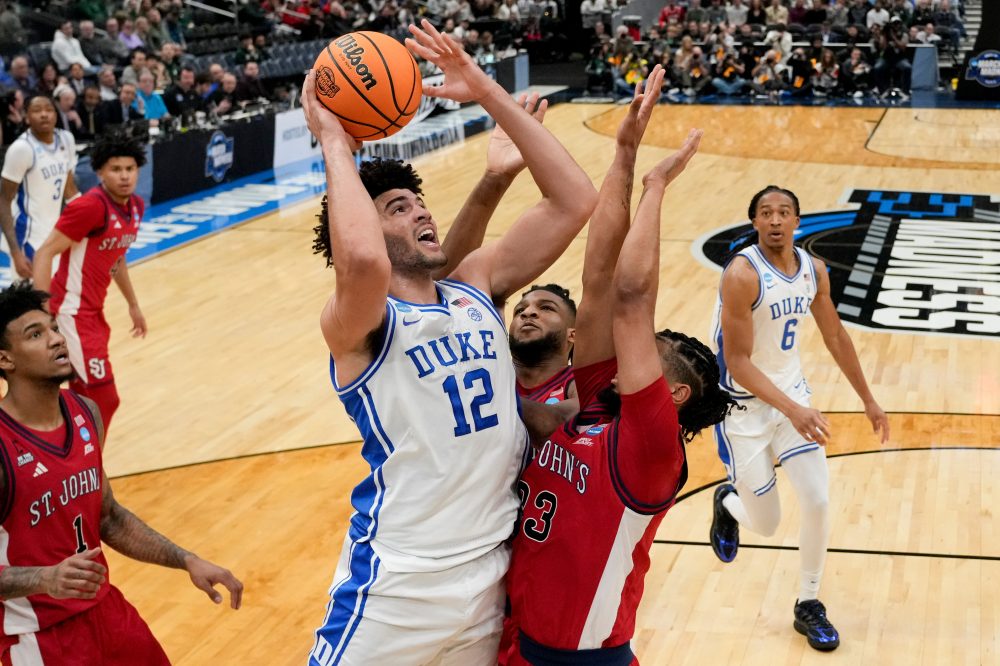

Duke University’s Cameron Boozer served as the cornerstone of his team’s success throughout this basketball season.
The towering 6-foot-9, 250-pound freshman forward displayed the physical strength to battle through contact while scoring. He possessed the versatility to stretch defenses with his outside shooting ability and demonstrated exceptional court vision when distributing the basketball, whether facing constant defensive pressure as the primary target on opposing teams’ game plans or orchestrating plays from the perimeter.
“You just want to affect winning in whatever way you can,” Boozer said.
The promising NBA draft prospect accomplished exactly that during a campaign in which his squad captured 35 victories, achieved the number one ranking in the Associated Press Top 25 poll, secured the top overall seeding for the NCAA Tournament, and advanced to the Elite Eight round. His efforts have now earned him recognition as The Associated Press men’s college basketball national player of the year, making him just the fifth first-year student to claim this distinction and the second consecutive Duke player to receive the award, extending the Blue Devils’ record as the program with the most winners.
“It just goes to show more about what our team has done, just because I think that really helps awards like this, having great team success,” Boozer told the AP. “It’s really just not me.”
Boozer, who earned unanimous first-team AP All-American recognition last month, captured 59 of 61 votes from AP Top 25 poll participants in Friday’s announcement. BYU freshman AJ Dybantsa, another projected high NBA draft selection, collected the remaining two votes following his nation-leading 25.5 points per game average.
The son of former Duke and NBA veteran Carlos Boozer posted averages of 22.5 points (ranking ninth nationally in Division I) and 10.2 rebounds (12th nationally) while sharing the national lead with 22 double-double performances. He also contributed 4.1 assists per contest while maintaining impressive shooting percentages of 55.6% from the field and 39.1% from three-point territory.
He becomes part of an exclusive group of freshman AP award recipients alongside last year’s Duke standout Cooper Flagg, former Blue Devil Zion Williamson (2019), Kentucky’s Anthony Davis (2012), and Texas star Kevin Durant (2007). Each of these players was selected first or second overall in their respective NBA drafts.
“I’m very grateful just that I’m even in those (NBA) conversations,” Boozer said. “I think a lot of people dream of being where I am. Sometimes you’ve got to take a step back and just remember that once upon a time, you were a kid dreaming to be here. So I think it’s very special.”
His coaching staff shares that sentiment about his abilities.
“We’ve been fortunate enough the last two years to have two of the best freshmen to ever play in college basketball back to back,” Duke associate head coach and former Blue Devils player Chris Carrawell said. “And Cam is right up there.”
Boozer represents Duke’s ninth AP winner, with each honor going to a different individual. UCLA ranks second with five recipients, though that total includes multiple awards for Kareem Abdul-Jabbar (1967 and 1969) and Bill Walton (1972 and 1973). UCLA, Ohio State, and Duke’s conference rival North Carolina are the only other institutions with three or more different players earning the recognition.
Boozer joined Duke alongside his twin brother Cayden after the pair guided Miami’s Columbus High School to four consecutive state championships. By late February, the Blue Devils had begun a four-week stretch at the top of the AP Top 25 rankings that extended into March Madness. Boozer — who describes winning as a learnable skill — consistently delivered his finest performances during Duke’s most significant contests, including throughout a challenging non-conference schedule.
He tied his season-high with 35 points during a November victory over Arkansas. He followed that effort with 29 points against defending national champion Florida. Additional standout performances included an 18-point, 15-rebound showing at Michigan State and a near triple-double (18 points, 10 rebounds, seven assists) in February’s triumph over Michigan.
Throughout the season, he persevered through physical confrontations and contact. He concluded Sunday’s season-ending defeat to UConn with 27 points despite playing with a swollen right eye from a first-half injury.
“There’s no agenda other than figuring out a way to win,” Wolverines coach Dusty May said. “I’ve seen him play a number of times this year where there’s six guys in the paint, and it’s not as if he’s jumping 40, 50 inches off the floor. His desire to rebound the ball, to set physical screens, to play to his advantages, is as impressive as any freshman that I can recall.”
Another obstacle involved handling the intense attention that accompanies expectations of excellence. Every errant shot, turnover, and difficult performance — like his 3-for-17 shooting struggle against Virginia shot-blocker Ugonna Onyenso in the ACC championship game while battling mounting frustration.
“He does a great job of flushing it and not letting it dwell on him too much,” Cayden said. “That’s something he’s always been able to do since we were younger. Obviously I talk to him when he needs me to. And I sometimes just understood that, hey, he’s going through something, give him some space for a little bit and he’ll figure it out.”
Cameron explained that finding solitude and stepping away from social media helps him cope. He credits prayer and a recent commitment to reading more books as beneficial practices.
Otherwise, he dedicates himself to continuous improvement as a player. He finds comfort in that consistent approach, as the results have consistently validated his efforts.
“I think just being prepared alleviates pressure,” Cameron said. “Being ready for a game, watching film, working out, knowing you put your time in, being confident in yourself — I think all that takes away a lot of the pressure that people talk about. At the end of the day, pressure really is what you put on yourself.”