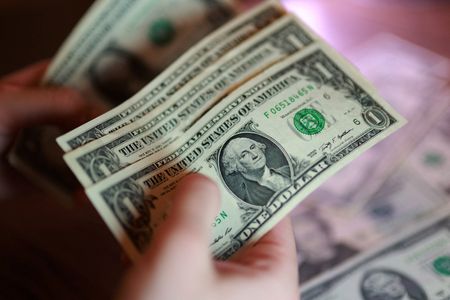

Despite the U.S. dollar’s recent surge, most foreign exchange analysts still believe the greenback will lose ground in the months ahead — though a growing number of experts are pushing back on that view, according to a new Reuters poll.
A brief easing of U.S.-Israeli military tensions with Iran gave the dollar a boost of around 4% from its low point in May, sending crude oil prices back to pre-conflict levels. At the same time, long-dollar bets climbed to their highest point since January 2025, according to data from the Commodity Futures Trading Commission.
The dollar has found additional support from persistently high U.S. inflation, a sturdy economy, elevated Treasury yields, and a June revelation that nearly half of Federal Reserve policymakers anticipate interest rate increases this year. Interest rate futures are currently pricing in close to two rate hikes before the end of 2025.
Yet analysts surveyed between June 26 and July 1 held firm to their longstanding prediction that the dollar will ultimately weaken. Poll median forecasts showed the euro climbing 2% to $1.16 by late September, reaching $1.17 by year-end, and hitting $1.18 within a year.
Jane Foley, head of FX strategy at Rabobank, offered one reason why: “There’s the possibility the Fed could end up cutting interest rates in 2027, so we’re more dovish than the market on the Fed. Those hikes getting priced out would weigh against the dollar,” she said, adding that she expects a choppy trading range in the near term.
Still, the poll revealed a notable split among forecasters. A strong 71% majority — 29 of 41 respondents — said current net-long dollar positions would hold or grow by the end of July. None of those surveyed expected a shift to net-short positioning.
Additionally, about one-third of strategists — 23 of 70 — predicted the euro-dollar rate would remain flat or even dip over the next three months, up from roughly 20% in June’s survey.
Bank of America FX strategist Alex Cohen said his team had recently revised its outlook upward. “We recently revised up our forecast to see additional dollar appreciation at least until the third quarter,” he said, noting he expects three Fed rate hikes this year.
Cohen also pointed to comments from Fed Chair Kevin Warsh as a key driver: “The way Warsh articulated things on the inflation front was a clear bullish-dollar signal in our view…and the data supports that. We’re looking for a much more hawkish outcome from the Fed relative to many other G10 central banks.”
The European Central Bank, which raised rates in June, is expected to hike only one more time this year.
Citibank’s head of G10 FX strategy, Dan Tobon, echoed a cautious tone, warning the euro could fall as low as $1.11 in the coming months — more than 4% below the poll’s median forecast.
“It’s not our base case we’re going to have this big inflationary wave…but if we get some upside surprises in the data, we’re likely to see even more hawkish repricing to a higher dollar. Whereas if the data misses, it’s not necessarily going to quickly unwind all the hawkishness priced in,” Tobon said.
On the other side of the globe, the Japanese yen has taken a significant hit from dollar strength, falling to a 40-year low earlier this week before weakening further to near 163 yen per dollar — a level that analysts say raises the likelihood of official government intervention.
Despite that pressure, poll respondents maintained their expectation for a gradual yen recovery over the next year, betting that elevated inflation will push the Bank of Japan to follow its recent rate hike with additional tightening measures. Median forecasts showed the yen strengthening to around 159 per dollar by late September, 156 by year-end, and 154 in a year’s time.