
A groundbreaking genetic study has overturned long-held assumptions about what transpired following the collapse of the Western Roman Empire in 476 AD, when Germanic leader Odoacer overthrew the young Emperor Romulus Augustulus in Italy, triggering the breakdown of centralized power across much of Europe.
Scientists analyzing DNA from ancient burial sites in what is now southern Germany have discovered how these monumental political upheavals impacted everyday citizens, while challenging the widespread belief in violent “barbarian invasions” that supposedly swept across the former empire’s territories.
The research revealed that once imperial marriage laws were no longer enforced, Roman garrison troops and city dwellers quickly began intermarrying with lower-status residents, including people of Northern European heritage.
“The temporal alignment between the fall of the Western Roman Empire in Italy and the genetic shift we detect in southern Germany is remarkably precise,” explained Joachim Burger, an anthropologist and population geneticist at Johannes Gutenberg University Mainz in Germany who served as the study’s senior author. The findings were published Wednesday in the journal Nature.
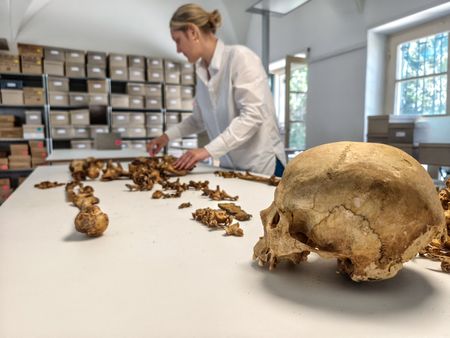
Scientists examined genetic material from 258 individuals buried in distinctive row-style graves across present-day Bavaria and Hesse, with 112 of these remains discovered at the Bavarian village of Altheim. The majority of burials occurred between 450 and 620 AD.
“Row grave cemeteries were a newly emerging early-medieval burial practice where individuals were buried in rows, often containing grave goods like clothing, jewelry and weapons. These cemeteries stretched across the former Roman frontier from the Netherlands to Hungary,” stated Jens Blöcher, a population geneticist at Johannes Gutenberg University Mainz who led the study.
Roman forces had constructed military installations along the German frontier to defend against attacks and civil unrest, with some of these outposts growing into substantial communities and eventually major cities. Mainz, Regensburg, Trier and Cologne all developed near the burial locations examined in this research.
The genetic evidence documented a significant population change that coincided with the late fifth-century breakdown of Roman governmental systems. Data showed that Northern Europeans had already begun migrating south into the region in small numbers during the empire’s lengthy decline, living apart from the established Roman communities, likely working as farm laborers. During this period, outsiders could receive land grants under specific conditions, including restrictions on marrying Romans.
“They have lived there for generations, marrying almost exclusively within their own group – preserving their northern genetic heritage,” Burger noted.
The Roman military and civilian populations displayed significant genetic diversity, including people with ancestral roots from throughout the empire. These groups were genetically different from the outsiders gradually arriving from Northern Europe, including areas as far away as Britain, as well as from the Balkans and even Asia.
The genetic data showed intermarriage between these two populations following the empire’s end and a peaceful blending of peoples that ultimately created a new early-medieval society.
“While we do detect north-to-south movement of people across the former imperial frontier, the majority of this migration occurred generations before the pivotal horizon” of the empire’s collapse, Burger explained, noting the movement began in the third and fourth centuries.
“Crucially, this influx was not driven by large, ethnically homogeneous tribal blocs or major clans, but rather by small kinship groups and even isolated individuals. This pattern directly contradicts the traditional narrative of a ‘mass barbarian invasion’ following Rome’s collapse,” Burger added.
Well before Romulus Augustulus was removed from power, the vast Roman Empire had been split into eastern and western sections. While the Western Roman Empire crumbled after an extended period of chaos and military defeats, the Eastern Roman Empire, later known as the Byzantine Empire, remained centered in Constantinople – modern-day Istanbul – and continued to flourish.
The genetic information also revealed demographic details about the studied population, showing life expectancies of approximately 40 years for women and 43 years for men, along with high infant death rates in a society where nearly 25 percent of children lost at least one parent by age 10.
Christianity had already become established as the official Roman religion. The genetic data indicated families followed monogamous nuclear structures, widows did not remarry within their deceased husband’s family, and there was strict prevention of marriages between close relatives like cousins.
“All these traits reflect Christian norms from Late Antiquity,” Burger observed.
The evidence suggests additional Northern Europeans continued arriving in the region during the centuries following the empire’s fall, with a new genetic pattern developing by approximately the seventh century – “one that closely resembles the genetic profile we observe today in central Europe,” according to Burger.