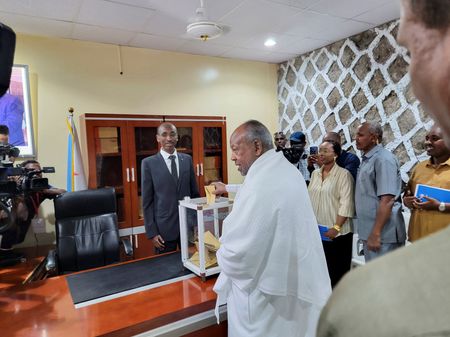

The long-serving leader of Djibouti has secured another presidential term after claiming nearly 98% of votes cast in Friday’s election, according to state-controlled television reports.
Ismael Omar Guelleh, age 78, captured 97.8% of ballots to win his sixth consecutive term leading the strategically important East African nation, state-owned Radio Television Djibouti announced Saturday. His victory extends a political dynasty that began 27 years ago.
Following the results, Guelleh shared a post on X featuring his photo alongside the French term “RÉÉLU,” meaning “re-elected.”
The outcome was widely anticipated for the veteran politician, who assumed power in 1999 after being chosen by his predecessor and uncle, Hassan Gouled Aptidon. Guelleh’s political party maintains control over the nation’s governing institutions.
Recent legislative changes cleared potential obstacles to his continued leadership. Last October, lawmakers eliminated the 75-year age restriction for presidential hopefuls and removed the requirement for a public referendum on constitutional modifications.
Opposition to Guelleh’s candidacy proved minimal during Friday’s voting. His sole challenger was Mohamed Farah Samatar, representing a minor political organization without parliamentary seats.
The country’s primary opposition groups have refused to participate in elections since 2016, claiming electoral officials demonstrate bias and lack independence.
Official statistics indicated 80.4% of eligible voters participated in the election. During the previous 2021 contest, Guelleh similarly dominated with more than 97% support.
The nation of fewer than one million residents occupies a crucial position along the Gulf of Aden near the Red Sea entrance. Multiple countries including the United States, China, France, Italy and Japan maintain military installations there. Since 2023, various commercial vessels damaged by Houthi militant attacks from Yemen have sought refuge in Djiboutian ports.
Compared to neighboring Horn of Africa countries, Djibouti has maintained relative political stability in recent years. Guelleh’s administration has prioritized major port development projects, positioning the country as the primary trade route for landlocked Ethiopia.
However, international human rights organizations have criticized Djiboutian officials for suppressing political opposition figures, activists and media personnel. Government representatives have rejected accusations of systematic abuse and dismissed critiques of their electoral procedures.
In 2020, security personnel suppressed uncommon street demonstrations that erupted following the detention of a former military pilot who had publicly criticized alleged government corruption and ethnic favoritism.