
Democratic Party leadership, struggling to remain competitive in conservative states where their political brand faces challenges, are trying an unconventional approach this election cycle: supporting candidates who aren’t Democrats.
Across states including Nebraska, Idaho and Alaska, Democratic officials are looking beyond their own party’s nominees while quietly encouraging — and sometimes openly endorsing — independent candidates they believe can perform better than those carrying the Democratic label. The Democratic National Committee and Washington allies are quietly backing this new approach.
Some of these independent candidates are coordinating through group messaging as they work on strategies that could disrupt Congress, which remains stuck in partisan deadlock.
Nebraska Democrats this week selected a nominee for U.S. Senate, Cindy Burbank, who stated that a key campaign goal was ensuring no Democrat would appear on the November ballot to split votes away from independent Dan Osborn. After voting ended, Burbank confirmed her intention to withdraw in the coming weeks during a private discussion with a party official, according to state Democratic chair Jane Kleeb.
Democratic leadership believes Osborn, who lost by just 7 points in his 2024 Senate race, represents the strongest opportunity to unseat Republican Sen. Pete Ricketts.
The Democratic shift toward independents represents a deliberate strategy in certain areas — and a more subtle understanding elsewhere — spanning multiple high-profile Senate and House races plus statehouse competitions. Independent Senate candidates are also campaigning in states like Idaho, South Dakota and Montana, where Democratic leadership has been reluctant to fully endorse the independents, though many consider them the party’s best option to block Republicans this election season.
“For some states, and Nebraska is one of them, where Democrats are 32% of the electorate, this is a long-term strategy for us,” said Kleeb, who also serves as a vice chair to the Democratic National Committee.
Kleeb explained her state party is supporting independents in at least four state legislative races beyond the U.S. Senate: “We have to build a coalition with independents in order to win elections so we can do good work for the people. Period.”
Parts of the Democratic Party’s national political infrastructure appear supportive.
The Democrats’ fundraising platform, ActBlue, works with some of the independent candidates, along with popular Democratic-allied website builders. Meanwhile, some of the party’s campaign committees in Washington quietly offer logistical assistance in certain cases, while avoiding public attacks on the independent candidates even in races where a Democratic nominee exists.
“The Democratic Party’s brand is awful right now,” said Democratic strategist Josh Schwerin. “The combination of the brand problem and the existential nature of the threat that our country is facing requires us to have a big tent and look for candidates who can win.”
Some Democratic donors, strategists and party leaders from other states have privately objected, arguing Democrats should not abandon their own nominees for short-term political advantages. They want Democratic officials, both in Washington and locally in conservative states, to work harder to improve the Democratic brand’s appeal — even if becoming competitive takes several more years.
“What’s the independent going to do for the Democratic Party if they win?” asked Democratic strategist Mike Ceraso, who views the shift toward independents as an effort to disguise Democrats in some instances. “We’re the party of truth and honesty and integrity, but we’re playing these stupid political games?”
Additionally, there’s no assurance that independent candidates, if elected, would back all Democratic policy priorities or even Democratic leadership in Congress.
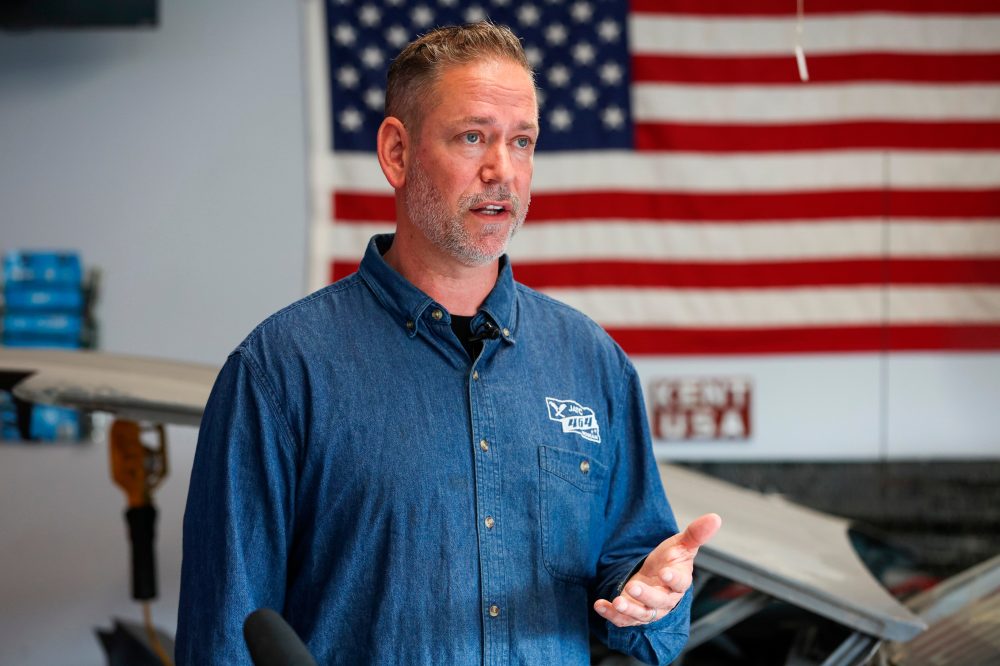
In Idaho, independent Senate candidate Todd Achilles, an Army veteran and former Democratic state legislator, said he won’t be caucusing with either party if elected. He described his politics as “straight down the middle,” and said he believes in individual liberties.
“Idahoans should be able to live how they want,” he said. But the Democratic Party was a bad fit because it “has given up on little red states like Idaho.”
Among his criticisms of Democrats is that the party made a significant error by initially running Joe Biden again for president in 2024. However, he also said “the shine is coming off” the former president, whom Idaho voters supported by 36 points in 2024.
Achilles said he and other military veterans running for Senate as independents communicate in the text chain and are “very much on the same page.” He says the group wants to establish “guardrails,” including term and age limits and campaign finance reform.
“The priority is to get Congress functioning again,” he said. “We gotta break the grip of the two-party system.”
In South Dakota, Navy and Air Force veteran Brian Bengs has started an independent campaign to defeat Republican incumbent Sen. Mike Rounds, who’s seeking a third term this fall.
Bengs campaigned as a Democrat against Senate Majority Leader John Thune four years ago and lost by 43 points.
A lifelong independent, he said he was rejected by the party this time when he requested to run with its organizational support but without the label. Nevertheless, he maintains he can win without the party’s formal endorsement.
One important lesson from his 2022 campaign, he says, was how difficult it was to connect with voters while carrying the Democratic Party label.
Voters would immediately ask, “What are you?” he recalled.
“When you say, ‘I’m a lifelong independent running as a Democrat,’” Bengs said, the response was swift. “‘I’ll never vote for a Democrat.’ And that was it,” he said.
“So that takeaway soured me on running again in any party system, because it was just a soul-sucking experience.”
In Alaska, some Democrats believe that commercial fisherman Bill Hill, a retired school superintendent, may represent their strongest chance at defeating first-term Republican Rep. Nick Begich for the state’s only House seat.
Hill, a lifelong independent, raised more than $780,000 in the first three months of the year, surpassing Democrat Matt Schultz, a pastor, who raised $578,000.
The state Democratic Party chose not to endorse Schultz at its recent convention, which Hill also attended. The House Democrats’ campaign committee in Washington has also declined so far to promote Schultz’s candidacy. Hill, meanwhile, is collecting local union endorsements.
Hill’s message to voters, he said, is the same for Republicans, Democrats and independents: “You need to be pragmatic about who you choose to support in this election cycle, because at the end of the day, we need a change in the House seat in Alaska.”
A spokeswoman for the National Republican Senatorial Committee criticized independents like Osborn, Bengs, Achilles and Seth Bodnar, who is running in Montana, as “fake Independents who would push liberal Democratic policies in the Senate.”
Currently, there are two independents in the Senate: Maine Sen. Angus King and Vermont Sen. Bernie Sanders. Both caucus with Democrats.
In an interview, Hill said he’s unlikely to caucus with Republicans in Washington if elected, but he’s not committing to joining Democrats either. He was hesitant to criticize the Democratic Party or the former president.
Hill acknowledged the challenge of running for Congress as an independent, but said there are benefits, too.
“There’s freedom,” he said. “I can truly represent the working people of Alaska.”