
Democratic Party leaders are expected to trail Republicans by multiple seats in 2026 as both parties compete to redraw congressional district boundaries nationwide. While Democrats could close this gap by 2028, they must navigate complex legal obstacles that Republican officials don’t encounter.
The challenge stems from Democrats needing to work around restrictions — many they previously supported — that limit their ability to respond in kind to Republican redistricting efforts.
In states like Colorado, New Jersey, New York and Washington, independent redistricting commissions create district maps designed to avoid favoring either political party. Democratic officials would need voter approval to dismantle these widely supported commissions and replace their neutral maps with heavily partisan ones, matching Republican actions following President Donald Trump’s call last year for extensive redistricting in GOP-controlled states to help maintain his party’s House control.
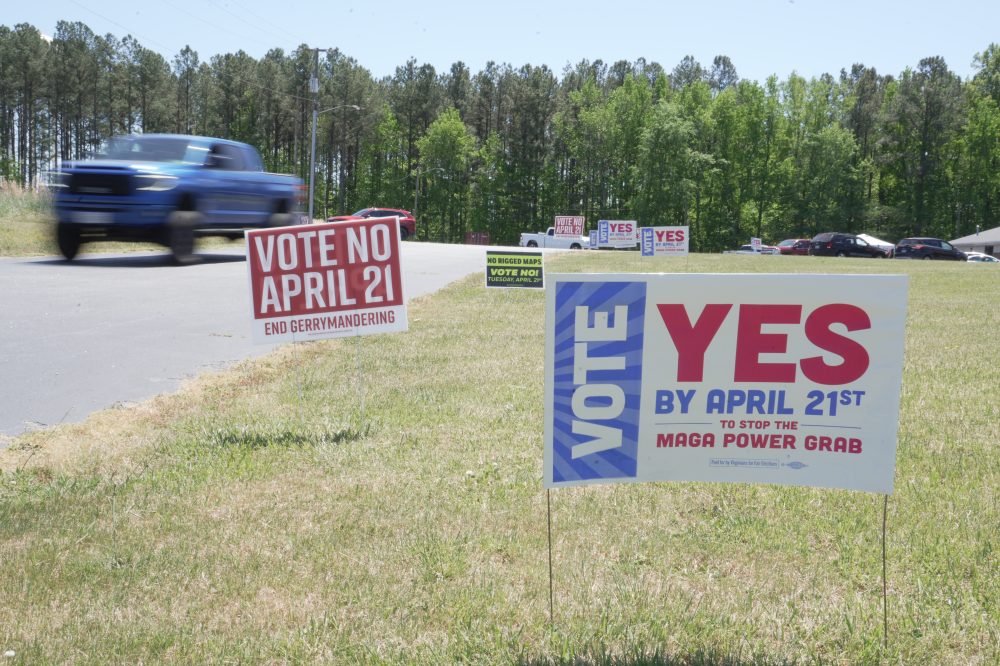
Any procedural mistakes by Democrats could lead courts to overturn new maps. This occurred recently in Virginia when the state Supreme Court struck down voter-approved maps that would have created four additional competitive seats for Democrats. The court determined the Democratic-controlled legislature failed to follow proper procedures when placing the measure before voters.
“It’s going to be expensive, it’s going to be unpopular, and it’s going to be a challenge for them to do what they want,” said Adam Kincaid, executive director of the National Republican Redistricting Trust.
Despite recent redistricting setbacks, Democrats remain positioned to capture House control this year. The most significant blow came when the conservative U.S. Supreme Court majority weakened a crucial Voting Rights Act provision, enabling Republicans to quickly eliminate at least three majority-Black House districts in the South currently held by Democrats.
Political strategists from both parties anticipate Democratic victories in November consistent with historical patterns when the incumbent president’s party faces voter dissatisfaction during midterm elections. During Trump’s initial midterm in 2018, Democrats secured 40 additional House seats.
However, achieving a House majority in 2028 appears significantly more challenging for Democrats.
Presidential election cycles typically produce closer results than midterm contests. Following the recent Supreme Court ruling, Republicans could easily eliminate five or more majority-minority Democratic districts next year in states where maps were already finalized for 2026. They could potentially gain four additional seats through redistricting in Indiana, where some state legislators who resisted last year were defeated in Republican primaries, and in Kentucky and Kansas, where Democratic governors who blocked Republican maps will reach term limits.
The mapping pressure intensifies for Democrats seeking to improve their 2028 House prospects, as the party also aims to reclaim the Senate and White House that year. Only with unified control could they attempt to pass federal legislation banning partisan gerrymandering that might eliminate what could become a lasting Republican advantage.
Following the 2030 census, House seats will shift to states experiencing rapid population growth, primarily those under Republican control. These states could gain up to 10 seats, largely from Democratic strongholds like California and New York.
“Looking at the next census makes me all the more stressed to ban partisan gerrymandering at the federal level,” said John Bisogano, executive director of the National Democratic Redistricting Committee.
Republicans encounter some legal challenges in the redistricting battle.
In Florida, their redrawn congressional map depends on the conservative-majority state Supreme Court overturning the state’s constitutional prohibition on partisan gerrymandering.
However, Democrats face significantly more barriers and must execute multiple complicated political strategies.
Only Illinois and Oregon offer Democrats opportunities to create additional competitive seats without major impediments.
Across Colorado, New York and New Jersey, Democrats could achieve nearly double-digit House seat gains, but only by successfully navigating constitutional changes.
In Maryland, Democrats who declined to redraw their map this year are working to place a constitutional amendment on November’s ballot that would authorize eliminating the state’s only Republican House seat in 2028.
Democrats point out that their voters have supported abandoning the reform approach they once preferred, allowing their party to match redistricting efforts by Trump and fellow Republicans. The biggest victory occurred in California, where a ballot measure adopting a new map to gain up to five seats passed decisively last year. Virginia’s map passed more narrowly, but Democrats there remain committed to implementing the 10-1 map in 2028.
In Washington state, Democrats’ only opportunity to revise the constitution and redraw maps requires winning a two-thirds legislative majority in November, a difficult task. Because Democrats expect strong November performance, they’re also hoping to capture state legislative seats that would give them mapping control in states like Minnesota, Pennsylvania and Wisconsin.
Wisconsin Democratic Party Chair Devin Remiker has proposed new maps allowing Democrats to win up to six seats in a state where Republicans currently hold six of eight House districts. Such aggressive action is necessary, he argued, given Republican activities elsewhere.
“If we’ve learned anything, we’ve learned that when you know a knife fight is coming — bring a bazooka,” he said.
In other states, Democrats express confidence in voter support.
“People in New York are pretty fired up given what they’ve seen around the country,” said U.S. Rep. Joe Morelle, a New York Democrat who maintains close ties with the top House Democrat, Hakeem Jeffries, also from New York.
However, New York voters cannot join the redistricting battle until next year because the state constitution requires amendment through statewide voting to permit it. This can only occur after the Democratic-controlled Legislature votes twice across two years to place the question on the ballot.
Similarly, Colorado Democrats previously supported creating an independent commission to redraw district lines in their state. While many have reconsidered, they cannot act until voters remove the commission’s map this fall and authorize Democratic redistricting for 2028.
Their proposed initiative faces a state Supreme Court challenge. Even with ballot approval, it could encounter a competing Republican measure to redraw the map favoring conservative candidates.
“Republicans are stealing votes of Americans all across the country, and Colorado voters will say: ‘Hey, you can’t do that,’” said Curtis Hubbard, a spokesman for Democrats promoting Colorado redistricting.
Colorado represents the most prominent example of Democrats’ redistricting position reversal.
Republicans gained control of numerous state legislatures in the 2010 midterm election and used that power to redraw maps nationwide, providing them a U.S. House advantage. Democrats responded by supporting nonpartisan redistricting, a movement that peaked in 2018 when Colorado Democrats backed a measure establishing such a commission in their state.
Currently, both candidates seeking the party’s gubernatorial nomination support overriding the commission. Former Democratic President Barack Obama, who made redistricting reform a central platform element, has also changed his position, advocating for aggressive nationwide map redrawing.
Nicholas Stephanopolous, a Harvard law professor, said Democrats clearly view Trump’s redistricting push as an existential threat.
“I think they’re going to move heaven and earth to respond,” he said.