
As concerns about cost of living continue to weigh heavily on American families, Democratic lawmakers are embracing a strategy typically associated with Republicans: reducing taxes to help people keep more money in their wallets.
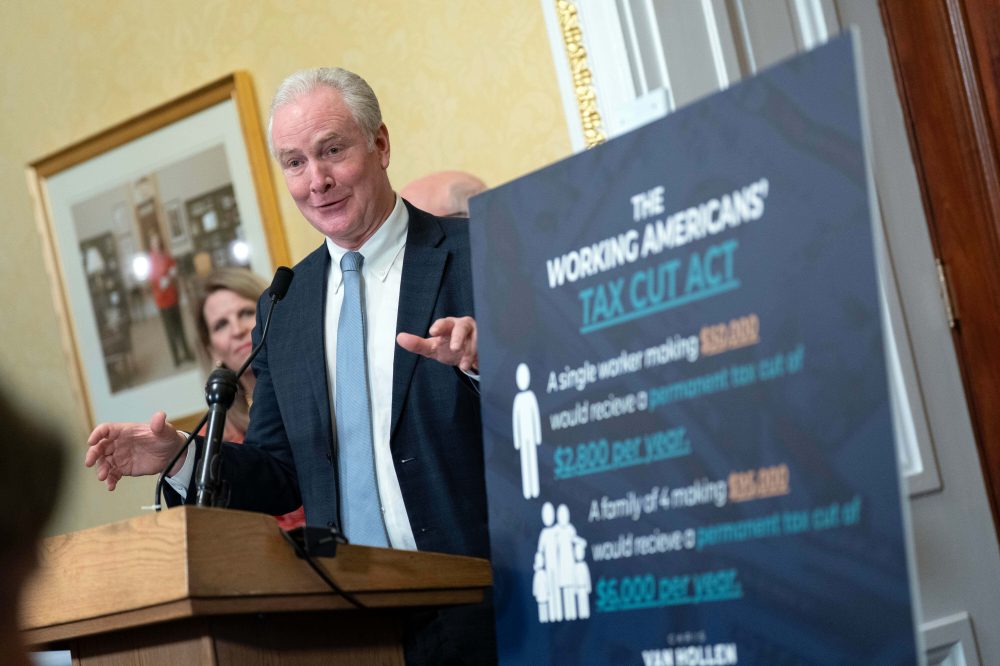
Maryland Senator Chris Van Hollen has introduced legislation that would essentially eliminate federal income taxes for individuals earning $46,000 or less per year, while also providing reductions for those making up to approximately $106,000 annually. Meanwhile, New Jersey Senator Cory Booker is pushing for households to pay zero income tax on their first $75,000 in earnings.
This shift represents an early indication that Democrats are attempting to reshape their image by borrowing from President Donald Trump’s successful campaign strategy, which featured easily understood promises such as eliminating taxes on tips and overtime pay.
However, these proposals could create conflicts with other Democratic priorities by removing substantial revenue sources that might otherwise fund efforts to reverse Trump’s tax benefits for wealthy Americans or restore Medicaid funding. The plans could also restrict resources available for new programs Democrats typically champion during campaigns.
Booker dismissed any comparisons to Trump’s approach, explaining he was responding to constituents who want “somebody to start fighting for them in a way that is bigger, bolder and more ambitious.”
Similar tax reduction ideas are emerging in state-level campaigns as well. Keisha Lance Bottoms, the former Atlanta mayor seeking Georgia’s governorship, proposes eliminating state income taxes for public school educators.
California gubernatorial candidate Rep. Katie Porter advocates for eliminating state income taxes for families earning under $100,000. She criticized Democrats for historically taking overly complex approaches to policy creation, citing President Joe Biden’s Inflation Reduction Act as an example with its credit for those earning less than 150% of their area’s median income. “I don’t even know what 150% the median income is in my area,” Porter remarked.
“I like this proposal more than a complex web of reductions because it’s more straightforward,” Porter explained. “This is a conversation that I think Democrats should have been owning for the last decade.”
During the 2024 presidential race, Trump dominated this messaging territory. While tax policy experts criticized his ideas as ineffective and wasteful, they connected with voters effectively.
Van Hollen remembered hearing hairdressers at his neighborhood barbershop enthusiastically discussing potential savings from Trump’s tip tax elimination proposal, which later became part of the Republican budget legislation that primarily benefited wealthy Americans while cutting Medicaid substantially.
“What our bill does is make sure all those people benefit,” Van Hollen stated.
Despite these new tax reduction proposals, Democrats continue advocating for increased taxes on extremely wealthy Americans.
Van Hollen’s plan includes an additional tax on income exceeding $1 million to fund the lower-income tax cuts. Both Booker and Porter propose raising corporate tax rates at federal and state levels respectively.
According to Yale Budget Lab analysis, Booker’s proposal would still create approximately $7 trillion in deficit spending, though Booker argues the study underestimates savings from eliminating wealthy Americans’ “tax avoidance schemes.”
Tax reductions targeting one income group often benefit higher earners as well, which has been Democrats’ primary criticism of Republican tax policies that typically provide modest savings for working families while delivering larger benefits to affluent taxpayers who already pay more.
Booker’s plan would raise the standard deduction for married couples from $31,500 to $75,000, eliminating taxes for working-class families while providing the largest benefits to those with higher incomes. Yale Budget Lab research shows his proposal would result in those earning up to the 80th income percentile—roughly $106,000 for individuals—saving 5.3% on their taxes, slightly more than those in the 20th-40th percentile range.
While Van Hollen’s cuts decrease as income rises, Yale Budget Lab analysis found they would only reduce the top 20% of earners’ taxable income by about 2%, with the most significant impact—approximately 12%—affecting the top 1%.
Since lower and some middle-income Americans already pay relatively little in taxes, the savings for higher middle-class earners could be more substantial under these proposals, according to policy analysts.
“The breaks that middle-income people are getting out of these proposals is not impressive,” said Vanessa Williamson from the Tax Policy Center.
Democrats’ decision to focus on ultra-wealthy Americans while largely excluding upper-middle-class taxpayers reflects the party’s increasingly affluent voter base, which includes educated urban residents who aren’t billionaires but earn more than most Americans.
“The Democratic approach is different than anything in the past, in that it’s trying to splice away the very wealthiest from people who are also wealthy,” explained Alan Cole, an economist with the conservative Tax Foundation in Washington, D.C. “Democratic priorities mirror what their coalition looks like.”
Chuck Marr, vice president at the liberal Center on Budget and Policy Priorities, emphasized that Democrats will need substantial revenue to reverse Trump’s tax cuts. “Reversing those costs a lot of money,” he noted.
Budget deficits, already elevated following the COVID-19 pandemic, have increased significantly during Trump’s second term, contributing to higher interest rates that worsen voters’ affordability concerns. Marr expressed concern that these proposals might benefit wealthier taxpayers more than intended. “I just don’t think the execution works as well as the intention,” Marr said.
Democratic lawmakers, however, remain enthusiastic about these initiatives. Van Hollen’s legislation has attracted 19 Democratic Senate co-sponsors plus the two independents who align with the party. Major labor organizations, including the AFL-CIO, have also endorsed the proposal.
AFL-CIO President Liz Shuler contrasted this legislation with previous Democratic worker assistance efforts during a recent press conference introducing the bill. “We need ideas that are as clear and simple as the demands workers have given us,” Shuler stated. “That’s how we restore faith — give people real relief.”
Porter argued her party must reconsider their tax philosophy, acknowledging concerns that California is losing residents to more conservative states like Texas.
“Democrats need to recognize that taxes are a tool, yes, for funding programs to help people,” she said, “but they are also a driver of unaffordability.”