
WASHINGTON (AP) — When democratic socialist Claire Valdez pulled off a victory in a New York congressional primary last week, the celebration at her Brooklyn warehouse party quickly took a pointed turn.
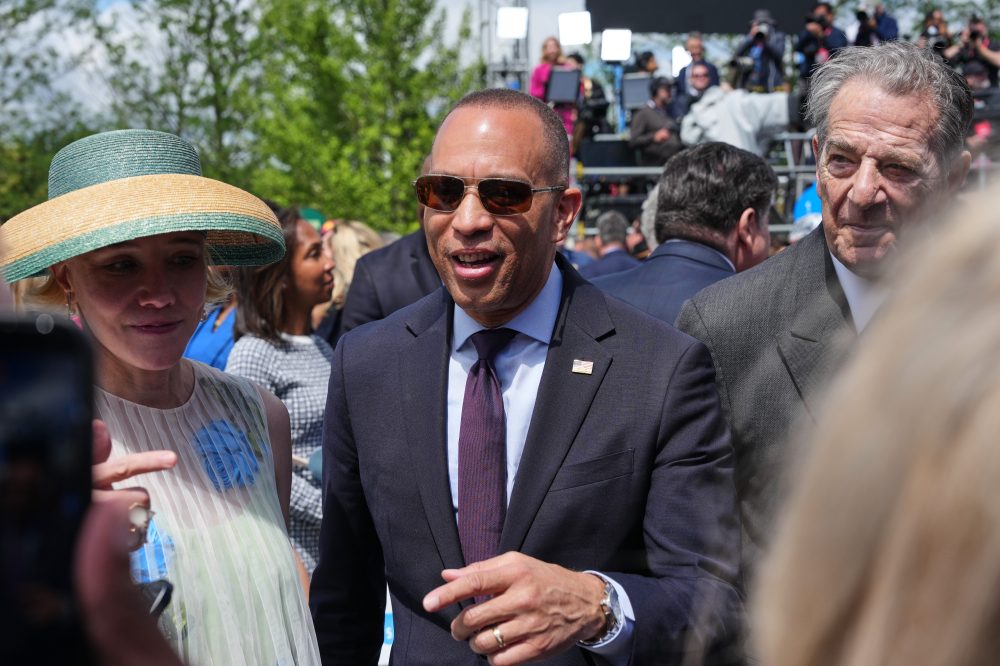
Supporters broke into chants of “You’re next!” as a photo of House Democratic leader Hakeem Jeffries of New York appeared on TV screens at the event.
That moment rattled Democratic Rep. Gregory Meeks, whose congressional district sits adjacent to the one Valdez is set to represent. Meeks noted that Jeffries would likely become the first Black speaker of the House if Democrats win back the majority — an achievement he said people “died to see something like that opportunity.”
The scene captures a broader struggle playing out inside the Democratic Party during a populist era.
As left-wing candidates gain ground in New York and other states, their campaigns are bumping up against long-standing institutions led by people of color. For a party that has long championed diversity, these confrontations are intensifying arguments over identity politics and widening the divide between progressive and moderate factions.
The result of these battles will determine who holds influence within the Democratic coalition as the party fights for control of Congress and gears up for what is expected to be a wide-open presidential primary in 2028.
Historically, minority-led organizations were seen as more radical and anti-establishment. Now, some Democratic leaders view the current left-wing surge as being largely driven by white college graduates. Progressives, however, maintain that their platform continues to resonate within communities of color.
“It’s complicated,” said Juan Proaño, CEO of the League of United Latin American Citizens. “But these changes are a real opportunity for our communities, and maybe a passing of the baton to a younger generation of leaders.”
When asked whether he might face a primary challenge of his own, Jeffries dismissed the question outright.
“When you ask me a serious question, I’ll give you a serious answer,” he told a reporter from Fox Business.
The political networks in many communities of color — once the distant aspirations of Black and Latino activists — have grown into a central pillar of the Democratic establishment. They played a major role in pushing the party to embrace civil rights and diversity as foundational values.
Some of the party’s longest-serving members and most influential political families now come from those communities, and figures like Jeffries climbed through those very systems to reach leadership positions.
But those organizations were built for a different political era.
“A lot of our communities are anchored in older, more traditional voters, and those older, more traditional voters carry older, more traditional values,” said Dallas Jones, who served as the Texas political director for Democrat Joe Biden’s 2020 presidential campaign. In the current Democratic debate pitting “people versus elites,” Jones said, “you cannot help but find that the Black community is caught up in the middle of it.”
Jones said that desire for generational change played a role in the May defeat of Texas Rep. Al Green, a progressive who was seeking his 12th term in Congress. Green, 78, a veteran civil rights activist, lost to Christian Menefee, a 38-year-old first-term congressman who is also Black, in a majority-Black district centered around Houston.
The Democratic electorate became slightly whiter in 2024 as former President Donald Trump made modest gains among Black and Hispanic voters. Meanwhile, white Democrats have grown more likely to identify as liberal than their Black and Hispanic counterparts, according to 2022 Gallup research.
Progressives contend they are challenging veteran lawmakers based on their ties to the establishment — not because of any demographic shift in the party. They point to recent progressive wins in House Democratic primaries for majority-minority districts in Pennsylvania and New Jersey as evidence of broader appeal.
“The point of being a senior Democrat is you’re supposed to be able to deliver more and impact the agenda,” said Regina Monge, a strategist who led a political action committee backing democratic socialist Zohran Mamdani in last year’s New York City mayoral race. “People are supposed to feel the benefits of their leadership in the district.”
Senior Democratic lawmakers are doubtful that last week’s results carry much national significance, even though Mamdani successfully backed a trio of insurgent candidates.
“Our path to 218” — the number of House seats needed for a majority — “wasn’t affected by those races that are getting a lot of news,” said Democratic Rep. Pete Aguilar of California, the highest-ranking Latino in Congress. “The mayor made some endorsements, and those individuals won, and I presume that they’re going to come and vote with the Democratic caucus when they get here.”
Many of today’s insurgent candidates are emerging from outside the traditional civil rights and community organizing structures that shaped politics in minority communities for generations.
Valdez, who is Latina and Native American, won the primary to fill the seat being vacated by retiring Rep. Nydia Velázquez, a former chair of the Congressional Hispanic Caucus who was born in Puerto Rico.
The current caucus leader, Rep. Adriano Espaillat of New York, lost his own primary to Darializa Avila Chevalier, another democratic socialist, in a district covering parts of Manhattan and the Bronx. Espaillat was born in the Dominican Republic; Chevalier’s parents are Dominican immigrants.
“We’re really looking at a moment in time where people are anxious about the future of our country,” said Katharine Pichardo, who heads Latino Victory.
Pichardo, who was a senior adviser during Espaillat’s first successful congressional run in 2016, said his message “needed to focus more on kitchen table issues” and be “forward looking” if he hoped to hold off Chevalier’s challenge.
She said incumbents hoping to fend off populist and ideologically driven challengers must “give people a sense of security against the very real anxiety over what’s going on in Washington, D.C.”
Basil Smikle, a former executive director of the New York State Democratic Party who now teaches at Columbia University, said insurgent candidates and their supporters view institutions as “inherently flawed.” He argued that party leaders “would do well to turn with the momentum and not against it.”
“This is an opportunity for Hakeem to turn around and say, ‘Look, I’m with you, I’m not going to stand in your way, let’s iron out our differences and make me speaker, get us back to power,’” Smikle said. “That would be the best way to bridge this divide.”
On Saturday, Jeffries took a step toward reconciliation by publicly congratulating New York City’s Democratic nominees, including both Valdez and Chevalier. He made no mention of his ideological differences with them or his backing of their opponents, focusing instead on the shared goal of working to “crush far-right extremism.”
“The path is different but the work is the same,” Jeffries said.