
WASHINGTON — Defense Secretary Pete Hegseth’s integration of evangelical Christian beliefs into Pentagon operations has sparked fresh controversy as the United States engages in military conflict with Iran.
Since taking office, Hegseth has organized monthly Christian worship gatherings for Pentagon staff and incorporated biblical passages into departmental promotional materials. The defense chief frequently promotes the idea that America was established as a Christian nation and encourages military personnel to embrace faith, raising concerns about the armed forces’ traditionally secular approach and religious diversity.
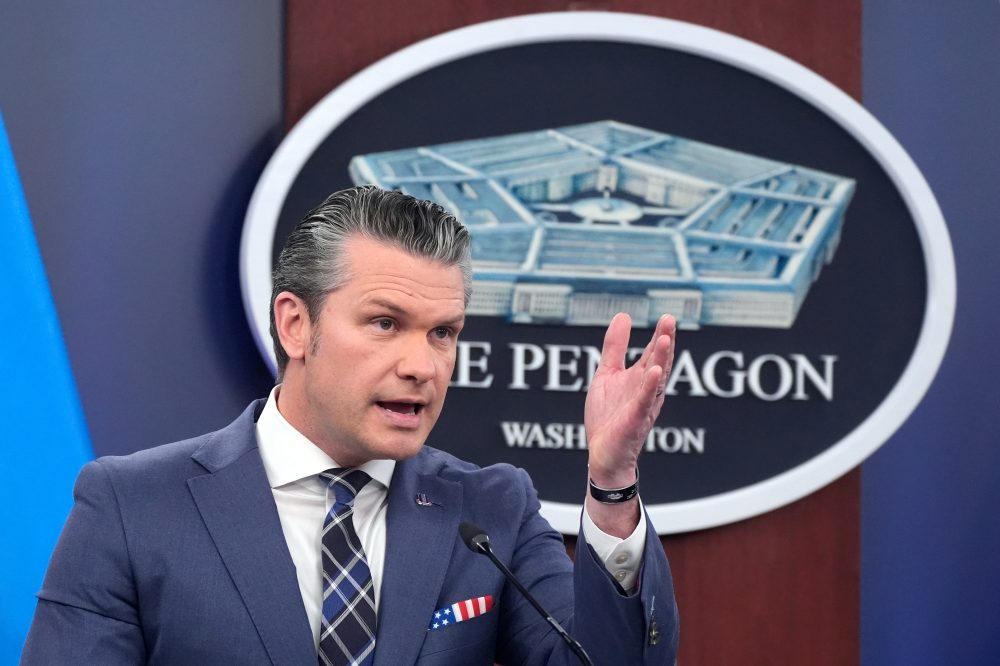
The current military engagement with Iran, an Islamic republic, has amplified concerns about Hegseth’s religious messaging. During a Pentagon briefing, he described Iranian leadership as “desperate and scrambling,” then quoted Psalm 144: “Blessed be the Lord, my rock, who trains my hands for war and my fingers for battle.”
Hegseth has previously praised the medieval Crusades, writing in his 2020 publication “American Crusade” that supporters of Western civilization should “thank a crusader.” His body art includes Crusader symbols: the Jerusalem Cross and “Deus Vult” (“God wills it”), which he describes as “the rallying cry of Christian knights as they marched to Jerusalem.”
Matthew D. Taylor, a Georgetown visiting scholar specializing in religious extremism who has criticized Hegseth, expressed alarm about the current situation. “The U.S. voluntarily going to war against a Muslim country with the military under the leadership of Pete Hegseth is exactly the kind of scenario that people like me were warning about before the election and throughout his appointment process,” Taylor stated.
Taylor argued that Hegseth’s approach “can only inflame and reinforce the fears and deep animosity that the regime in Iran has towards the U.S.”
When questioned about whether Hegseth interprets the Iranian conflict through a religious lens, Pentagon officials referenced a CBS interview where he appeared to confirm this perspective. “We’re fighting religious fanatics who seek a nuclear capability in order for some religious Armageddon,” Hegseth said regarding Iranian leadership. “But from my perspective, I mean, obviously I’m a man of faith who encourages our troops to lean into their faith, rely on God.”
Many evangelical Christians have been shaped by apocalyptic literature and films depicting end-times scenarios, with some believing Middle Eastern conflicts involving Israel will trigger Christ’s return. Christian Zionist leader John Hagee, who heads Christians United for Israel, commented on the Iran war: “Prophetically, we’re right on cue.”
However, Hegseth’s denomination takes a different theological approach. Pastor Doug Wilson of the Communion of Reformed Evangelical Churches believes most biblical apocalyptic events have already occurred, setting the stage for gradual global Christianization before Christ’s return.
While Hegseth hasn’t explicitly connected the Iran conflict to Christian prophecy, viral claims emerged suggesting military leaders were telling troops the war fulfilled biblical end-times predictions. These allegations originated from Mikey Weinstein of the Military Religious Freedom Foundation, prompting 30 Democratic Congress members to request a Pentagon investigation.
Weinstein declined to provide documentation supporting his claims when interviewed, citing troops’ fears of retaliation. Three major religious watchdog organizations reported receiving no similar complaints, and the Pentagon refused to address the allegations.
Hegseth’s church network promotes traditional gender roles, prohibiting women from leadership positions and advocating for criminalizing homosexuality. He recently shared content from a pastor opposing women’s voting rights. Wilson, the denomination’s prominent leader, identifies as a Christian nationalist and spoke at the Pentagon in February at Hegseth’s invitation.
Both Wilson and Hegseth have questioned Muslim immigration policies. Wilson advocates restricting Muslim immigration to maintain America’s Christian majority, while Hegseth’s book expressed concern about Muslim population growth and the popularity of the name Muhammad in America.
As defense secretary, Hegseth has implemented policies reflecting his conservative Christian beliefs, including prohibiting transgender military service, reducing diversity programs, and examining women’s combat roles.
Christopher Newport University political scientist Youssef Chouhoud criticized these developments, stating: “The intrusion of Christian nationalist policy, not just Christian nationalist rhetoric … that is what’s troubling.”
Hegseth plans to overhaul the military chaplain system, which traditionally serves personnel of all faiths and those without religious beliefs. He eliminated the 2025 Army Spiritual Fitness Guide and aims to strengthen chaplains’ religious emphasis, which he claims has been weakened “in an atmosphere of political correctness and secular humanism.”
Retired Army Colonel and chaplain Rabbi Laurence Bazer warned this approach could alienate service members when military leadership draws exclusively from one religious tradition. “The U.S. military reflects the full diversity of this country — people of every faith step forward to serve,” Bazer stated. “That diversity is a strength worth protecting.”