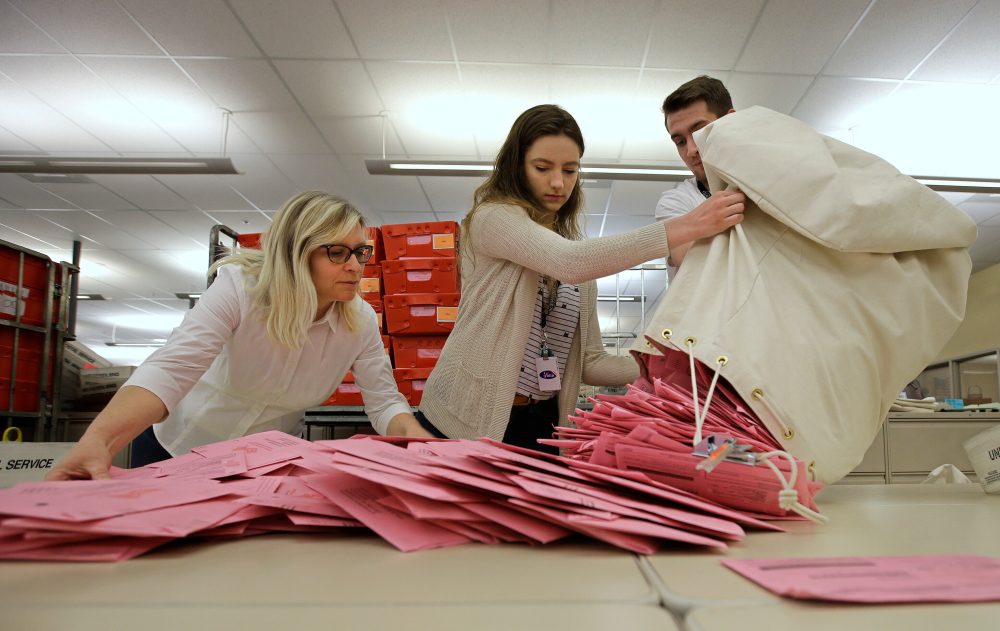

While Election Day falls on November 3rd this year, voters in 14 states who mail their ballots have additional time for their votes to arrive and be tallied – anywhere from one day to several weeks after the election.
This extended timeframe faces a crucial test as the U.S. Supreme Court prepares to hear arguments Monday in a case that could eliminate these grace periods entirely. A ruling against these policies would force affected states to quickly adapt their procedures with just months remaining before absentee ballots go out for the upcoming midterm elections.
The decision’s impact could reach beyond the 14 states with standard ballot grace periods. According to data from the National Conference of State Legislatures and the Voting Rights Lab, 29 states currently permit late-arriving military and overseas ballots.
Election officials from states and major cities warned the court about “the risks of confusion and disenfranchisement” should mail ballot grace periods be suddenly eliminated in jurisdictions where voters have depended on them for years.
Stuart Holmes, who oversees elections for Washington’s Secretary of State office, noted that 127,000 ballots arrived after Election Day in 2024. He expects roughly that same number of ballots would face rejection if Mississippi loses its case. Washington allows the longest grace period nationwide at 21 days post-election.
Should the court rule that ballots become invalid even when postmarked by Election Day, “it might as well have never been received,” Holmes explained.
“There’s no way to resolve that issue,” Holmes said. “There’s no second chance.”
Counting ballots beyond Election Day has drawn criticism from President Donald Trump since his 2020 “STOP THE COUNT” efforts. Trump and supporters contend the practice delays outcomes and creates suspicion about vote totals. This challenge fits into Trump’s wider criticism of mail voting, which he claims encourages fraud despite contrary evidence and successful implementation across multiple states over many years.
The Republican National Committee and Mississippi’s Libertarian Party filed suit against Mississippi Secretary of State Michael Watson, also a Republican. They contend federal Election Day laws require voting to occur on a single day. Grace periods for mail ballot receipt – also used in Washington D.C. and three U.S. territories – break federal law, according to their argument.
“Election Day is Election Day for a reason,” Ohio state Sen. Theresa Gavarone, a Republican, stated during last year’s debate over her state’s prohibition of the practice. “Allowing ballots to be delivered days after the election does nothing but hurt the integrity and credibility of our elections.”
In court filings backing Mississippi, voting rights organizations, local election administrators and groups representing military and overseas voters defend states’ authority to establish their own voting procedures. The Constitution grants states power to determine the “times, places and manner” of elections.
Grace period advocates warned the court that upholding the 5th Circuit Court of Appeals’ decision striking down Mississippi’s law would create disorder and uncertainty in this year’s midterm contests.
“State legislatures have recognized this issue and set election deadlines that balance the interests of canvassing speed and ballot security depending on the specific needs of each individual state,” local election officials and governments informed the court.
These organizations said removing grace periods could impact ballot verification procedures, provisional ballot handling, and military and overseas ballot processing that typically occurs after Election Day.
Every state requires ballots to be cast or postmarked by Election Day. The 14 states with grace periods accept and tally mailed ballots for timeframes spanning from one day post-election in Texas to Washington state’s 21-day window. Mississippi’s challenged grace period lasts five days.
A November 2025 Brookings Institution analysis determined mail voting offers a practical, secure method to expand voter participation, finding approximately four fraud cases per 10 million mail ballots. About 30% of U.S. voters chose this option during the 2024 presidential race.
Anticipating the Mississippi case outcome, several states have already taken action.
According to the National Conference of State Legislatures and Voting Rights Lab, four states – Ohio, Kansas, North Dakota and Utah – removed grace periods last year. Minnesota reduced its ballot deadline from poll closing on Election Day to 5 p.m.
When signing Ohio’s legislation, Republican Gov. Mike DeWine – who had promised not to approve additional election restrictions promoted by fellow Republicans – said the Mississippi lawsuit compelled his decision.
“I believe that this four-day grace period is reasonable, and I think for many reasons it makes a lot of sense,” he stated then, acknowledging his preference to reject the bill.
However, DeWine said a ruling against Mississippi would endanger similar statutes in other states like Ohio, leaving insufficient time for adjustments.
For Adriane Mohlenkamp, Ohio’s former grace period offered reassurance against concerns that factors beyond her control might invalidate her ballot.
“I live in a rural part of the state and sometimes our mail has to go to a larger city and then come back,” explained Mohlenkamp, 48, a stay-at-home mother and volunteer in Athens who doesn’t align with either major party. “It gave me a safe feeling, because, even if I do my due diligence and return it in enough time, I can’t always anticipate what it does when it leaves my hands.”
Katy Owens Hubler, elections program director at the National Conference of State Legislatures, explained that in certain large states, distributing all mailed ballots and receiving them back within designated timeframes proves challenging.
She noted the postmark matter has grown more complex for states following recent U.S. Postal Service mail processing modifications.
An updated agency rule from December stated postmarks may not reflect the initial day the Postal Service receives mail, but instead when it reached a processing facility. These facilities may be more distant from some communities due to consolidations, a group of U.S. senators informed the postmaster earlier this year.
Responding to potential Postal Service processing delays, some states have suggested extending ballot deadlines – California by three days, Virginia by five hours and Kansas by one hour depending on county, per NCSL data.
Owens Hubler emphasized that notifying voters of any changes from the Supreme Court’s Mississippi case ruling must happen rapidly.
“It’s not ideal to do it in a big election year like this year,” she said. “Voters do adapt, but if there is a change from a postmarked-by to a received-by date, that needs to be communicated and signaled well in advance.”