
DES MOINES, Iowa (AP) — Rev. Sarah Trone Garriott moves effortlessly between the pulpit and the campaign trail, equally at ease discussing faith and political issues.
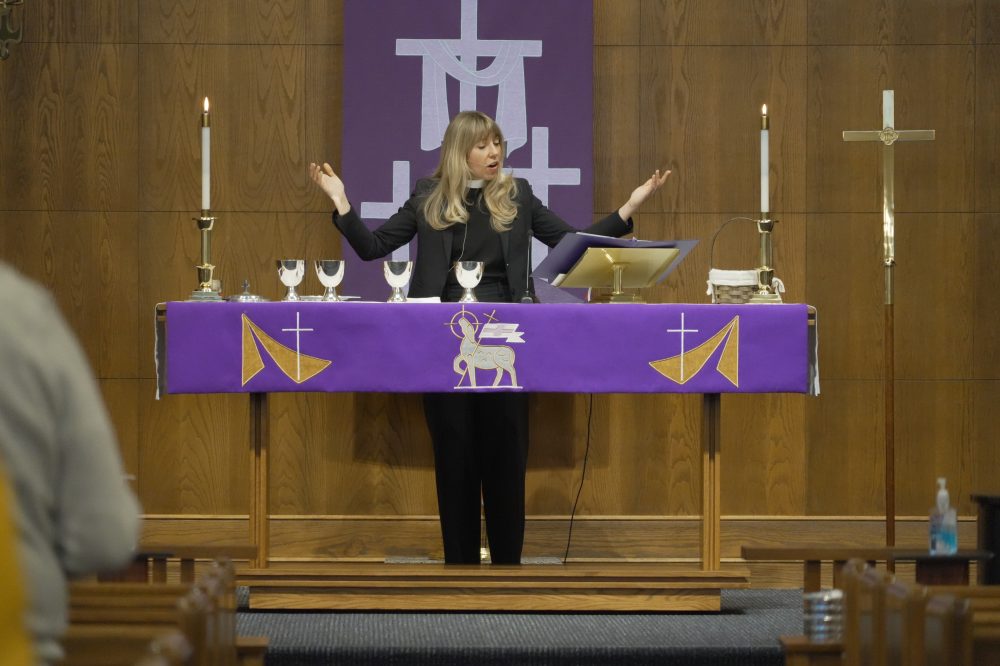
Last Sunday, she delivered a powerful message at Grace Lutheran Church urging congregants to embrace strangers as Christ would. Just one day earlier, she was campaigning across rural Iowa, condemning cuts to Medicaid and their effects on healthcare accessibility for residents.
The Lutheran minister and state legislator represents one of three religious leaders in Iowa seeking Democratic nominations for U.S. House seats.
Following years where white Christian voters have heavily backed Republican Donald Trump, an unprecedented number of religious leaders are now pursuing political office under the Democratic banner. While James Talarico, a 36-year-old Presbyterian Church (U.S.A.) seminary student who recently secured his Texas primary victory for U.S. Senate, has captured widespread media coverage, he represents just one example of numerous progressive candidates with theological backgrounds this election cycle.
“Because there’s been the tendency to define Christianity as very conservative and with a Christian nationalist lens, I think you are seeing people on the Democratic side saying, ‘Wait a minute. There are different ways to think about how our faith informs our policy,’” said Melissa Deckman, CEO of the Public Religion Research Institute.
The Democratic Party now faces the complex task of developing sustainable faith-based messaging within a coalition that includes more religious diversity than Republicans while also accommodating a significant portion of non-religious voters.
Trone Garriott, who received ordination through the Evangelical Lutheran Church in America, has built extensive experience in interfaith collaboration, which she credits with strengthening her own Lutheran identity. This background shapes her campaign approach, allowing her to move naturally from a Friday evening Lenten fish fry at a Catholic parish to an Iftar meal at a nearby mosque.
Even with prominent politicians like former President Joe Biden, a devout Catholic Democrat, speaking openly about their beliefs, Trone Garriott believes many Democrats struggle to connect with certain religious communities due to discomfort in meaningful faith discussions.
“A lot of folks just don’t have the practice to do it in a way that doesn’t feel like it’s imposing oneself on others or being dismissive of other perspectives,” she said. “Folks tend to fall back into this, ‘Well, everyone’s basically the same.’ We’re different and those differences are important.”
However, Trone Garriott observes that Democrats are recognizing that minimizing religious distinctions isn’t effective. “That left a vacuum that the religious right has filled. And there are a lot of people now realizing that it is really important to speak about these issues from the perspective of faith and claim their faith,” she said.
Talarico, a Texas state legislator who gained national recognition following his appearance on Joe Rogan’s podcast last summer, exemplifies this approach.
“If we have to force people to put up a poster, to me that means that we have a dead religion,” he said of his opposition to a Texas bill requiring that public schools display the Ten Commandments.
Deckman notes that Talarico stands out among white Democrats for his ease in discussing Biblical teachings. However, this has also made him a target for conservative critics, especially regarding his theological justifications for supporting abortion access and LGBTQ+ rights.
“He would be one that I would say, ‘Wait a minute. You are misrepresenting the word of God,’” said Bob Vander Plaats, the politically influential president and CEO of the conservative Christian group The Family Leader. “The GOP has been vastly more consistent in their proximity to God’s word, versus using a verse here and there to try to back up a position.”
During the 2024 election, Trump again secured support from approximately 8 in 10 white evangelical Christian voters, according to AP VoteCast, a comprehensive survey of more than 120,000 voters, while the same percentage of Black Protestant voters chose Democrat Kamala Harris. Roughly 7 in 10 non-religious voters backed Harris.
Democratic Kentucky Gov. Andy Beshear attributes this lack of support from certain religious voters to the party’s messaging approach.
“We stopped talking about our why,” he said. “When that happens, I think you lose your authenticity. And sometimes that means that people stop believing that you are going to work as hard as you’re committed to doing.”
As speculation grows about a potential 2028 presidential run, Beshear, who serves as a deacon in his Disciples of Christ congregation, plans to share his motivations through his upcoming book, “Go and Do Likewise: How We Heal a Broken Country,” referencing the Biblical Parable of the Good Samaritan.
“My faith is is my authentic why. It’s what drives me to try to better this world,” he said.
The overwhelming Trump support among white Christians has prompted some to engage in self-reflection. “I put that on us as pastors, that maybe we haven’t done a great job of explaining the faith to people,” said Clint Twedt-Ball, a minister seeking office in Iowa’s 2nd Congressional District.
Black religious leaders running as Democrats isn’t unprecedented. U.S. Sen. Raphael Warnock, D-Ga., serves as a Baptist senior pastor and the late Rev. Jesse Jackson mounted two presidential campaigns. However, fewer examples exist of white clergy pursuing similar paths, despite possessing obvious transferable skills like public speaking that benefit campaigning.
Both Twedt-Ball, a third-generation United Methodist pastor and founder of the nonprofit Matthew 25, and Lindsay James, a PCUSA chaplain also running in Iowa’s 2nd district, cite the 2016 election as the turning point for their political engagement.
This movement of pastors entering politics extends beyond congressional campaigns.
Rae Huang, also a PCUSA minister and Democratic Socialists of America member, is challenging Los Angeles Mayor Karen Bass. Huang reports that her openness about being a pastor generates questions from voters.
“‘Are you somebody who is homophobic? Are you somebody who is gonna try and create a theocracy in our city?’ Because that’s all they’ve known,” she recalled. She views this as a chance to present voters with a positive theological vision. “Religion doesn’t have to be that space of oppression, that space where we have been suppressing voices rather than uplifting and liberating.”
Following his election as New York City’s first Muslim mayor, Zohran Mamdani discussed on comedian Trevor Noah’s podcast the significance of having imagination for change in politics — a concept Noah connected to religious faith.
“Religion is declining, but it’s declining in areas where people are particularly left-leaning or progressive,” Noah said. “One of the things that faith requires of you is the ability to believe that this current state that you’re in is not the end — there is a possibility that something can be greater.”
Mamdani, who isn’t clergy but speaks openly about his faith, concurred. “It’s often in houses of worship where New Yorkers still have that trust,” he said. “It’s by and large lost when it comes to politics.”
Huang, whom the Los Angeles Times suggested could be “L.A.’s Mamdani,” shares this perspective.
“We’re called and being invited to be prophetic, to be forward thinking, to actually grow our imagination,” she said. “The religious right has a hold over American culture. I think that’s changing. I think progressive Christianity is beginning to stand up.”