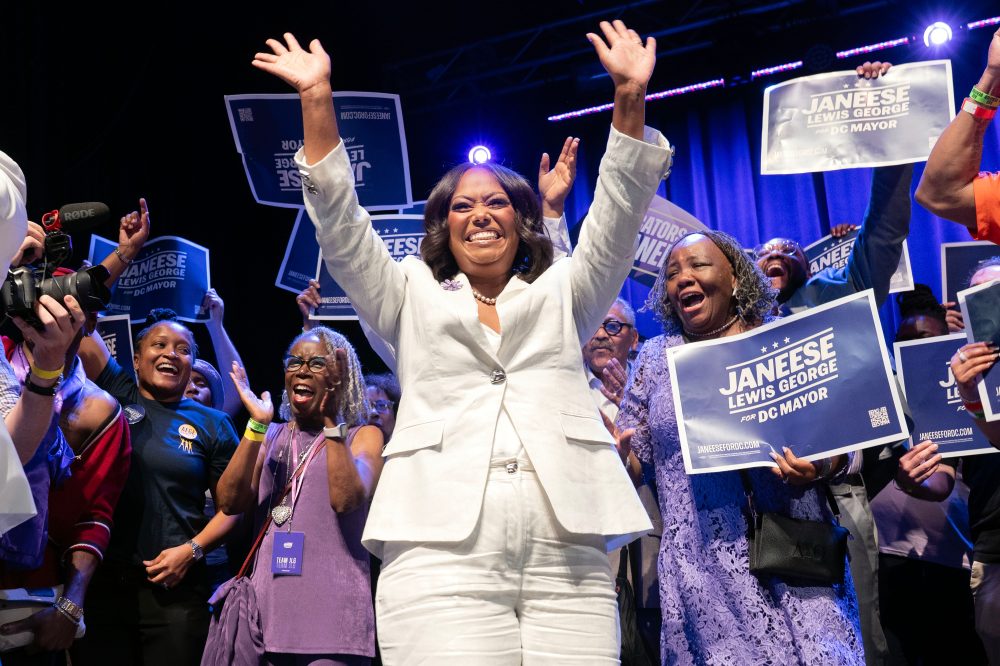

WASHINGTON (AP) — Janeese Lewis George claimed victory Tuesday in Washington, D.C.’s Democratic mayoral primary, setting the stage for a likely confrontation with the Trump administration over its ongoing efforts to limit the city’s self-governance.
Because Washington is a heavily Democratic city, Lewis George is considered the strong favorite heading into November’s general election. Her win means she will succeed moderate Muriel Bowser, who chose not to seek a fourth term.
Lewis George will not be alone in facing off against federal pressure. Robert White Jr., who won the Democratic primary for the district’s congressional delegate seat, is also expected to take a tougher stance against the Trump administration than his predecessor. Both candidates campaigned on promises to more forcefully resist federal moves affecting the city, including the ongoing deployment of the National Guard in what has been described as an open-ended crime-fighting mission.
Speaking to a crowd of enthusiastic supporters Tuesday night, Lewis George made her intentions clear: “As mayor, I will work with anyone who makes D.C. safer, but I will also stand up to Trump.”
Washington operates under limited autonomy, with federal officials retaining considerable authority over local matters — including the right to approve the city’s budget and laws passed by the D.C. Council.
President Donald Trump moved further into that space last year, briefly taking control of the city’s police force and launching a law enforcement surge that included National Guard troops. His efforts to shrink the federal government also hit the capital region hard, eliminating thousands of jobs. Trump has also been leaving his mark on the city’s physical landscape, renovating well-known landmarks and attaching his name and image to buildings.
Lewis George, a member of the D.C. Council who describes herself as a democratic socialist, was already on Trump’s radar before the primary results came in. Last week, the president threatened to place the district under direct federal control if she won the race.
“Maybe we’d take back Washington, run it on the federal basis,” Trump said.
Her main challenger, former D.C. Council member Kenyan McDuffie, formally conceded the race Thursday and confirmed he had reached out to Lewis George to congratulate her.
“While the final certification process will continue, it is clear that the voters have chosen a different path,” McDuffie said in a written statement. He extended his best wishes to Lewis George for the general election and encouraged his own supporters to stay engaged.
“The campaign may be over, but the work of building a safer, more affordable, more prosperous city continues,” he said.
Lewis George, 38, is a third-generation Washington native. She has promised to overturn an executive order issued by the city’s police chief that allows local law enforcement to work alongside Immigration and Customs Enforcement agents, arguing the order “hurt the trust of our community.”
She has also pledged to use every tool available under the city’s home rule agreement to push back against what she characterized as authoritarian interference in local governance.
“We have legal tools we can use to fight back,” she told The Associated Press ahead of the vote. “And we know that when we have gone to court, we’ve won.”
Outgoing Mayor Bowser faced ongoing criticism from residents who felt she was too accommodating toward the Trump administration. Meanwhile, Eleanor Holmes Norton — the district’s 18-term, 89-year-old congressional delegate — also drew criticism from those who believed she was not doing enough to counter the administration’s actions against the city.
Beyond the federal fight, Lewis George has made the cost of living a central issue. Her platform includes rent assistance, eliminating below-minimum-wage pay for tipped workers, and reining in high utility costs.
Tuesday’s primary was notable for several reasons: it was the first time in a generation that D.C. voters chose both a new mayor and a new congressional delegate in the same election. It was also the city’s first election conducted using ranked choice voting.