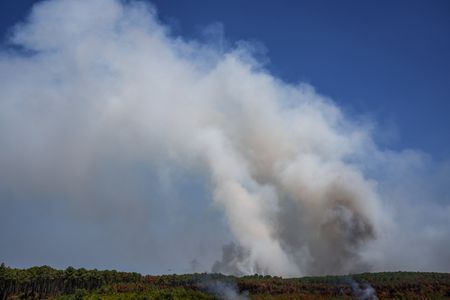

France is battling a wildfire season unlike anything the country has seen before, with hundreds of thousands of people forced to flee their homes and the peak tourist season taking a serious economic hit.
Beyond the sheer size of the fires, the blazes are also behaving in ways previously unrecorded in France — including the formation of the nation’s very first documented pyrocumulonimbus, commonly called a “fire-cloud.”
What exactly is a fire-cloud?
A pyrocumulonimbus is a massive cloud that forms directly above a large wildfire. The intense heat from the blaze pushes smoke, ash, and water vapor high up into the atmosphere, creating a towering column of superheated air.
David Bowman, a professor of pyrogeography and fire science at the University of Tasmania, described it this way to Reuters: “You can think of it as like a chimney, which is a fire at the bottom and the smoke going straight up a chimney into the stratosphere.”
Jean-Christophe Vincendon, wildfire coordinator for the French national meteorological service, noted that while weather experts can recognize conditions that make fire-clouds more likely, pinpointing exactly when or where one will form is not yet possible.
Why do fire-clouds make wildfires more dangerous?
Fire-clouds can dramatically increase the unpredictability of a wildfire. They can generate intense winds that suddenly shift the direction of a fire, and they can produce lightning strikes that spark entirely new blazes in other locations.
They can also trigger what scientists call a “plume collapse” when the cloud runs out of energy. As Bowman explained, “When the plume collapses, it’s a showering of debris, burning debris.”
What does this mean going forward?
French officials confirmed on Saturday that a pyrocumulonimbus was observed near Bordeaux — the first time such an event has been officially recorded in France.
Marc Vermeulen, head of the Gironde fire and rescue service, said the unpredictable nature of these fire-clouds creates an extra burden for emergency responders, who may need to expand evacuation zones as a precaution.
Bowman warned that Western Europe should now prepare to see more of these events, which have historically been associated with vast wilderness regions like those found in Canada and Australia.
“This is a very gravely serious milestone,” Bowman said. “It is fascinating, but it is also absolutely disastrous and terrible, and we just don’t want more of these things.”