
WASHINGTON (AP) — Congressional members who experienced combat firsthand in Iraq and Afghanistan following September 11th are bringing their battlefield perspectives to bear as they evaluate President Donald Trump’s military actions against Iran, creating deeply personal stakes in the current war discussions.
These veteran legislators describe conflicted emotions — feeling satisfaction that Iranian leadership responsible for targeting American troops for decades faces consequences, while simultaneously worrying that a new generation of service members might endure similar combat ordeals.
Arizona Democratic Senator Ruben Gallego, whose unit experienced devastating casualties during the Iraq conflict, expressed this internal struggle: “Do I take gratification? You know there’s the Marine side of me: Yeah, of course. I know they killed a lot of American soldiers, American Marines. But do I also understand that I have a responsibility not to let my lust for revenge drive my country into another war?”
The post-9/11 military experiences also influence Trump administration decision-makers, considering that key figures like Vice President JD Vance and Defense Secretary Pete Hegseth previously served in Iraq deployments.
Gallego and fellow Capitol Hill veterans are drawing extensively on their combat backgrounds to evaluate the Iranian situation. These lawmakers display memorial bracelets bearing fallen comrades’ names, share accounts of attacks by Iranian-supported militant organizations, and recall their own combat wounds.
Although initial Iran-related votes split largely along partisan lines — Republicans supporting Trump’s approach while Democrats cautioned against prolonged engagement — military veterans from both parties express serious concerns about entering this conflict.
Arizona Republican Representative Eli Crane, a former Navy SEAL who enlisted immediately after the September 11th attacks, explained his position: “As somebody who knows a lot of friends that didn’t come home and a lot of Gold Star families, that’s why the week before the attack, I was actually one of the ones that was talking about caution and why we needed to avoid at all costs getting into another long, drawn-out Middle Eastern war.”
Trump administration briefings somewhat eased Crane’s worries by suggesting the president doesn’t intend extended warfare. He opposed a war powers resolution that would have required congressional approval for continued Iranian strikes.
However, Crane acknowledged military operations’ unpredictable nature: “I’ve been on military operations that did not go to plan many times, and so I understand the nature,” while urging the administration to proceed with “humility and caution.”
Democratic lawmakers like Gallego feared such measured approaches came too late. They honored the six American military personnel killed in the Kuwait drone attack while expressing concern about additional casualties.
“War is dirty, and mistakes happen,” Gallego observed. Extended conflicts increase chances of American military deaths, he noted, recalling Iraq experiences where friends died from seemingly random enemy fire.
Nevertheless, numerous Republicans maintained that attacking Iran was essential to stop a regime that has spent decades training and equipping Middle Eastern militant organizations. House Foreign Affairs Committee Chairman Brian Mast led floor opposition to the war powers resolution.
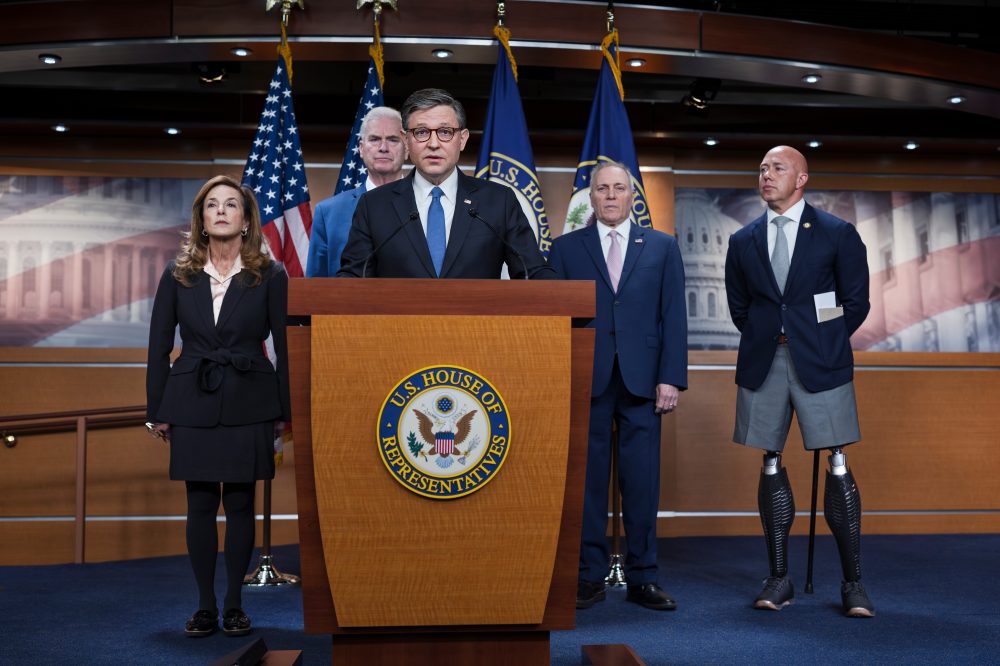
Mast, an Army explosive ordnance disposal specialist who lost both legs to an Afghan improvised explosive device, stated: “Me especially, many of my other colleagues, no one wants to see our military go into combat or war.”
He continued: “But Iran’s terror, which has caused the deaths of thousands of Americans, it has to stop.”
Significant questions face Congress as Iranian conflicts expand across the Middle East. Operations costs will likely reach billions, forcing the Trump administration to request substantial congressional funding soon. The war outbreak has also disrupted international partnerships and future American foreign policy directions.
The specter of another extended conflict overshadows everything. Legislators say they must honor fallen colleagues by preventing such outcomes.
Democratic Representative Pat Ryan, touching a bracelet inscribed with names of friends killed during his two Iraq Army tours, declared: “To me, it’s to speak out. It’s to say another generation should not go fight in an open-ended, ill-conceived regime change war in the Middle East.”
Others recalled their wartime frustrations with Washington, particularly soldiers fighting with inadequately armored vehicles and insufficient personnel.
Democratic Representative Jason Crow, who rose from Army private to captain through Iraq and Afghanistan deployments, reflected: “I know what it was like to be on the very end of the receiving line of the decisions made in Washington.”
Crow said frontline troops often suffered “because people stopped asking tough questions. People stopped being held accountable. Congress stopped voting on it.”
Illinois Democratic Senator Tammy Duckworth, who lost her legs when her Blackhawk helicopter was struck by a rocket-propelled grenade in Iraq while serving with the Illinois National Guard, said such experiences motivated her congressional candidacy.
“I ran for Congress so that when the drums of war started beating once again, I’d be in a position to make sure that our elected officials fully considered the true cost of the war,” she explained. “Not just in dollars and cents but in human lives.”