
WASHINGTON (AP) — For decades, holiday gatherings and milestone moments have carried the weight of an empty chair. Certain days on the calendar meant visits to gravesites, standing before stone markers that bore the names of people who gave their lives for a cause.
They are a scattered few, living in different corners of the country, yet connected by a shared and painful history: each lost a family member to violence during the fight for voting and civil rights. Their loved ones fell along a long, bloody road that seemed to reach its destination when the nation appeared to finally live up to its founding ideals.
Now, 61 years later — as the United States nears its 250th birthday — those sacrifices are being called into question. Through a series of rulings over the past 12 years, including one handed down this past April, the Supreme Court has effectively gutted the Voting Rights Act of 1965, the very law those family members died trying to bring into existence.
“My mother’s blood is on that bill. We were always proud of that, and now it’s gone,” said Anthony Liuzzo, whose mother, Viola Liuzzo, was killed on an Alabama highway between Selma and Montgomery in 1965 while transporting civil rights marchers.
Those who have criticized the law argue that the country has moved forward — a point the Chief Justice made in a 2013 ruling that marked the first significant rollback of the law’s protections.
But the families of those who died see things differently. They point to how quickly Republican-controlled state legislatures moved to eliminate majority-Black congressional districts following the court’s April ruling, which severely weakened the section of the law that had shielded minority communities’ voting rights. Though filled with sorrow and fury, these survivors say they have no intention of giving up the fight.
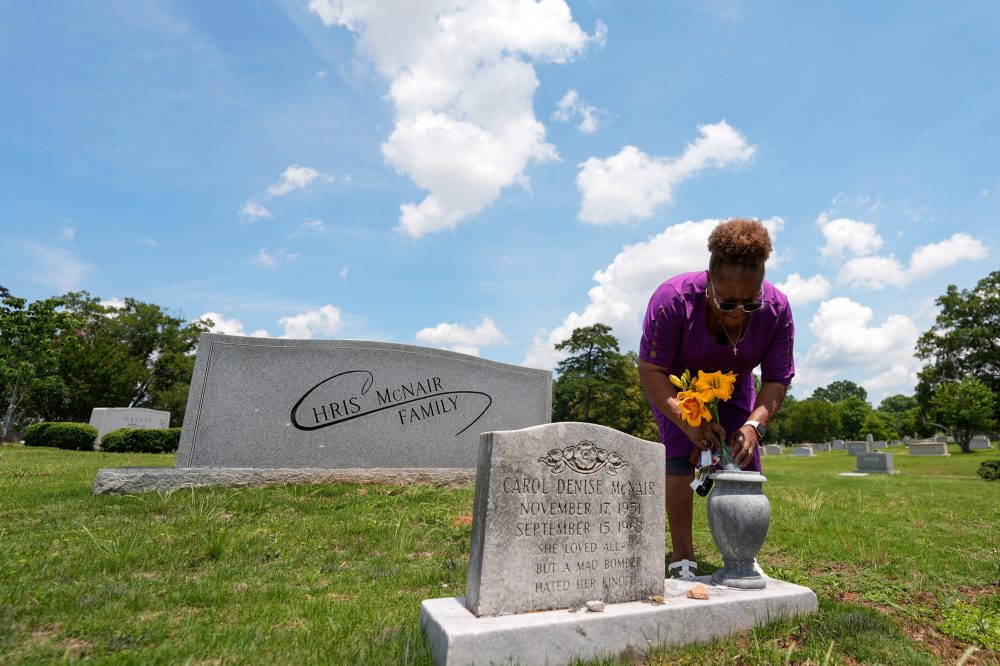
Lisa McNair entered the world on September 19, 1964 — born just days after the death of her older sister, Denise, who was killed in the September 15, 1963, bombing of the 16th Street Baptist Church in Birmingham, Alabama. That church had served as a key gathering place for civil rights organizing.
The explosion took the lives of Denise McNair, age 11; Addie Mae Collins, 14; Carole Robertson, 14; and Cynthia Morris Wesley, 14. Close to two dozen other people were wounded. Three members of the Ku Klux Klan were eventually convicted for the crime.
One of Lisa McNair’s earliest memories connected to her sister involves a box their grandmother kept from the funeral home — inside were Denise’s shoes, a purse, and a chunk of concrete the size of a rock that had been lodged in Denise’s skull.
The attack thrust the civil rights movement into the national spotlight and drew outrage from Democratic President John F. Kennedy.
The era was turbulent, McNair recalled, but it felt as though the country was moving toward something better. For most of her life, she said, “I’ve seen advances” — on television, in advertising, in interracial marriages, and in civil rights and voting rights — “a plethora of rights that we got over the greater part of my lifetime.” That sense of progress, she said, has now reversed.
McNair, 61, described feeling “physically sick” over the Supreme Court’s ruling and the actions that followed from lower courts and state legislatures.
“I am constantly working to pray my way through it, so I can get up and go to work in the morning and do what I need to do. But I just want to ask every white person I see, What more do you want?” she said. “Why do you hate us so?”
Michael Schwerner — known as Mickey — grew up in a family where standing up for human rights and pushing back against social injustice were simply expected. In 1964, he traveled to Mississippi as part of Freedom Summer. That June, he disappeared along with Andrew Goodman and James Chaney while the three were looking into a bombing at a Black church.
Their remains were discovered weeks later, buried inside an earthen dam in a remote part of Neshoba County. Schwerner was 24 and Goodman was 20; both were white. Chaney, who was Black, was 21.
Stephen Schwerner, who passed away earlier this year and had been a social activist in his own right, told The Associated Press in a 2023 interview that from the moment the family learned his younger brother and the others had gone missing, they knew the men were dead.
“Our family was very out front in the media that the only reason there was international attention was two of the young men were white,” said Stephen’s daughter, Cassie Schwerner. “Had all three of those young men been Black, they would have ended up absent from our history and our narrative.”
Cassie Schwerner, who serves as executive director of Morningside Center for Teaching Social Responsibility, said her family has tracked the voting rights struggle through its highs and lows — including the 2013 Supreme Court decision that allowed states and counties with histories of discriminatory voting practices to change their election rules without first obtaining approval from the Department of Justice.
The court’s ruling this past April, she said, stirred rage “and a good deal of sadness — not for me and my family, but for this country.” There remains, she added, much work to be done across many areas.
Tamara Orange said that when she heard about the Supreme Court’s latest Voting Rights Act decision, one of her reactions was unexpected: relief. “Relief that my dad is not here to see that; that Jimmie Lee Jackson is not here to see it; that Viola Liuzzo is not here to see it,” she said. “I’m relieved for them because to me, it’s as though the sacrifices that were made were done in vain.”
Her father, James Orange, had been working with the Southern Christian Leadership Conference to organize voting rights demonstrations in Marion and Perry County, Alabama, in 1965. After young people joined the effort, he was arrested on a charge of contributing to the delinquency of minors. Word spread that he might be taken from the jail and lynched.
A protest aimed at preventing that outcome ended with Jackson — a 26-year-old Black church deacon — being shot in the stomach by a state trooper as he tried to protect his mother and grandfather.
Jackson’s death became the spark that ignited what would become the Selma to Montgomery march and the events of “Bloody Sunday.”
James Orange remained active in the movement throughout his life and died in 2008, his daughter said. Even after the Voting Rights Act was signed into law, she recalled him warning: “Be careful or we’re going to lose it.”
Anthony Liuzzo had just celebrated his 10th birthday when his mother, then 39, left their middle-class Michigan neighborhood and made her way to Selma, Alabama. She had been moved to tears watching footage from “Bloody Sunday” on television.
Viola Liuzzo took part in a portion of the second march and then spent time ferrying other civil rights workers through the Black Belt region of the state. On March 25, 1965, while transporting one protester along the highway between Selma and Montgomery, a car pulled up beside her and shots were fired into the vehicle.
The call came close to midnight. Anthony Liuzzo recalls the person on the line asking his father whether his wife was Viola, then saying, “We got bad news for you. She’s been shot.” When his father asked if she was okay, the caller replied, “No, she’s dead” — and hung up.
An FBI informant quickly identified members of the Ku Klux Klan as the killers. The three men charged avoided conviction in state court but were later found guilty in federal court.
Anthony Liuzzo and his siblings grew up carrying the absence of missed birthdays and life events that their mother never got to share. His solace had been knowing that the voting rights she died for had become the law of the land. But the Supreme Court’s April ruling — and the rapid response from Republican-led legislatures in several Southern states to eliminate congressional districts represented by Black lawmakers — left him furious and heartbroken.
Still, he said, he remains proud that his mother had the courage to go to Selma “when others sat in their pretty little houses.”
The inscription carved at the base of Vernon Dahmer Sr.’s tombstone says it plainly: “If you don’t vote, you don’t count.”
Those words capture both the mission of his life and the circumstances of his death.
Even after Democratic President Lyndon Johnson signed the Voting Rights Act into law, not every state rushed to put it into practice. In Mississippi, the law came paired with a poll tax set at $2. That may sound small, but as Dahmer’s son, Dennis Dahmer Sr., explained, when a farmworker might earn only $5 a day, it was a meaningful barrier.
The elder Dahmer, who was 57 at the time of his death, had built a successful business — owning a store, a sawmill, and a farm near Hattiesburg. He was also a civil rights leader and served as NAACP president in Ford County. He offered to cover the $2 poll tax for Black residents who wished to register to vote.
He had long been a target of the local Ku Klux Klan. There was harassment, threatening phone calls, and the windows of his store were shot out — but no one confronted him directly, because his sons were always nearby and armed.
That intimidation seemed to fade after Johnson signed the law into effect.
“The Klan quit calling,” Dennis Dahmer said. “They quit shooting out the windows, so my family thought that all of this was behind us.”
That sense of safety shattered in the early morning hours of January 10, 1966, when two carloads of Klan members arrived. They firebombed the house and the neighboring grocery store and opened fire on the home. The elder Dahmer fought back, drawing on his substantial supply of weapons to hold off the attackers.
His wife and the three children who were home that night survived, but he suffered devastating injuries from breathing in smoke and toxic fumes from the fire. He died later that same day.
Dennis Dahmer, then 12 years old, stood at his father’s hospital bedside wondering why anyone would want his father dead simply for helping Black people exercise their right to vote.
A former Imperial Wizard of the Ku Klux Klan, Sam Bowers, was convicted in 1998 for ordering the attack and received a life sentence.
Like the other families in this story, Dennis Dahmer’s family has watched the Voting Rights Act be taken apart piece by piece over the years.
“Finally, they basically turned it into a relic,” he said.
His response now is to speak out, push for massive voter participation, and make sure people understand the cost that certain families paid so that all Americans could have the right to vote and be represented by someone of their own choosing.
“We’re living in a time when America has a lot of the same characteristics of the 1960s that I grew up in,” he said. “People say, are we going back? Hell, we’re already there.”