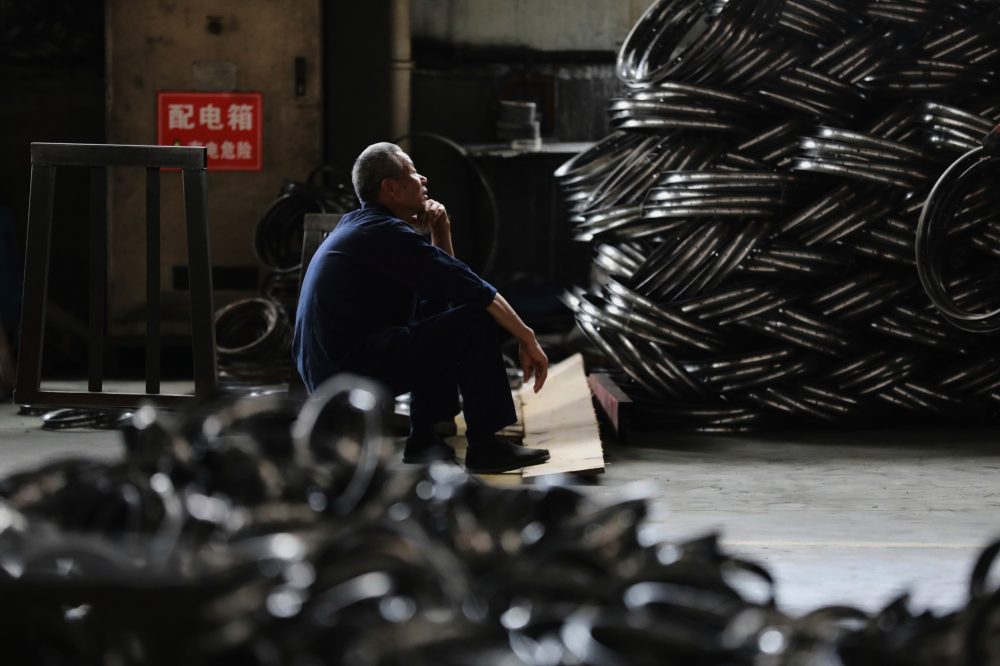

Manufacturing activity in China barely expanded during May, with new government statistics highlighting concerns about the world’s second-largest economy’s ability to maintain momentum amid international pressures.
Data from the National Bureau of Statistics showed the official manufacturing purchasing managers index declined to 50 from April’s reading of 50.3. The index operates on a 0-100 scale where numbers above 50 signal growth and figures below 50 indicate shrinkage.
Several key indicators within the report showed weakening trends. New orders fell to 49.9 from the previous month’s 50.6, while production slightly decreased to 51.2 from 51.5 in April. Raw material inventory levels also dropped to 48.6 from April’s 49.3.
Despite global energy market disruptions stemming from the Iran war, China has experienced fewer negative impacts compared to other nations dealing with rising inflation as oil costs have climbed following the Strait of Hormuz closure, a critical shipping route for one-fifth of global oil during normal times.
Economic experts note that China’s substantial oil stockpiles and varied energy supply sources have allowed the nation to largely avoid serious consequences from the conflict.
“Though the energy crisis remains the dominant headwind for Asia, China is relatively more shielded given its robust energy security set-up,” Frederic Neumann, Chief Asia Economist at HSBC bank, wrote in a research note last week.
Export markets continue playing a crucial role in China’s economic performance, according to HSBC analysis.
Although Chinese shipments to America have declined compared to the same periods last year during most recent months, international exports have shown strength, especially to European and Southeast Asian markets.
Optimism for improved U.S. trade relations has grown following President Donald Trump’s summit with Chinese leader Xi Jinping in Beijing during mid-May, when both nations agreed to establish separate trade and investment boards.
Vehicle, technology and artificial intelligence-related exports have supported growth, though some economists express broader economic concerns. Internal consumer demand continues struggling following an extended real estate sector decline that has damaged consumer confidence and investment activity.
“Domestic demand is lagging, but high-end manufacturing and exports are holding the line,” Robin Xing, Chief China Economist at Morgan Stanley, wrote in a research note last week.
Government officials have established an annual economic growth goal of 4.5% to 5% for this year. This represents the most modest target since 1991, though only marginally below the “around 5%” objective established in 2025.
Morgan Stanley analysts believe China will probably achieve its 2026 target, but oil pricing and reduced uncertainty surrounding global petroleum supplies will be critical factors influencing future economic direction.