
California’s chaotic and high-stakes gubernatorial election reaches a critical moment this Tuesday as voters prepare to select their next governor.
The state seeks a successor to Democratic Governor Gavin Newsom, with the outcome poised to shape the direction of a state government known for pioneering progressive policies while facing criticism from Republican President Donald Trump. As America’s most populated state with one of the globe’s biggest economies, California houses entertainment industry leaders, tech innovators, and agricultural producers.
The campaign took an unexpected turn this April when Representative Eric Swalwell, who had been gaining momentum among Democratic establishment figures, faced sexual assault allegations and withdrew from the race.
Since 2010, California has used a “jungle primary” system instead of traditional partisan primaries. Every voter receives an identical ballot listing all contenders, with the two highest vote-getters moving forward to the general election without regard to party membership.
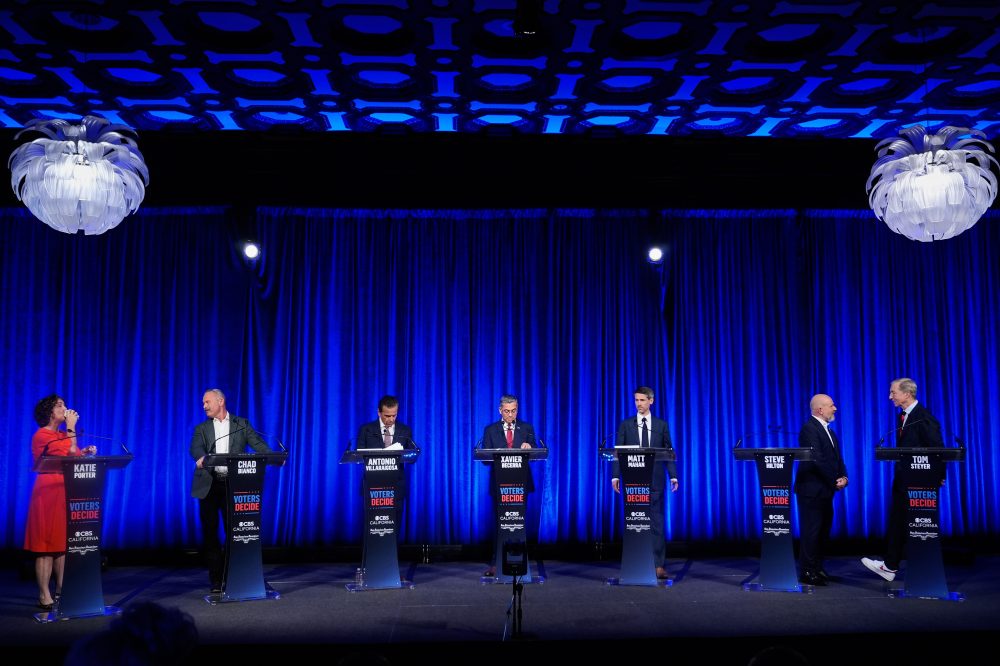
Polling data from mid-to-late May indicates Democrat Xavier Becerra and Republican Steve Hilton each command roughly 20 percent support among probable voters. One survey placed Democrat Tom Steyer in close competition with Becerra and Hilton, while Republican Chad Bianco and Democrat Katie Porter showed weaker performance, though another poll found similar backing levels for Steyer, Bianco and Porter. No other contenders reached double-digit support in either survey.
With 61 candidates listed on the ballot, financial resources and media focus have concentrated on several experienced political figures. These are the leading competitors.
Becerra brings three and a half decades of experience in California and federal government. He held a Democratic leadership position in the U.S. House before then-Governor Jerry Brown selected him as California attorney general following Kamala Harris’s election to the U.S. Senate. From this position, he mounted aggressive legal challenges against Trump and his policies throughout the president’s initial term.
Subsequently, he joined President Joe Biden’s administration as secretary of Health and Human Services.
This background forms the foundation of his appeal to voters as a reliable leader capable of governing California and confronting Trump. However, it has also drawn criticism.
Former Biden administration colleagues have questioned his performance as health secretary, and he continues facing inquiries about a former senior aide’s conviction for misappropriating campaign money.
Following Swalwell’s exit, Becerra gained backing from numerous California Democratic leaders, including major labor organizations, Planned Parenthood and the LGBTQ rights organization Equality California.
Trump’s backing provides Hilton an advantage among Republicans and potentially the most direct route to the general election among all candidates. However, this could prove problematic in November within a state that heavily rejected the Republican president. During debate appearances, Hilton typically refrained from discussing Trump without being asked directly.
Hilton works as a conservative political commentator and previously hosted shows on Fox News. Born in England, he provided advisory services to former British Prime Minister David Cameron.
Acknowledging Democratic dominance throughout California, he encourages voters to choose a Republican to balance the majority in Sacramento. Unlike Bianco’s emphasis on cultural matters, Hilton’s platform aligns more closely with traditional Republican priorities of reduced taxation and limited government. He has promised to eliminate income taxes on the first $100,000 of earnings and significantly reduce gasoline costs.
As the billionaire creator of a San Francisco hedge fund, Steyer — or at least his image — appears ubiquitously before the primary. His unprecedented spending, primarily from personal wealth, has made his advertisements unavoidable. This has elevated him among the race’s leading candidates.
Steyer, who lacks elected office experience, initially gained recognition as a contributor to Democratic politicians and organizations focused on climate change advocacy. He funded efforts demanding Trump’s impeachment during his first presidency, and subsequently invested in his own 2020 Democratic presidential campaign before withdrawing after poor results in early primary states and caucuses.
Steyer campaigns as a progressive populist, criticizing the political influence of special interests and corporations. His platform has attracted unexpected supporters for a billionaire investor, including the Bernie Sanders-affiliated organization Our Revolution.
Serving as mayor of San Jose, Mahan represents a moderate Democrat embracing Silicon Valley’s innovation-focused philosophy. His pro-business approach and entrepreneurial experience have gained favor among some technology sector leaders.
Mahan advocates California should return to “basics,” prioritizing technical problem-solving over political conflicts. He joined the race recently as an outsider to Sacramento establishment, developing statewide recognition primarily through criticism of Newsom and the Legislature’s handling of homelessness and criminal activity.
His support from technology executives — along with their substantial financial contributions — has created controversy within certain party segments, especially among labor unions and populists concerned about Silicon Valley elite influence.
Nevertheless, he has found difficulty unifying support among pro-business progressives, with some supporters maintaining multiple options. Google co-founder Sergey Brin and Palantir co-founder Joe Lonsdale also contributed to Republican Steve Hilton.
Previously an academic, Porter gained recognition through whiteboard presentations and clear policy explanations during three congressional terms representing Orange County. Her confrontational exchanges with corporate executives during Capitol Hill testimony became widely shared online.
Porter emphasizes her populist, anti-corporate credentials, claiming she can advocate for ordinary Californians against powerful entities. Prior to seeking office, she served as California’s independent banking monitor in the national mortgage settlement after the 2008 financial crisis.
Her policy expertise has earned endorsements from newspaper editorial boards. However, she has faced challenges regarding her leadership temperament. Leaked recordings revealed her harshly criticizing a staff member visible in a Zoom call and threatening to abandon a television interview. She has issued apologies and committed to more respectful treatment of others.
Porter sought a Senate seat in 2024, but did not advance past the primary.
The former Los Angeles mayor and state Assembly speaker has found limited success after spending more than ten years away from public service.
Once a union organizer, Villaraigosa became Los Angeles’s first Latino mayor in over 100 years, serving from 2005 through 2013.
Villaraigosa promotes his experience in LA and the state Capitol, campaigning as a practical, moderate problem-solver in subtle contrast to Democratic opponents highlighting their progressive ideological commitments.
Villaraigosa’s background lies in Southern California’s political network, which would differ from four terms under Brown and Newsom, both governors from the San Francisco Bay Area.
He sought the governorship in 2018 but placed third in the primary.
Bianco serves as Riverside County sheriff and highlights his 30-year law enforcement career, promising to address crime and homelessness.
As a strong Trump supporter, Bianco gained national attention when his department confiscated 1,000 boxes of election materials including over 500,000 ballots from a 2025 special election concerning redistricting. He claims this represents legitimate criminal investigation work, while critics view it as acknowledgment of unsubstantiated conspiracy theories that motivate Trump’s supporters. The state Supreme Court ordered him to stop the investigation in April.
The seizure created conflict with California’s Democratic attorney general and increased his visibility among Republicans.