
Chinese coast guard vessels turned water cannons on two Philippine government fisheries ships in the South China Sea on Friday, the third such confrontation in a single week — all while senior diplomats were gathered in Manila for major regional foreign minister talks where those very disputes were front and center.
China asserts ownership over nearly all of the South China Sea, a critical global shipping lane, despite a 2016 international arbitration ruling under the 1982 U.N. Convention on the Law of the Sea that struck down Beijing’s sweeping territorial claims.
Friday’s incident took place near Scarborough Shoal for the second consecutive day. The Philippine coast guard reported that a Chinese vessel came within seven meters — roughly 23 feet — of a Philippine fisheries ship in what officials described as a “reckless” move that put both crews at serious risk of collision.
Philippine coast guard officials strongly condemned “the dangerous and unprofessional actions of the China coast guard,” asserting that the shoal “is an integral part of the Philippine territory and its surrounding waters form part of the country’s territorial sea and exclusive economic zone.”
The Chinese coast guard offered a different account, saying multiple Philippine ships — including three coast guard vessels — had gathered in the area. Chinese officials said they issued verbal warnings, deployed interception measures, and fired water cannons to drive the vessels away.
“We sternly warn the Philippines to immediately cease its infringing and provocative actions or bear all consequences that may arise,” the Chinese coast guard said in an official statement.
Earlier in the week, a confrontation on Monday at the Second Thomas Shoal resulted in two people being injured. The Philippines said two of its sailors aboard a boat were struck by wooden poles wielded by Chinese coast guard personnel in a separate vessel. China, for its part, accused Philippine sailors of attacking the Chinese side with oars and long sticks.
The long-running territorial disputes were a central focus of the Association of Southeast Asian Nations foreign ministers and their counterparts from Asia and Western nations, who held three days of closed-door discussions beginning Tuesday in the Philippine capital.
ASEAN ministers addressed the South China Sea situation on Tuesday and released a joint statement noting that “concerns were expressed by some ministers on the land reclamations, activities, serious incidents in the area, including actions that put the safety of all persons at risk, and damage to the marine environment.”
The 11-nation bloc’s top diplomats also acknowledged “significant progress” in ongoing negotiations with China on a code of conduct intended to reduce the risk of armed conflict in the disputed waters, expressing hope that the talks could be wrapped up by the end of this year.
U.S. Secretary of State Marco Rubio met Wednesday with his Chinese counterpart, Wang Yi, on the sidelines of the ASEAN gathering. The two discussed Monday’s incident at the Second Thomas Shoal, with Rubio characterizing it as “escalatory.”
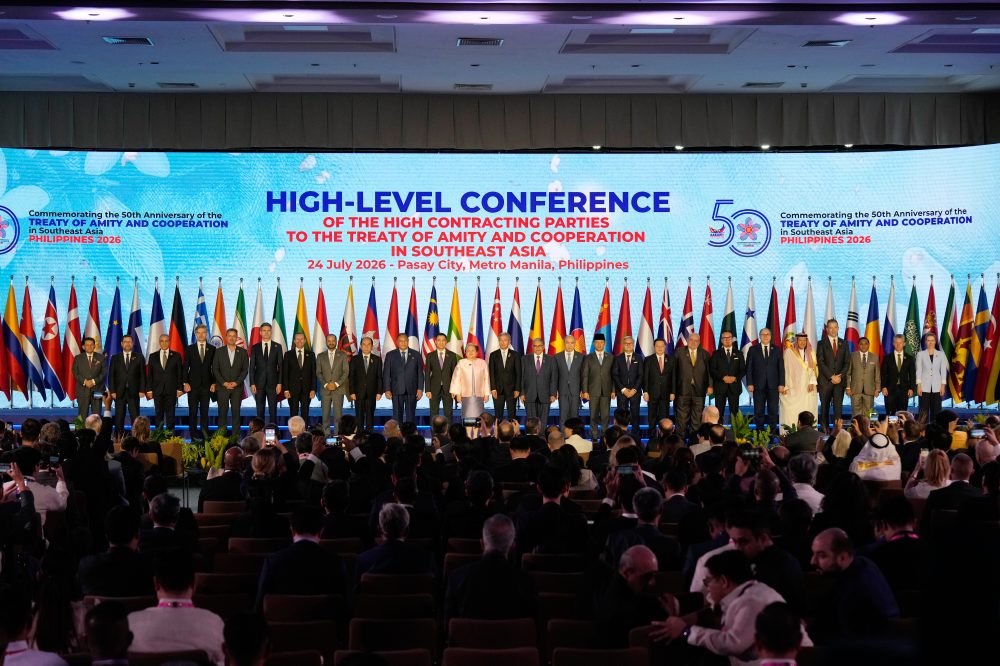
The week of high-level ministerial meetings in Manila concluded Friday with a ceremony marking the anniversary of ASEAN’s 1976 Treaty of Amity and Cooperation, a regional nonaggression agreement. Philippine Foreign Secretary Theresa Lazaro used the occasion to emphasize the importance of defending peace in uncertain times.
“Peace is a daily choice,” Lazaro said. “It requires continuous labor, deliberate restraint, inclusive dialogue and an unyielding adherence to the rule of law.”