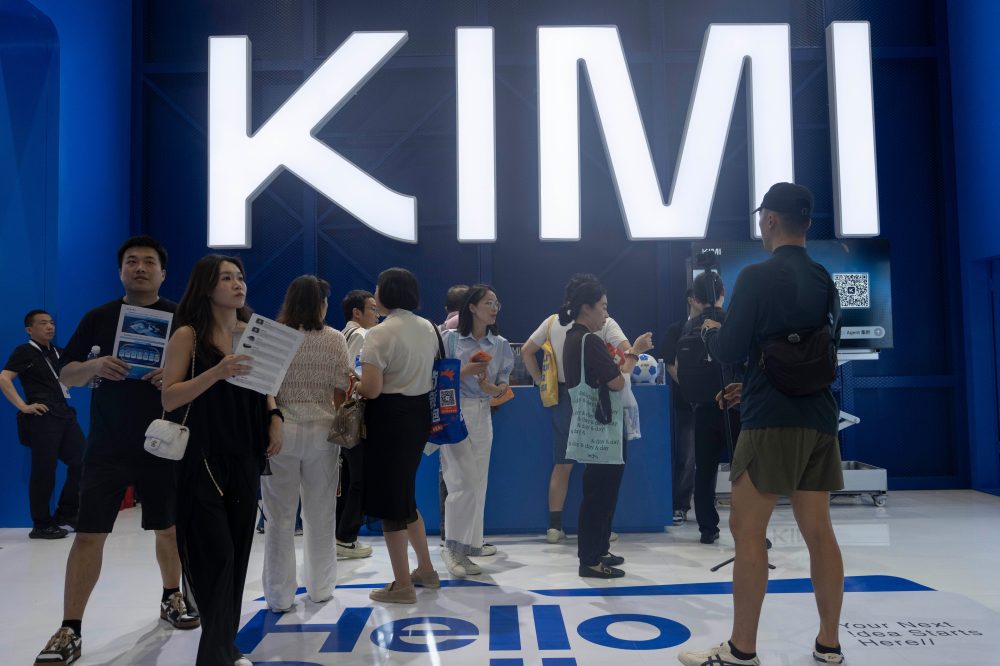

HONG KONG (AP) — A newly released Chinese artificial intelligence model known as Kimi K3 has stopped accepting new subscribers after a massive wave of interest pushed the system to its limits within just days of becoming publicly available.
The situation underscores the growing challenges Chinese AI developers face in scaling up to meet surging demand, both domestically and internationally, as competition between the United States and China in the technology sector continues to intensify.
Chinese AI models built on open-source frameworks and offered at lower costs — including DeepSeek’s latest V4 — have been rapidly gaining worldwide attention. Earlier in 2025, DeepSeek sent shockwaves through global markets and helped establish China as a genuine competitor to the U.S. in the frontier AI space, where Chinese models are largely open source.
“Kimi K3 has received far more love than we expected,” wrote Moonshot AI, the Beijing-based company behind the model, in a post on X late Sunday. “Over the past 48 hours, demand has pushed close to the limits of our current capacity.”
Moonshot AI said it is focusing on serving existing subscribers while temporarily putting new sign-ups on hold. “We’re adding capacity as fast as we can and will reopen new subscription spots in batches,” the company added. A similar message was shared on Chinese social media platforms.
Kimi K3 made its public debut late last week, positioning itself as a direct challenge to more advanced AI systems developed by companies like Anthropic, OpenAI, and others. With 2.8 trillion parameters — a standard measure of an AI model’s power and capability — it is considered the largest open-source AI model in the world.
“New model releases generally trigger massive interest, which can strain existing compute infrastructure,” said Lian Jye Su, a chief analyst at the technology research and advisory group Omdia. “This does show Moonshot AI does not have sufficient compute chips to serve the current surge in demand.”
Su added that Moonshot AI likely did not fully anticipate just how popular K3 would become. The model is described as “very demanding” when it comes to computing requirements, making it both difficult and costly to allocate the necessary resources.
After its release, Kimi K3 climbed to the top of the rankings on Arena, an AI model evaluation platform, based on front-end coding capability — a widely used measure of AI performance among major advanced models.
The launch has also weighed on shares of major American technology companies, with investors worried that more affordable Chinese AI models could erode the pricing power and market demand of U.S. AI firms. This comes even as U.S.-led export restrictions have already blocked China from accessing some of the world’s most advanced technologies, including cutting-edge computer chips.
K3 is among several recent Chinese AI releases drawing strong reactions globally. Over the weekend, Chinese tech giant Alibaba previewed its latest Qwen3.8 Max model, which it described as having 2.4 trillion parameters, calling it one of the world’s most powerful models and ranking it second only to Anthropic’s Fable 5. Last month, Chinese startup Zhipu, also known as Z.ai, launched its GLM-5.2 model, which quickly gained widespread adoption around the world.