
BEIJING (AP) — When global sensation BTS kicked off their first world tour in over three years, fans noticed a glaring absence from their 12-month schedule: China.
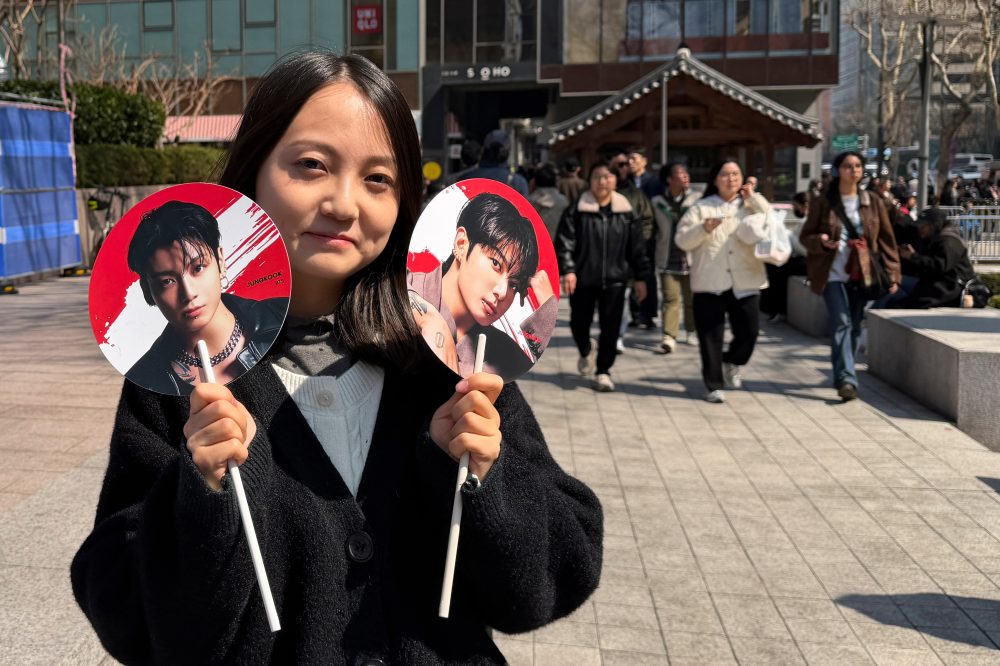
The exclusion of Chinese audiences comes as no shock to industry watchers. Beijing has maintained an unofficial blockade against South Korean entertainment since 2016, affecting everything from pop concerts to television shows and films. This restriction forces devoted Chinese fans to travel to Seoul to catch their favorite performers — a journey many made this week for BTS’s opening shows.
Beijing frequently employs economic measures during diplomatic tensions. The entertainment restriction began when South Korea agreed to host American anti-missile defense technology on its territory. What makes this particular blockade unique is its duration, which experts say reflects Beijing’s anxiety about Korean pop culture’s overwhelming appeal among Chinese youth. The government strongly promotes domestic cultural content instead.
Recent speculation about potentially relaxing these restrictions — something South Korean President Lee Jae Myung has openly hoped for as he works with Chinese leader Xi Jinping to strengthen bilateral relations — has brought renewed attention to the issue.
Beijing’s economic pressure tactics demonstrate government determination, establish clear boundaries for unacceptable behavior, and boost domestic nationalism, according to Seung-Youn Oh, a Bryn Mawr College professor researching China’s informal economic penalties.
“From China’s perspective, these actions go beyond symbolism,” she said in a written response to questions. “They are strategic tools to shape the international environment.”
Korean pop groups with international members have been permitted to perform in China. Merchandise shops selling K-pop items draw lengthy queues and require advance bookings during busy periods.
Streaming services have made Korean dramas somewhat accessible — though newer episodes often appear as unauthorized copies. A survey of four major Chinese platforms revealed roughly 50 available dramas, all produced at least four years ago.
The restrictions don’t extend to Macao and Hong Kong — where BTS plans to perform in 2027 — since both territories operate under separate governmental systems within China.
“I’m already really grateful that they can perform in places like Hong Kong, Macao and Taiwan,” said Tian Xin, who traveled to Seoul last month for a free comeback concert ahead of the tour. “The rest is a matter of national policy. Of course, I still hope they can come closer to us — fans always want that.”
The missile defense installation, called THAAD, targets North Korean threats, but China argued its radar capabilities could monitor Chinese territory. While Americans operate the system, Beijing’s anger focused on South Korea’s decision to permit the deployment.
Beyond entertainment restrictions, China also forced out South Korean retail chains. The THAAD system continues operating — though recent surveillance footage and imagery suggest the U.S. may have relocated some interceptor missiles to Middle Eastern conflicts involving Iran.
Initially, China embraced the “Korean Wave” as culturally compatible entertainment that could replace Western pop culture, according to a Korea Creative Content Agency report from earlier this year. However, Korean music and drama popularity exploded during the 2010s, creating what the report described as a phenomenon requiring government oversight.
“The Chinese government had never experienced anything like that before,” said Dong-ha Kim, a professor at the Busan University of Foreign Studies.
“While the dispute over THAAD happened to coincide with that period, Beijing’s fundamental concern goes deeper,” he said. “It cannot allow foreign culture to shape the thinking of its young people, especially when its government has no control over the content.”
In 2021, the government prohibited feminine-appearing men from television, likely targeting aesthetics Chinese performers adopted from Korean and Japanese entertainers.
China also aims to build its own pop culture influence globally. Consider the Labubu toy phenomenon and expanding food and beverage franchises.
“China wants cultural governance — to grow its own music industry,” said Hyunji Lee, a financial analyst who covers the entertainment sector. “If K-pop floods back in, there’s a direct conflict.”
However, China has never officially confirmed any prohibition exists.
“China has never imposed any so-called bans on the Republic of Korea,” Foreign Ministry spokesperson Zhao Lijian said in 2022. Another spokesperson, Lin Jian, said last September that China welcomes “healthy and beneficial” cultural exchange with South Korea.
Optimism for lifting restrictions increased after Lee and Xi held two meetings. During Lee’s January visit to China, both governments agreed to expand cultural and content cooperation — but only incrementally, beginning with soccer and the traditional board game go.
Xi referenced two Chinese proverbs, according to South Korean officials: “Three feet of ice does not form in a single day” and “Fruit falls only when it ripens.” These sayings indicate any policy changes will require time and proper circumstances.
On Chinese social platforms, some users argued that K-pop — with its provocative choreography — isn’t suitable for children. Others worried Korean entertainment might dominate local industries. Fans expressed hope for domestic performances that would eliminate expensive overseas travel and accommodation costs.
Yu Sang, a fan and event coordinator, made five trips to Seoul last year for K-pop events and organized a “KPop Demon Hunters” gathering at a Beijing shopping center on New Year’s Eve.
“The fans in China are incredibly devoted,” she said. “If you go to the Arctic, I’ll go to the Arctic with you.”
The restrictions have transformed how South Korean entertainment companies view the Chinese marketplace.
Television drama producers have suffered the most significant losses and stand to benefit most from policy changes, more so than the K-pop industry, according to analyst Lee.
Unauthorized versions generate no revenue for producers. These dramas appear on small applications and sometimes vanish within days, based on social media reports. Some applications themselves disappear, then resurface with modified names.
Netflix and Disney+, which distribute most South Korean dramas worldwide, remain blocked in China. Access requires virtual private networks, which violate Chinese law (though enforcement varies).
The K-pop industry has adapted so China no longer represents a crucial market. Japan has become the primary anchor market, while North America serves as the main expansion target.
“China matters,” Lee said, “but it’s not something companies are desperately waiting on anymore.”