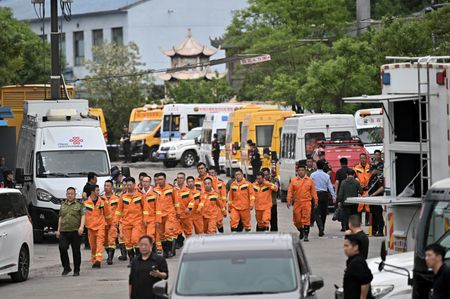

BEIJING – Chinese authorities are conducting a comprehensive investigation into a devastating coal mine explosion that claimed at least 82 lives on Friday, uncovering an elaborate scheme of deception designed to hide illegal mining operations from government inspectors.
The fatal gas blast occurred at the Liushenyu mine located in Shanxi province, a coal-producing region in northern China. Two people remain missing while 128 others were taken to hospitals for treatment, according to government media reports.
This incident marks China’s most catastrophic mining disaster since 2009, when 108 workers perished in a gas explosion at the Xinxing Mine in Heilongjiang province.
Initial findings from the investigation reveal that the mine operator maintained secret tunnels, doctored blueprints, and employed unregistered workers who lacked mandatory safety tracking devices, state news agency Xinhua reported Tuesday.
The mining facility, operated by Shanxi Tongzhou Coal Coking Group, maintained dual sets of operational plans and monitoring systems. Officials used one set for actual mining activities while presenting the other to government inspectors, effectively concealing portions of their operation from regulatory supervision.
Company representatives could not be reached for comment, as state media reports indicate they have been taken into custody.
Coal extracted from these unauthorized tunnels was excluded from official production records and escaped taxation.
These duplicate planning systems are commonly referred to as “yin-yang drawings” – one version displayed openly for inspector review and another kept secret. The national mine safety administration acknowledges that such profit-motivated deceptions persist throughout China’s coal industry despite enforcement efforts.
According to Xinhua, the Liushenyu operation “constructed false doors using wire mesh and woven plastic bags coated with mortar, creating barriers that closely resembled the natural rock walls of mining tunnels.”
Mine personnel received advance warning when inspectors approached, allowing them to close these deceptive barriers and apply coal dust to camouflage them within the underground passages.
To avoid detection, mine management employed subcontracted workers in the concealed areas without providing mandatory identification and location tracking equipment or recording their presence in official entry logs.
These tracking devices would have enabled authorities to monitor worker locations throughout the underground facility, particularly during emergency situations.
Official records indicated only 124 workers had entered the mine when Friday’s explosion occurred, based on footage broadcast by state television CCTV on Monday. However, 247 workers were actually present in the facility, indicating that 123 individuals were operating in unmonitored tunnels beyond official oversight.
The absence of precise maps and worker location data has significantly complicated rescue efforts, state media reported.
The Liushenyu facility – designated as a “high-gas mine” due to elevated explosion risks – also intentionally failed to install gas-detection equipment to further avoid regulatory scrutiny, according to a separate report from state radio.
These violations were previously known to authorities before Friday’s tragedy. In 2025, regulators fined the mine operator after discovering hidden work areas, but “the penalty failed to serve as an effective deterrent, and the company continued illegal production,” Xinhua stated.
Following this incident, several mines throughout China have suspended or reduced operations for safety evaluations.