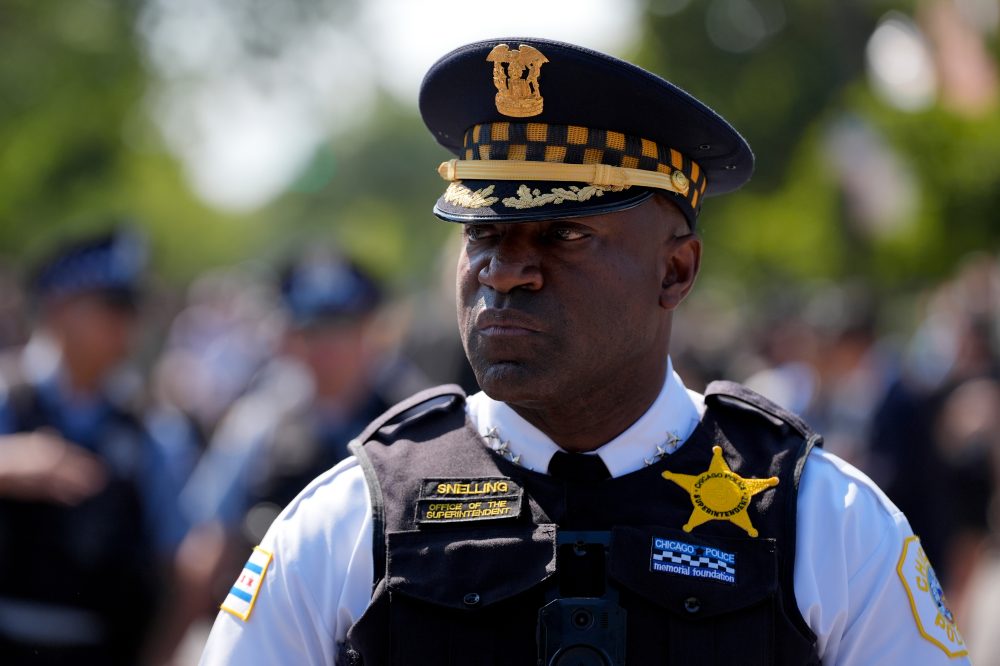

Chicago Police Superintendent Larry Snelling announced Wednesday that he plans to retire, ending a three-year run at the helm of one of the country’s largest law enforcement agencies.
Snelling took charge of the 12,000-officer department three years ago, making community trust and reducing violent crime central priorities of his leadership. He emphasized innovation and stronger relationships between officers and the neighborhoods they serve.
Crime statistics from the department show that murders and shootings — traditionally the key indicators of crime trends in Chicago — have dropped significantly this year, falling 32% and 41%, respectively, compared to 2023.
In a written statement, Snelling did not specify what motivated his decision to leave, but expressed appreciation for the support he received. “I am closing out this chapter of my life with a heart full of gratitude for every Chicagoan and every community partner who embraced me during my time at the Chicago Police Department,” he said.
The superintendent’s role in Chicago has long been a challenging one. Many of Snelling’s predecessors lasted only a few years before stepping down amid pressure from various interest groups, including the local police union.
Among the more difficult periods of his tenure, Snelling oversaw the department as hundreds of National Guard troops were deployed to Chicago as part of President Donald Trump’s immigration enforcement efforts targeting cities with Democratic leadership. He had to balance maintaining public safety without appearing to align too closely with federal immigration authorities — a position that risked damaging community trust and sparking protests.
In 2024, Snelling helped coordinate security for the Democratic National Convention, during which then-Vice President Kamala Harris formally accepted her party’s presidential nomination. Officers received training in constitutional policing and de-escalation techniques, while a select group underwent specialized preparation for responding to civil unrest and riots.
Snelling also guided the department through its ongoing compliance with a federally monitored reform plan — known as a consent decree — approved by a federal judge in 2019. The plan was put in place following a U.S. Justice Department report that identified widespread civil rights violations within the department. It called for expanded community policing efforts and enhanced training on the use of force.
Mayor Brandon Johnson praised Snelling’s service in a statement of his own. “We’re grateful for Superintendent Snelling’s dedicated leadership and the work we’ve accomplished together to advance a community safety strategy rooted in strong partnerships and deep community engagement across Chicago,” Johnson said.
Snelling, who grew up on Chicago’s South Side, joined the police department in 1992 as a patrol officer, according to the mayor. He later rose to lead the department’s counterterrorism division. In 2023, the City Council voted unanimously to confirm him as superintendent.
His retirement takes effect July 15. Fred Waller will serve as interim superintendent while officials conduct a search for a permanent replacement, Mayor Johnson said.