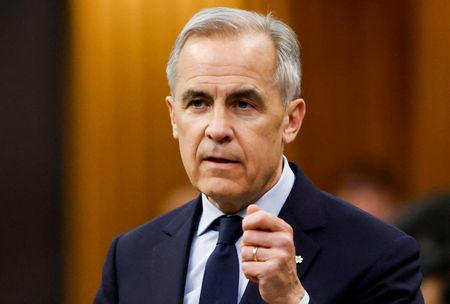

Canadian Prime Minister Mark Carney appears positioned to gain a parliamentary majority for his Liberal administration following Monday’s special elections, a development that would strengthen his ability to advance his policy priorities amid growing global uncertainty.
Monday’s voting takes place in three districts across Ontario and Quebec, with two of these areas having historically supported Liberal candidates. Securing victory in just one district would provide Carney with the majority he needs, while polling data suggests the Liberals may claim at least two seats.
Carney has indicated this parliamentary control would enhance his capacity to address ongoing trade disputes with the United States under President Donald Trump’s administration. The Liberal Party currently holds 171 positions in Canada’s 343-member House of Commons.
Achieving a parliamentary majority would grant Carney greater governing flexibility and strengthen his leadership position through 2029, when the next national elections are scheduled.
“He will be able to pass legislation without having to go to the opposition to secure enough votes,” explained Andrew McDougall, who teaches Canadian politics at the University of Toronto. The Liberal government has depended on occasional Conservative Party support to advance economic and trade-related bills over the past year.
McDougall noted that majority control would also allow Carney to determine when future elections occur. Minority governments face the constant threat of sudden elections if they fail confidence votes and typically survive less than two years.
Carney’s position has been bolstered by five opposition lawmakers who joined the Liberal Party over five months, providing him with a more substantial margin beyond a single-seat majority. Only governments under Canada’s first prime minister John A. Macdonald and Jean Chretien have experienced more defections to the ruling party.
This past Wednesday, veteran Conservative politician Marilyn Gladu announced her switch to Carney’s government, stating Canada requires “a serious leader who can address the uncertainty that has arrived due to the unjustified American tariffs.”
Gladu, a former chemical engineer who has faced criticism for promoting unverified scientific treatments during COVID-19, opposing conversion therapy bans, and suggesting military intervention against Indigenous pipeline protests, expressed gratitude to Carney for welcoming her into “the large Liberal tent.”
Speaking Thursday, Carney emphasized that fundamental Liberal Party principles including inclusivity, diversity, and protecting Charter of Rights and Freedoms remain unchanged, with government caucus membership requiring support for these values.
However, Yves-Francois Blanchet, who leads the separatist Bloc Quebecois party, criticized the development, saying “the ideological differences between the Liberals and Conservatives are getting thinner and thinner by the minute.”
The Bloc Quebecois faces an extremely close contest with the Liberals in Terrebonne, Quebec. While the Liberals won this district by a single vote in the previous federal election, Canada’s Supreme Court invalidated the result due to a printing error on a voter’s envelope.
The remaining two contested seats are located in Ontario, including one left vacant by former Deputy Prime Minister Chrystia Freeland and another previously occupied by former Liberal member Bill Blair, who stepped down after receiving appointment as ambassador to the United Kingdom. Analysts expect the Liberals to retain both positions.
“What we’re seeing right now is a change of focus for the Liberal party,” observed Laura Stephenson, who chairs the political science department at the University of Western Ontario.
Stephenson noted that while Carney’s predecessor Justin Trudeau moved the party leftward and emphasized Indigenous reconciliation, minority rights, and immigration, Carney faces more immediate challenges as a more centrist leader.
“He is focused on helping Canada survive the economic turmoil, not remaking society,” she explained. “When we’re in tough times like this, there are different calculations being made.”
New polling data from Nanos indicates more than half of Canadians favor Carney as prime minister, with only 23% supporting Conservative leader Pierre Poilievre. Before Carney assumed Liberal Party leadership last year, Poilievre was projected to win the next election by over 20 percentage points.
“Carney has done a fairly good job showing Canadians he can handle Trump,” McDougall from the University of Toronto said. “He’s shown Canadians he’s a competent manager of the economy and the country. And so far Canadians have not been overly impressed by the alternatives.”