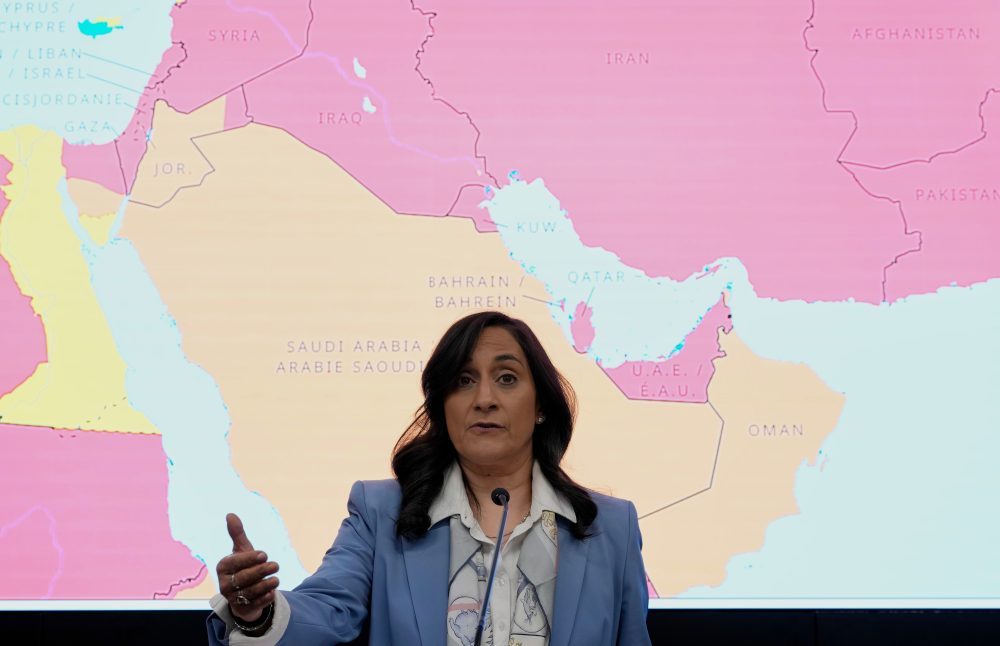

ANKARA, Turkey — Canadian Foreign Minister Anita Anand declared Tuesday that Ottawa had no advance warning about the U.S.-Israeli military strikes against Iran that ignited the current Middle East war and will not take part in any offensive combat operations.
Speaking by phone with The Associated Press before meeting with Turkish Foreign Minister Hakan Fidan in Ankara, Anand emphasized that Canada’s main focus remains reducing tensions in the region and safeguarding civilian populations.
The Canadian foreign minister traveled to Turkey for regional discussions as fighting continues across the Middle East.
Last week, U.S. President Donald Trump urged NATO members and other major nations to assist in reopening the Strait of Hormuz, cautioning that the alliance could face dire consequences if they decline to help. Iran has shut down the crucial shipping route since hostilities began, causing fuel costs to surge and creating disruptions in global commerce and transportation.
“Canada was not consulted, did not participate in the military action, and has no intention of participating in the offensive military operation,” Anand stated. “Our foreign policy is focused on de-escalation and the protection of civilians and humanitarianism generally.”
The minister noted that during her discussion with Turkish Vice President Cevdet Yilmaz, both officials concurred that “de-escalation is of the utmost priority and that the war in the Middle East needs to end in the interests of civilian lives.”
Throughout the conflict, NATO defensive systems have successfully stopped three ballistic missiles launched by Iran toward Turkish airspace. These incidents prompted the alliance to station an additional Patriot missile defense battery on Turkish soil.
In a separate AP interview earlier this week, Fidan stated that Turkey’s primary goal is staying out of the conflict and dismissed the possibility of a military response for now, noting that NATO’s protective measures have proven successful.
When questioned about whether Canada would respond if a NATO member came under attack, Anand replied: “We will take all decisions concerning the alliance in conjunction with the alliance.”
Canadian Prime Minister Mark Carney originally supported the Iranian strikes but subsequently said he endorsed them “with some regret” because they exemplified an extreme breakdown of global order.
Anand maintained that Canada’s international policy remains unchanged.
“It has been our long-standing position that Iran is a destabilizing force in the Middle East and in particular, Iran’s proliferation of its nuclear capacity,” she explained. Anand clarified that Carney’s shift wasn’t about changing that position, but rather about promoting regional peace, supporting Gulf nations under attack, and putting civilians and infrastructure first.
The Canadian minister also voiced alarm about the fighting between Israel and Hezbollah in Lebanon, noting that Lebanese citizens “are bearing the brunt of the ongoing war.”
On Monday, Canada joined France, Germany, Italy, and the United Kingdom in releasing a joint statement cautioning about the serious ramifications of increasing violence in Lebanon. The declaration warned that a major Israeli ground campaign could result in catastrophic humanitarian impacts and that extended fighting “must be averted.”
“And we very much are concerned with Hezbollah’s attacks on Israel and the targeting of civilians,” Anand said. “We want to ensure that there is meaningful engagement by Israeli and Lebanese representatives to negotiate a sustainable political solution.”