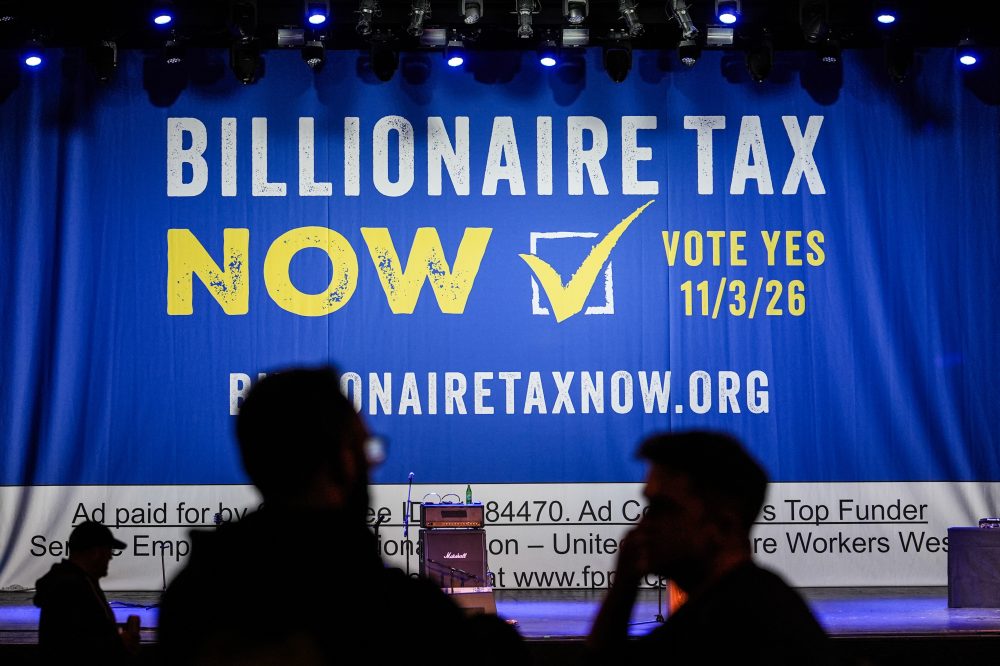

Voters in California will have a major financial question on their November ballot after the labor union behind a proposed billionaire tax announced Thursday it will not back down despite mounting pressure to pull the measure.
The proposal, supported by the Service Employees International Union Healthcare Workers West, would apply a one-time 5% tax to individuals with a net worth above $1 billion who were living in California as of January 1, 2026. Supporters say the tax could bring in $100 billion in revenue, with the bulk of that money earmarked to shore up the state’s Medicaid program in the wake of federal funding cuts.
“We aren’t backing down,” campaign spokeswoman Debru Carthan declared during a Zoom call with reporters.
The measure faces significant opposition, including from Democratic Gov. Gavin Newsom — who is weighing a presidential campaign ahead of leaving office in January — along with many of the union’s traditional political allies. Critics argue the tax is only a short-term answer to a long-term problem and warn that it could push the state’s wealthiest residents to relocate, along with the income tax dollars they bring with them. Newsom has broadly resisted tax increases throughout his time as governor.
A broad coalition of healthcare, education, and housing organizations — among them the California Medical Association and the California School Boards Association — came together last week to fight the proposal.
“The dangerous wealth tax directly threatens vital funding for education and schools, healthcare and clinics, public safety, and infrastructure projects by making California’s revenue even more volatile,” the coalition said in a written statement.
Brian Brokaw, a political adviser to Newsom who is leading a committee working to defeat the tax, warned that the measure would “make California’s biggest challenges worse.”
“Driving away the state’s sustainable tax base for a one-time grab is bad policy and an even worse deal for 40 million Californians who will be left holding the bag,” Brokaw said.
If passed, the revenue collected would be distributed over several years. The nonpartisan Legislative Analyst’s Office projects the tax would bring in tens of billions of dollars in the early years, but that income tax revenues would then fall by hundreds of millions of dollars each year afterward.
A number of wealthy Silicon Valley tech figures who oppose the measure have already moved assets out of state or threatened to do so to sidestep the potential tax. They have collectively spent millions of dollars in an effort to defeat it.
Since the proposal was first unveiled in October, Google co-founder Sergey Brin has contributed $82 million to a political committee called Building a Better California, which supports various efforts aimed at countering the billionaire tax. That committee has now raised more than $118 million in total, drawing from fewer than a dozen donors.
California currently depends on its top 1% of earners for nearly half of all personal income tax revenue collected by the state.
Last week, the union offered a compromise, proposing a scaled-back 2% tax on billionaires and asking Newsom to get on board. The governor’s office rejected the offer, saying the lower rate did not change his position.
Martin Gilens, a political science professor at the University of California, Los Angeles, said the proposal is drawing interest from Democrats in part because of the current political climate around affordability, income inequality, and cuts to federal programs.
“There’s kind of a perfect storm that sort of bolsters preexisting inclinations to be sympathetic to the idea of raising taxes on the well-to-do,” Gilens said.
Still, Gilens noted there are real hurdles ahead. Support for ballot measures often erodes as election day approaches, and if the measure does pass, it would likely face legal challenges in court.