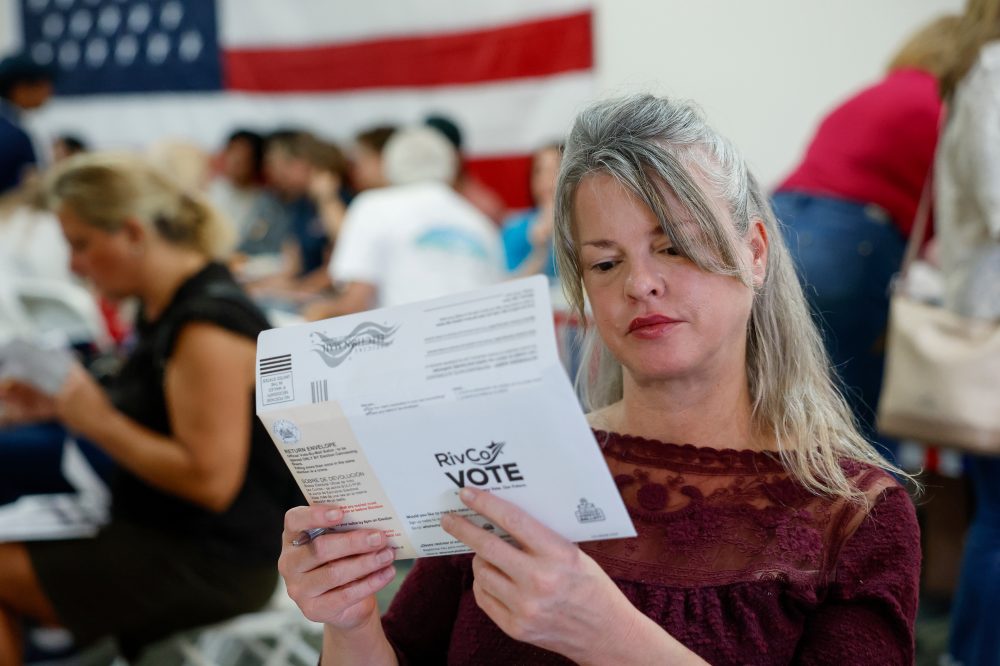

WASHINGTON — California voters face a crowded ballot Tuesday as they choose between 61 candidates seeking the governor’s office, while also selecting congressional nominees under newly drawn district lines approved by voters in a 2025 ballot measure.
The ballot includes numerous state and local races, featuring a Los Angeles mayoral contest where the sitting Democratic mayor confronts over a dozen opponents. One challenger is a former reality television star who has gained attention from President Donald Trump, another former reality TV figure.
California’s unique primary system, which places all candidates on one ballot without party divisions, has created complex campaign strategies in several prominent races, particularly the contest to succeed term-limited Democratic governor. Though Democratic contenders typically benefit from facing Republican opponents in this heavily blue state, the abundance of well-known Democratic candidates risks dividing their party’s vote and potentially allowing two Republican candidates to reach the general election, ensuring a Republican victory.
Democratic hopefuls include former health secretary, former congressional representative, the mayor of San Jose, a billionaire who ran for president in 2020, and a former Los Angeles mayor. Republican contenders feature a county sheriff from Riverside and a conservative media personality backed by Trump.
Two additional Democrats appear on the ballot despite ending their campaigns. One was a leading candidate who withdrew on April 12 amid sexual assault claims he disputes, subsequently resigning from Congress two days afterward.
Congressional races for the closely contested House feature a new district map that favors Democrats, creating challenges for several incumbent Republican representatives. Voters endorsed these new boundaries in a November 2025 referendum, responding to Trump’s efforts in Texas and elsewhere to increase Republican seats before the midterm elections.
In one congressional district, a Republican representative evaluated his limited prospects and departed the Republican Party in March to seek reelection as an independent candidate.
Two Republican House members now compete against each other in another district, while a Democratic challenger hopes to secure one of the two general election positions.
A special election in another congressional district will complete the term of a late Republican representative who passed away in January. The contest features five candidates, including the Democratic state Senate leader and the Republican Assembly minority leader. Without a majority winner, the leading two candidates will face off on August 4. The victor will serve under current district lines, not the new map taking effect next Congress.
A separate special election for another vacant congressional seat will occur June 16, also using existing boundaries.
Los Angeles mayoral candidate Karen Bass pursues a second term in the nonpartisan position against multiple challengers including a technology entrepreneur, a former MTV reality show participant, a city council member, and others. Trump recently expressed support for the reality show veteran, saying he would like to see him succeed.
Democrats maintain substantial advantages in statewide contests due to strong support in densely populated regions around major cities. Republicans perform better in less populated northern areas and the Central Valley, while remaining competitive in Southern California suburbs outside the largest metropolitan areas. No Republican has captured statewide office in California since 2006.
Voting concludes at 8 p.m. Pacific Time, equivalent to 11 p.m. Eastern Time.
The Associated Press will report results and announce winners across numerous contested positions including congressional seats, statewide offices, state legislative races, and major local contests.
All registered California voters may participate in the primary election.
Current registration includes approximately 23.1 million voters as of April 3, with roughly 10.4 million Democrats, 5.8 million Republicans, and 5.3 million unaffiliated with any party.
Previous primary turnout reached about 7.3 million votes in 2024, representing roughly one-third of registered voters.
Nearly 89% of 2024 primary votes were submitted before election day.
Early voting has already produced about 2.6 million ballots as of Thursday.
Most California counties typically release mail-in voting results in their initial reports, usually before reporting in-person election day totals. Nearly half release most early in-person voting results in their first update.
Since mail voting generally favors Democrats while election day voting tends toward Republicans, early mail ballot reports may show Democratic leads that Republicans could narrow as election day results arrive.
In 2024 primaries, initial results appeared at 11:08 p.m. Eastern Time, eight minutes after poll closing. Final overnight updates came at 6:01 a.m. Eastern with approximately 52% counted. The tally reached 99% completion about two weeks later.
The Associated Press declares winners only when no remaining scenario could allow trailing candidates to overcome their deficits. For uncalled races, coverage continues for significant developments while clarifying that no winner has been determined.
California lacks automatic recount provisions. Any registered voter may request and fund a recount. The AP may declare winners in races subject to recounts when leads appear too large to overcome.
Upcoming election dates include 14 days until the June 16 special primary, 63 days until the August 4 special general election, 77 days until the August 18 special general election, and 154 days until the November 3 general election.