
Four Republicans are competing in Tuesday’s primary election for South Dakota governor, creating one of the most contested races in the state. The current governor, along with the state House speaker, the state’s sole congressional representative, and a business owner are all vying for the nomination.
Larry Rhoden, the incumbent governor, is seeking his first full term in office. Rhoden previously served as lieutenant governor under Kristi Noem but took over the governor’s role when Noem left in early 2025 to join Donald Trump’s presidential administration.
Despite his position as sitting governor, Rhoden faces significant opposition from three challengers: Dusty Johnson, who currently represents South Dakota in the U.S. House; Jon Hansen, who leads the state House as speaker; and business owner Toby Doeden.
The Republican primary winner will go head-to-head with Dan Ahlers, a former state senator, in November’s general election. Ahlers faces no competition for the Democratic nomination.
Tuesday’s ballot also features a U.S. Senate race where Mike Rounds, the Republican incumbent, seeks his third term. Rounds will face Justin McNeal in the primary, a Navy veteran who attempted to run as an independent against Johnson in 2024 but was removed from the ballot due to signature issues on his petition.
Julian Beaudion, a nonprofit leader and former state trooper, runs unopposed for the Democratic Senate nomination. Brian Bengs, an attorney and military veteran, will compete in the general election as an independent candidate. Bengs previously sought the Senate seat in 2022, capturing 26% of votes against John Thune, the Republican Senate Majority Leader.
For the U.S. House position, Marty Jackley, the state attorney general, is running to take Johnson’s seat. His Republican primary opponent is James Bialota.
Donald Trump has given his endorsement to Rounds for Senate and Jackley for the House race, but chose not to back any gubernatorial candidate.
South Dakota’s primary system requires candidates for governor, U.S. Senate, and U.S. House to earn at least 35% of votes to secure the nomination. Should no candidate meet this benchmark, the two highest vote-getters will compete in a June 23 runoff election.
The mayor’s race in Sioux Falls, the state’s largest city, features five candidates competing to succeed the term-limited Paul TenHaken. A runoff will occur if no candidate wins a majority of votes.
Election observers will focus on two key counties: Minnehaha County in the east, which includes Sioux Falls, and Pennington County in the west, home to Rapid City.
Given South Dakota’s strong Republican voting history in general elections, Tuesday’s GOP primary winners are expected to have substantial advantages heading into the fall campaign.
Voting concludes at 7 p.m. local time, translating to 8 p.m. and 9 p.m. Eastern Time due to the state spanning two time zones. Most polling locations operate on Central time and close at 8 p.m. ET, while Mountain time zones close an hour later.
The Associated Press will track results and announce winners in competitive primaries for federal and state offices, as well as the Sioux Falls mayoral contest.
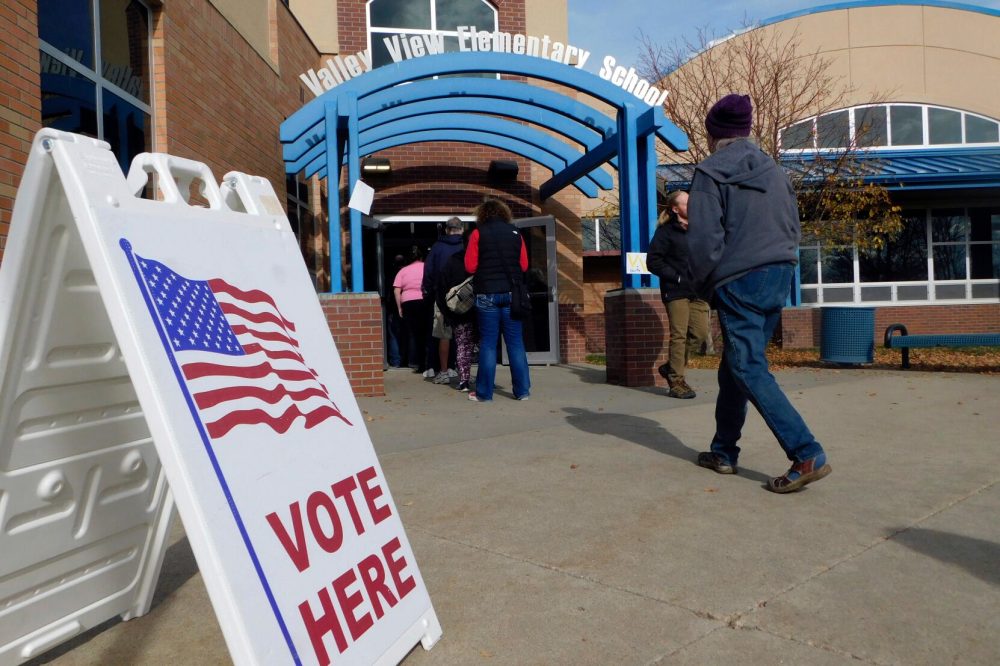
Voting rules restrict registered party members to their own party’s primary. Democrats cannot participate in Republican primaries and vice versa. Independent voters and those without party affiliation can vote in Democratic primaries but are excluded from Republican contests.
Registration data from April 1 shows approximately 674,000 voters statewide: roughly 318,000 Republicans, 138,000 Democrats, and 157,000 independents or unaffiliated voters.
The 2022 Republican U.S. Senate primary drew nearly 119,000 voters. Early voting accounted for about 19% of the 2024 primary turnout and roughly 20% in 2022.
Through May 26, approximately 17,000 ballots were already submitted for Tuesday’s election, with about 79% in the Republican primary and 15% in the Democratic primary.
The state typically releases mail-in and early in-person voting results alongside Election Day totals. More than half of South Dakota’s 66 counties usually report most or all results in their initial update.
Despite the two-time-zone challenge, state regulations prevent any results from being released until 9 p.m. ET, when the final polls close.
In 2022’s most recent Senate primary, the AP began reporting results at 9:02 p.m. ET and provided the final update at 3:22 a.m. ET with over 99% of votes tallied.
The AP declares winners only when trailing candidates have no mathematical path to victory, never making projections. Uncalled races receive continued coverage of significant developments like candidate concessions, with clear explanations of why no winner has been declared.
Automatic recounts occur only in tie situations. Statewide candidates may request recounts when margins are 0.25% or less of total votes, while state legislative and local candidates face a higher 2% threshold. The AP may still call races subject to recounts if leads are too substantial for challenges to alter outcomes.
The 2026 midterm elections are 154 days away as of Tuesday.