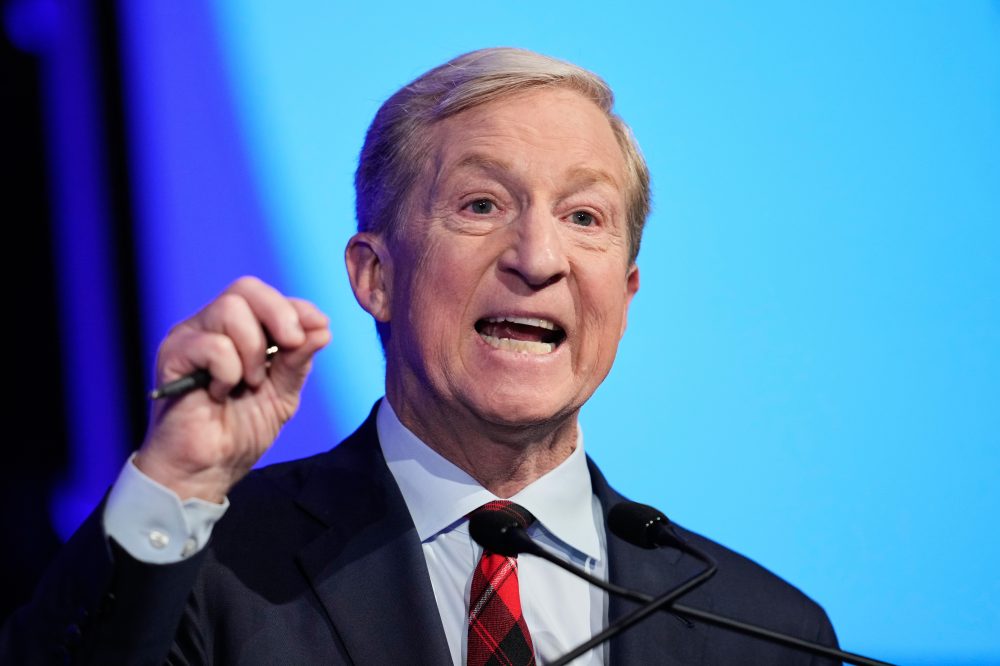

A wealthy California Democrat has shattered national records for political advertising expenditures in his quest to become the state’s chief executive, according to campaign finance data.
Tom Steyer, a billionaire who previously managed hedge funds before becoming a progressive political activist, has invested or committed over $195 million toward television, cable, and radio advertisements, with spending continuing to climb, based on information gathered by AdImpact, which monitors political advertising.
The massive advertising campaign by the former White House hopeful has sparked accusations that he’s attempting to purchase the state’s top political position. His advertising expenditures dwarf those of his closest Democratic competitor, Xavier Becerra, by more than 2,000 percent as both candidates compete for advancement to the general election in November.
Across the United States, no other candidate approaches Steyer’s spending levels.
In second place nationally, Georgia Republican healthcare business leader Rick Jackson has invested approximately $83 million on campaign advertisements in his gubernatorial primary contest, which is advancing to a June runoff election. The third-highest spender is Jackson’s Republican opponent, Lt. Gov. Burt Jones, who enjoys President Donald Trump’s backing and has committed nearly $31 million to advertising, AdImpact reports.
Behind Jones was Democratic U.S. Rep. Raja Krishnamoorthi of Illinois, who invested more than $28 million on advertisements in an unsuccessful Senate campaign.
Katie Porter, a former U.S. House member competing among seven prominent Democrats in the California contest, has consistently attacked Steyer for utilizing his personal wealth to maintain constant voter exposure while facing minimal financial competition from other candidates.
“She isn’t spending hundreds of millions of dollars of personal wealth trying to buy the governor’s office,” her campaign wrote in an email to supporters.
Steyer’s advertising expenditure has surpassed the previous 2010 benchmark established by Republican Meg Whitman, who invested $178.5 million total in an unsuccessful gubernatorial campaign, primarily using personal funds. That contest represented the most expensive statewide campaign in American political history at the time. However, when accounting for inflation, Whitman maintains the state spending record, though her total covered the complete election cycle rather than just the primary phase.
Despite his unprecedented financial commitment, Steyer hasn’t established a commanding lead in the competitive race. He remains part of a top-tier group of several contenders — including Becerra and Republican Steve Hilton — as the campaign approaches the June 2 primary election. Mail-in voting commenced earlier this month.
Nevertheless, Steyer’s financial resources provide him a significant promotional advantage during the campaign’s critical final phase. He’s maintained consistent advertising and digital content challenging Becerra’s qualifications and track record, while Becerra, a former state attorney general and Biden administration health secretary, lacks comparable resources for effective responses.
One Becerra advertisement attempted to appeal to voters potentially overwhelmed by Steyer’s advertising saturation. It featured peaceful imagery of Joshua trees, ocean waves, and towering redwoods with a subtle message: “You can stop the endless Tom Steyer ads. Vote Xavier Becerra.”
Steyer’s monetary advantage has enabled him to expand his campaign presence beyond conventional television and radio spots, maintaining regular content on digital platforms including YouTube and Instagram. The New York Times revealed his campaign compensated a progressive Texas influencer $100,000 to support Steyer’s election bid. The Sacramento Bee also reported Becerra had engaged an influencer.
Numerous voters have delayed casting ballots in a contest lacking a prominent frontrunner and clear leader. The ballot will feature more than 50 candidates. California employs a “top two” primary format placing all candidates on a single ballot, with only the highest two vote recipients proceeding to November, irrespective of political party.
“In a race this close, it all matters,” said Democratic consultant Andrew Acosta.
Historical evidence demonstrates that financial resources don’t guarantee electoral success.
Billionaire developer Rick Caruso invested more than $100 million in 2022 pursuing the Los Angeles mayoral position, largely using personal funds, but suffered a decisive loss to Mayor Karen Bass, who spent significantly less than Caruso’s total. Billionaire former New York City Mayor Michael Bloomberg committed over $1 billion of personal wealth to his 2020 presidential campaign before withdrawing. Steyer’s financial resources failed to establish him as a viable contender in the 2020 presidential race, leading to his early withdrawal following disappointing results in the South Carolina primary.
Democratic San Jose Mayor Matt Mahan’s gubernatorial campaign received support from independent committees funded with millions from technology executives and venture capital investors, yet he struggled to build momentum in the race.
Steyer has never served in elected office.
During a 2019 Associated Press interview, when asked about accusations of attempting to purchase the presidency, Steyer responded:
“I don’t think that’s possible,” Steyer said at the time, before adding, “I’m never going to apologize for succeeding in business. That’s America, right?”
The election occurs as California faces ongoing homelessness challenges, wildfire insurance availability issues, anticipated budget deficits, and housing expenses beyond many working families’ means. Voters simultaneously confront increasing daily costs for food, utilities, and gasoline.
The AdImpact information excludes advertisements on certain popular streaming platforms like Hulu and YouTube or direct mail campaigns.