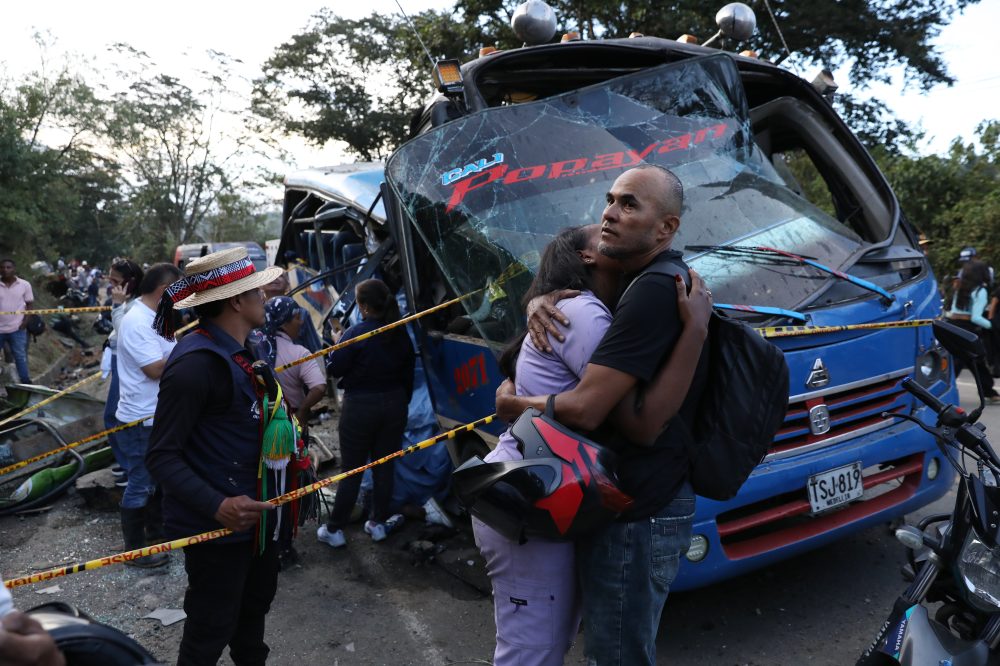

BOGOTÁ, Colombia — Thirteen passengers died and 38 others were wounded when an explosive went off aboard a bus traveling through southwestern Colombia on Saturday, marking the deadliest incident in a recent surge of violence tied to narcotics trafficking.
The blast occurred as the vehicle moved along the Panamerican Highway in Cajibio municipality, according to Cauca region Governor Octavio Guzmán, who announced the attack on social media. Among those hurt were five children, Cauca Health Secretary Carolina Camargo reported to Noticias Caracol television.
Colombia’s Armed Forces Commander Gen. Hugo López characterized the incident as a “terrorist act” during a press briefing, pointing to criminal networks led by “Iván Mordisco” — a high-priority fugitive — along with the Jaime Martínez faction. These groups are breakaway elements from the former Revolutionary Armed Forces of Colombia operating in the area.
Both organizations rejected the 2016 peace accord signed between the government and the main rebel group.
Colombian President Gustavo Petro denounced the bombing on social media platform X.
“Those who carried out the attack and killed seven civilians — and wounded 17 others — in Cajibío — many of them Indigenous people — are terrorists, fascists, and drug traffickers,” he wrote.
The bus attack represents just one incident in a wave of at least 26 explosive attacks targeting public facilities across southwestern Colombia over the past 48 hours, all of which have harmed civilians rather than military targets, López stated.
Other recent incidents included gunfire directed at a police facility in rural Jamundi and an assault on a Civil Aviation radar installation in El Tambo, where officials intercepted three bomb-carrying drones on Saturday. Those attacks caused no casualties.
On Friday, explosive-rigged vehicles detonated near military installations in Cali and Palmira, resulting in property damage.
The spike in regional violence — occurring in territory where illegal armed organizations compete for drug trafficking control — triggered the deployment of senior government officials to the area Saturday. Defense Minister Pedro Sánchez led a delegation including regional governors and local officials meeting in Palmira when the fatal bus explosion happened.
“These criminals seek to instill fear, but we will respond with firmness,” Sánchez posted on X.
Valle del Cauca Governor Francisca Toro has requested “immediate support” from national authorities. In her social media message, Toro demanded strengthened security forces, improved intelligence work and “decisive actions” against criminal activity amid what she termed a “terrorist-level escalation.”
Government sources indicate that Cauca and Valle del Cauca regions function as crucial operational centers for illegal groups competing to control maritime and river pathways to Buenaventura port — a major shipping hub for narcotics bound for Central America and Europe.
Authorities have posted a reward exceeding $1 million for information leading to the arrest of “Marlon,” identified as the regional dissident leader. Local officials on Friday announced a $14,000 bounty for details helping identify and locate those responsible for the Cali and Palmira attacks.