
A deadly stabbing incident involving a British teenager has sparked intense discussions about law enforcement practices and racial dynamics after video emerged showing police restraining the victim while dismissing his pleas for help.
Henry Nowak, an 18-year-old student, was fatally wounded in December, but the case gained widespread attention this week following the sentencing of his attacker and the release of disturbing footage from the scene.
Vickrum Digwa, 23, who is Sikh, received a life sentence with a minimum 21-year term Monday after being convicted of murder. Digwa had falsely told responding officers that Nowak, who was white, had racially attacked him.
Law enforcement personnel responding to the scene in Southampton, a coastal community in southern England, initially accepted Digwa’s account. However, court proceedings revealed that Digwa had fabricated the racism allegations.
Prime Minister Keir Starmer expressed his revulsion at the footage and questioned how “accusations of racism informed the decision-making in this case.”
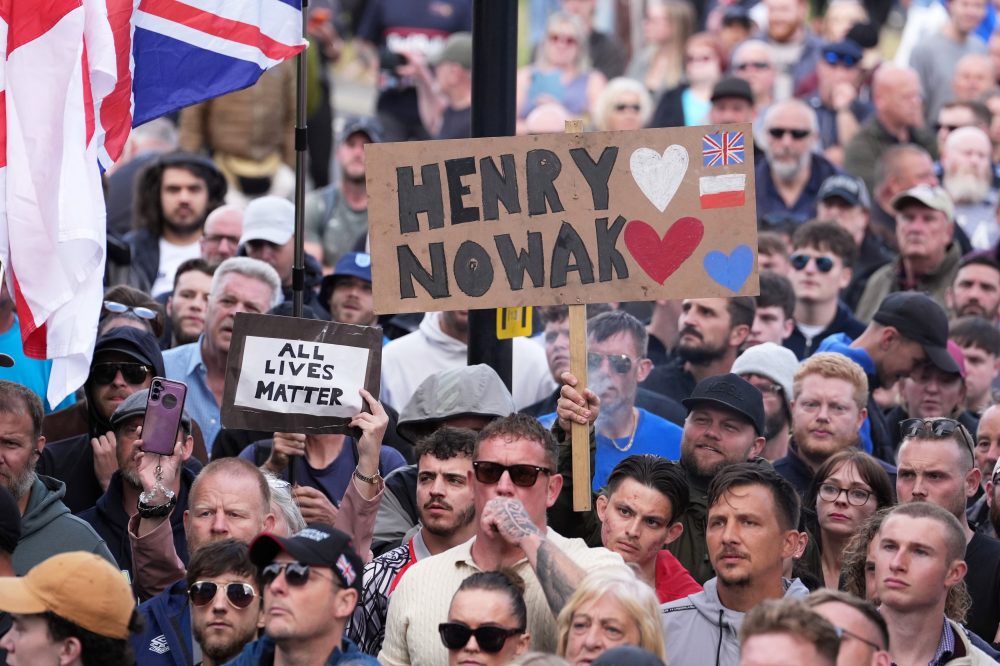
Demonstrators assembled outside Southampton’s police headquarters to voice their outrage over Nowak’s death.
Video evidence shows the university student lying on the ground, informing officers of his stab wounds while they restrained his arms and attempted to force him upright. He repeatedly stated he was unable to breathe.
“You’ve been stabbed? Whereabouts?” an officer said in the video. “Don’t think you have, mate.”
Following the court proceedings, the victim’s father, Mark Nowak, emphasized that the tragedy wasn’t centered on racism or religion, expressing hope that his son’s death would contribute to improved street safety rather than fostering “further division, hatred or tension.”
However, Nigel Farage, leader of the anti-immigrant Reform UK party, characterized the incident Tuesday as evidence of so-called two-tier policing — a far-right assertion that ethnic minorities receive preferential treatment over white individuals.
Farage urged people to respond with “pure cold rage,” demanding an end to “anti-white prejudice” and promoting the concept “that white lives matter just as much as Black lives.”
Home Secretary Shabana Mahmood dismissed claims of differential policing standards across communities and appealed to Parliament members not to “allow this murder to turn communities against one another.”
Mahmood acknowledged public shock over the tragic footage and emphasized the government’s commitment to dramatically reducing knife-related violence.
She appealed for restraint while the Independent Office for Police Conduct examines the actions of Hampshire and Isle of Wight Constabulary officers. She noted that online misinformation had resulted in death threats against an uninvolved officer.
“Misinformation and inflammatory commentary is making a dreadful situation even worse,” she said. “We must all together condemn it.”
Two years prior, a stabbing attack that claimed three young lives and injured 10 others at a dance class in northern England triggered nearly a week of widespread unrest after social media users incorrectly identified the teenage perpetrator as a Muslim asylum-seeker. The violent confrontations with law enforcement primarily targeted migrants and Muslims.
The British-born attacker’s parents were Rwandan Christians, and while investigators couldn’t determine his motivation, they ruled out terrorism. Authorities discovered materials about Nazi Germany, the Rwandan genocide and car bombs on his electronic devices.
In Nowak’s case, the first-year University of Southampton student had been socializing with friends when officers arrived at what was reported as an assault. Nowak was visible on a driveway, supported by someone who mentioned he had blood in his mouth.
Digwa stood close by and informed officers he had also sustained injuries, indicating his allegedly swollen eyelid. He alleged that Nowak had removed his turban and grabbed his hair.
Following Nowak’s restraint, officers positioned him on his side while searching for stab wounds. He appeared unconscious when an officer announced his arrest for assault and recited his legal rights.
Upon discovering his injuries, officers removed the handcuffs and began CPR, according to police statements.
Digwa faced conviction for murder at Southampton Crown Court.
Judge William Mousley told Digwa he rejected the claim that Nowak made racist remarks toward him.
“You are the only person to make that claim and it is completely at odds with his previous character,” he said.
In Britain, where firearm possession faces strict regulation, knives frequently serve as weapons in violent incidents and face similar restrictions. Generally, individuals cannot carry bladed implements except pocketknives with cutting edges under 3 inches. However, Sikhs may carry ceremonial knives called kirpans for religious purposes.
Mousley noted that Digwa possessed a small kirpan, which Sikhs are religiously required to carry, but also had an 8-inch sheathed Sikh dagger that served as the murder weapon. He stated that the religious connection of the weapons had put other Sikhs at risk.
“Your actions have stirred up racial tension in Southampton and across the country which have made many Sikhs worried about their own safety even though they have done absolutely nothing wrong,” the judge said.
Law enforcement officials apologized to Nowak’s family and stated that Digwa’s deception had misled responding officers.
“It is devastating the officers did not believe Henry when he said he’d been stabbed and couldn’t breathe,” Police and Crime Commissioner Donna Jones said. “The details of the police response raises serious concerns about police impartiality, fairness and judgment.”
Digwa’s mother, Kiran Kaur, 53, was found guilty of assisting an offender after attempting to conceal the murder weapon. Her sentencing is scheduled for July 17.