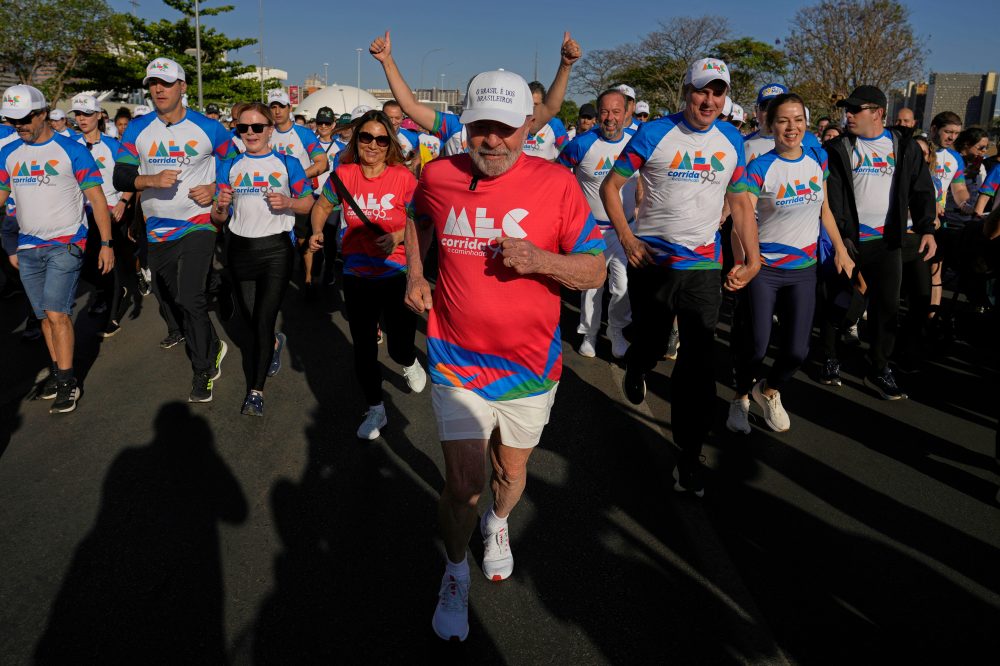

SAO PAULO (AP) — Daily gym sessions and workout videos are taking center stage over traditional campaign appearances and media interviews.
At 80 years old, Brazilian President Luiz Inácio Lula da Silva is making physical fitness a cornerstone of his reelection campaign, with exercise routines that some observers say generate more enthusiasm than his political platform.
Although Brazilian voters remain split on whether Lula should pursue an unprecedented fourth non-consecutive presidential term, most agree his dedication to daily treadmill sessions sets a positive example.
“He is a bit too old to campaign again. We’d better have someone else running. But his workouts are indeed a good example for people like me,” said Marcela Peres, 63, as she exercised in a hotel gym in Brasilia on Wednesday.
Lula’s emphasis on demonstrating physical vigor has prompted his primary opponent, Sen. Flávio Bolsonaro, son of former President Jair Bolsonaro, to showcase his own athletic abilities.
With some voters worried that Lula could follow the same trajectory as former U.S. President Joe Biden, who stepped away from the 2024 presidential race due to age and health concerns, the Brazilian leader is using fitness displays to convince supporters to back him once more.
“One of these idiots said it was not me, that it was a clone,” Lula said in March, days after his wife, Rosângela da Silva, posted a video of his workout routine. “Go to the gym. Get ready. Drink less and work to see what happens. I want to live 120 years.”
During his initial two presidential terms, Lula regularly participated in soccer games, continued exercising throughout his 580-day imprisonment, and promoted physical activity when he campaigned in 2022 to defeat then-incumbent Bolsonaro, a former military officer with health issues.
Should Lula succeed in October’s election, he would surpass his own milestone as Brazil’s oldest elected president.
His primary challenger is nearly half his age.
The 45-year-old Bolsonaro recently ridiculed Lula by likening him to an aging Chevrolet Opala that is “all backward” and “drinks a lot (of fuel).”
Lula, who has been on virtually every presidential ballot since Brazil’s military dictatorship ended in 1985, dismissed the criticism by calling himself a “turbo car” instead.
“He is doing this to steer away from the Joe Biden effect,” said Carlos Melo, a political science professor at Insper university in Sao Paulo. “Flávio Bolsonaro is trying to say he is actually the young one. This is a game of image.”
The younger Bolsonaro is also demonstrating his physical condition by posting videos of himself jogging to meetings and performing dance moves on stage.
This aspect of his public persona only emerged in December, when his father designated him as the presidential candidate while incarcerated in the capital, Brasilia, where he was serving a 27-year sentence for orchestrating a coup attempt before being transferred to house arrest.
Political consultant Felipe Soutello, who has managed multiple Brazilian political campaigns, explained that modern electoral bids require candidates to appear dynamic and energetic, regardless of their age.
“The opposition will use a certain ageism, a little prejudice against older generations, as a tool to hurt the president’s performance,” Soutello said.
However, he pointed out that Brazil is experiencing a demographic transformation, with voters over 60 comprising one-quarter of the electorate. “They have more political weight than the young people,” he said.
According to research firm Nexus, citing data from Brazil’s supreme electoral court, the number of eligible Brazilian voters above 60 increased from 20.8 million in 2010 to 36.2 million in March of this year.
Musician Antonio Moreira, 50, enjoys beach workouts in Rio de Janeiro, displaying his physique, tan, and tattoos. He represents a small but crucial demographic that could determine the election outcome: voters who remain undecided between Lula and Bolsonaro.
In the previous election, Lula prevailed with only 50.9% of votes, marking the closest margin in Brazilian electoral history.
“Nobody wants to vote for a president that is stumbling,” Moreira said, adding that Lula’s workouts also encourage older people to stay active.
Regarding Bolsonaro’s dance performances, Moreira noted that “a little dance can define an entire political career” in Brazil. But that’s not enough.
“It is okay to do it as they do to seek for votes, but to reach a different kind of voter there needs to be more real proposals, right?”