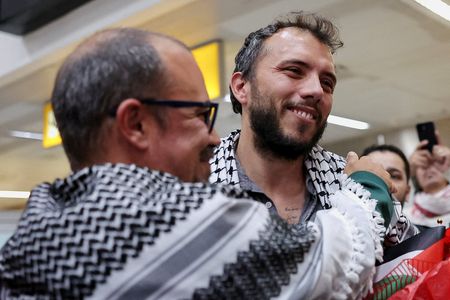

A Brazilian activist arrived back in São Paulo on Monday after spending 10 days in Israeli custody, making serious allegations about his treatment while detained.
Thiago Avila was part of an international aid mission called the Global Sumud Flotilla that departed from Spain on April 12, aiming to deliver humanitarian supplies to Gaza and challenge Israel’s naval blockade. Israeli naval forces stopped the flotilla at sea, arresting Avila and Spanish citizen Abu Keshek while directing over 100 other pro-Palestinian demonstrators to Crete.
Israeli authorities held the two men on charges including providing assistance to enemies and communicating with terrorist organizations. Both men rejected these accusations. They were freed on Saturday and transferred to immigration officials for removal from the country.
Speaking to media at São Paulo-Guarulhos International Airport, Avila described his experience in harsh terms. “My return was simply a correction of a serious violation. I was kidnapped by Israel, I wasn’t imprisoned,” he stated.
The activist described enduring various forms of mistreatment alongside Abu Keshek, while claiming Palestinian detainees in adjacent cells faced even harsher conditions.
Israeli officials rejected torture allegations made by Adalah, a human rights organization that provided legal representation for the men during Israeli court proceedings. Israel maintained that all actions taken followed proper legal procedures.
Both the Spanish and Brazilian governments have condemned the detention as illegal.
At the airport, with supporters displaying banners urging Brazil to sever diplomatic relations with Israel, Avila made political statements. “We need to defeat (Israeli Prime Minister) Netanyahu and (U.S. President) Donald Trump, we need to defeat the war criminals,” he declared.
Hamas, the Palestinian militant organization that governs Gaza, is classified as a terrorist group by Israel and many Western nations.
The current conflict began with Hamas’s October 7, 2023, assault on Israel, sparking a war that has displaced most of Gaza’s residents and created widespread dependence on humanitarian assistance that aid organizations say is not arriving quickly enough.